Wednesday, September 2, 2026
  • en English
  • de Deutsch
SmartBuildingsCompass
Header SBC English
  • Home
  • Housing
  • Everyday aids & Technology
  • Dementia & Health
  • Care & Relief
  • Download: Housing Tips
  • Find a solution
    • Dementia
    • Special Feature: Age-friendly Construction & Renovation
    • Home & Living
    • Tools & Solutions
    • Crisis-resilient caregiving household
    • Stay healthy
No Result
View All Result
  • Home
  • Housing
  • Everyday aids & Technology
  • Dementia & Health
  • Care & Relief
  • Download: Housing Tips
  • Find a solution
    • Dementia
    • Special Feature: Age-friendly Construction & Renovation
    • Home & Living
    • Tools & Solutions
    • Crisis-resilient caregiving household
    • Stay healthy
No Result
View All Result
SmartBuildingsCompass
No Result
View All Result
Home Dementia

Bruges shows how it’s done: A city becomes dementia-friendly

Bruges, West Flanders: With its Dementievriendelijk Brugge project, this Belgian city in the northwest of the country is demonstrating what active inclusion and quality of life in urban areas can look like. Photo: Shutterstock

Bruges, West Flanders: With its Dementievriendelijk Brugge project, this Belgian city in the northwest of the country is demonstrating what active inclusion and quality of life in urban areas can look like. Photo: Shutterstock

This article is also available in: Deutsch

In times of demographic change, cities are faced with the major challenge of adapting to the needs of older people and people suffering from dementia. With its “Dementievriendelijk Brugge” project, the city of Bruges in north-west Belgium (West Flanders) shows what a liveable, inclusive city can look like.

Bruges is also facing the challenges of an ageing population. The city has therefore opted for an active health and social policy. Project manager Quintina Jonckheere is one of the driving forces behind the concept of the “dementia-friendly city” – and emphasizes: “You don’t have to be perfectly prepared – you just have to get started”.

You might also be interested in

Interview: Interior designer Melanie Mikalauskas, who works intensively on the interplay between dementia, perception and the living environment. Credit: Melanie Mikalauskas

When rooms confuse: What a dementia-friendly home needs

10. April 2026
Interview: The two dementia experts Raphael Schönborn and Dr. Sara Silvaieh (Credits: left/Thomas Werchota, right/private)

Dementia up to 45% delayable: What prevention can achieve

27. March 2026
The book "A very special journey" is a special kind of travel guide: for people who accompany a loved one with dementia. Book cover: Penquin Randomhouse Verlag

Emma Heming Willis: “The unexpected journey”

12. January 2026
The Picasso "Tête de Femme" (1941) - a gouache on paper, with an estimated value of around 1 million euros - will be raffled off. Credit: Picasso Estate, Paris, 2025

1 Picasso for 100 euros: A French idea that finances hope

12. January 2026
What does “dementia-friendly city” mean?

Bruges takes a holistic approach to dementia. It is not just about care and medical treatment. The topic is taken out of the taboo zone and people with dementia are actively included in the city and in social life. The focus is on the quality of life and the possibilities of those affected – not just their diagnosis and their deficits: “We create visibility without stigmatizing.”

Header SBC English
Quintina Jonckheere, project manager for the “Dementia-Friendly City” initiative in Bruges (source: private)

This attitude is reflected in the basic principles formulated by the project team (see info box below). They range from respectful communication to social participation and support for family caregivers. Ultimately, the aim is to create an urban climate in which people with dementia are visible, welcome and included.

Two examples illustrate the approach: Information should be formulated clearly and respectfully, and conversations should always address people personally. Restaurant staff, for example, are trained in how they can better support people with dementia. For example, by using clear language, allowing enough time to pay or repeating information. “Even small things make a big difference for those affected,” says Jonckheere. Museums also offer guided tours for people with dementia. Specially trained museum guides enable people with dementia to take a quiet and undisturbed tour of selected works of art.

Together instead of alone

At the heart of the project is the learning network, in which numerous local organizations regularly exchange ideas: care homes, social services, educational institutions and volunteers work together on ideas on how Bruges can become more dementia-friendly. There are also areas that at first glance have nothing to do with care: For example, the sports administration, cultural facilities, the building authority, citizen services. Everywhere, people with dementia encounter employees who need to be trained and sensitized.

“Even in areas where you wouldn’t expect it, the topic needs to be present,” emphasises Jonckheere. Only through continuous educational work dementia can be anchored in urban society as a joint task: “Cooperation is crucial. No one can tackle the issue alone – we need the whole city.” The large number of organisations involved shows the extent to which an ageing society influences urban life and affects all areas of life.

Family carers are also part of the network. Their role is essential, emphasises Jonckheere: “In the future, society will be even more dependent on the care of relatives. That’s why we need to do everything we can to support these people.” Many family members who are carers are already under a lot of pressure: Work, children, household – and then caring for someone with dementia on top of that. “It is massively underestimated how stressful this can be,” says Jonckheere.

In order to master the challenges of an ageing society, ideas are discussed together, results are analyzed and lessons are learned from experience. This is not about a fixed package of measures, but about an ongoing dialog: “Our work is never finished,” says Jonckheere. Rather, it is an ongoing process in which political signals are sent, experiences are exchanged and concrete suggestions for improvement are jointly developed.

Quintina Jonckheere explains another advantage of working together: “Although there are many good solutions for people with dementia, they are often not known – neither by those affected nor by the organizations themselves. Cooperation is therefore essential: “When we work together, everyone benefits. The organizations, but above all the people with dementia, who don’t have to be sent from one place to the next.”

Anyone applying to the city for funding for a dementia-friendly project must also cooperate with other local stakeholders – this is a clear prerequisite. Because only together can synergetic solutions be developed that go beyond the individual approach and make the city as a whole more dementia-friendly.


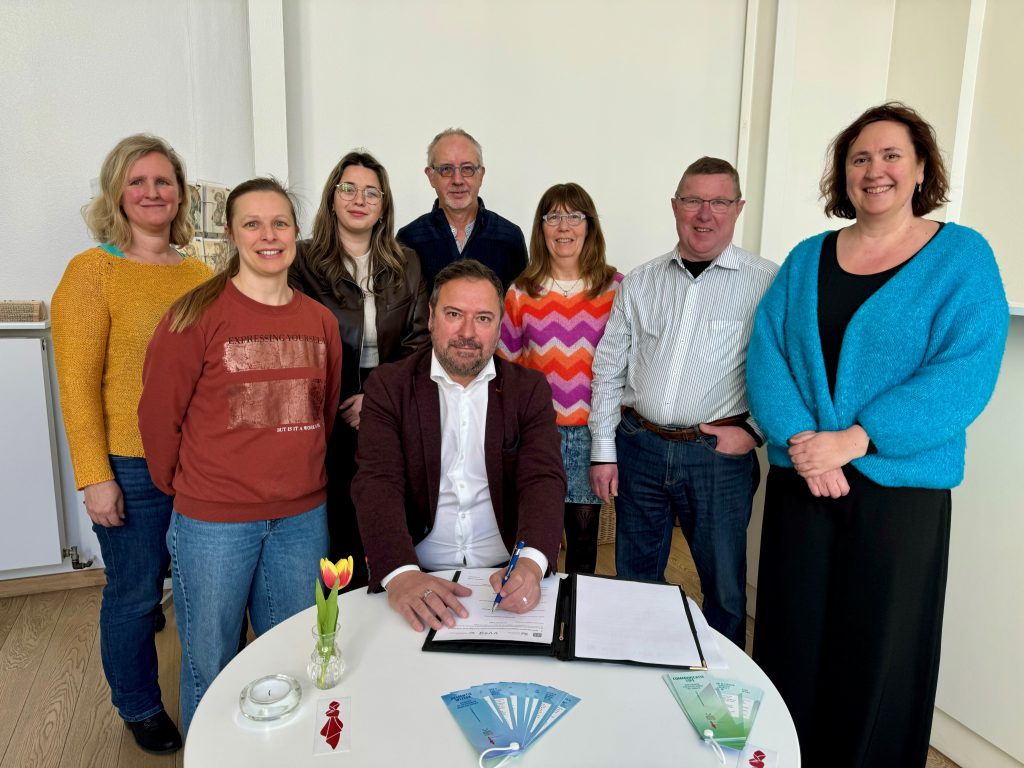
The "Learning Network" around Quintina Jonckheere together with City Councillor Pablo Annys, Chairman of the Special Committee for Social Affairs, signing the Dementia Friendly Declaration of Commitment
New approaches to care and support

Quintina Jonckheere emphasizes that the ageing population and associated chronic diseases such as dementia will be a permanent challenge for society. A fundamental shift in thinking in the healthcare sector is therefore becoming increasingly important: away from a purely medical approach (“cure”) towards a caring, person-centered approach (“care”).

This new approach – also known as “cure to care” – is being pursued by more and more organizations and educational institutions, such as the “HoWest” University of Applied Sciences in Bruges. They have even developed their own training package entitled “Van Cure naar Care” – i.e. “From Cure to Care”. Their aim: to increase the palliative care skills of healthcare providers and improve the integration of possible care planning, palliative care and end-of-life care in Flemish healthcare organizations.

At the same time, care is increasingly becoming a task for society as a whole: neighborhoods, volunteers and associations are playing an ever more important role. Good care must not rest solely on the shoulders of individuals: “We need ‘caring neighborhoods’.”

In Bruges, this concept is promoted through specific projects that strengthen neighborhood support and facilitate mutual assistance in everyday life. The data shows that people of low socio-economic status in particular are often more dependent on their neighborhood than on family or friends. “If we want to protect the most vulnerable people in our city, we need to strengthen their neighborhoods,” explains Jonckheere. Such neighborhood structures not only make the city more dementia-friendly, but also promote social participation.

Looking ahead: What the future holds

What does Quintina Jonckheere want for the future? To develop the city into a healthy city with citizens who have a high level of health literacy. This means that people are able to understand and critically categorise health information and apply it to their own life situation. Surveys currently show that the health literacy of many citizens in Belgium is still too low: “Almost two third of Belgians have insufficient health skills.” A field of action to which Jonckheere will pay particular attention.

What advice does Jonckheere have for other cities? “Don’t wait. Just get started. Even small steps can have a big impact.” She emphasizes that building a dementia-friendly or caring community does not depend on perfect conditions or big budgets. The first step is to start conversations, involve local experts, listen and connect existing resources. In this way, solutions that often already exist locally can become visible and effective.

Further information about the project:
🔗 www.brugge.be/dementievriendelijk

What makes Bruges dementia-friendly?

The city is focussing on a holistic approach that goes beyond care and medicine:

  • Taboo-breaking measures raise public awareness of dementia. Challenges can only be overcome if we talk about them.
  • The focus is on the strengths and possibilities of those affected – without denying their limitations. Quality of life even with a dementia diagnosis.
  • People with dementia are given a voice and are actively involved in projects.
  • Dementia-friendly communication is key – simple, respectful and inclusive.
  • Cooperation between a wide range of organizations creates a network of shared responsibility.
  • Family Carers are involved and valued.
  • Neighborhoods are strengthened in order to help together.
  • Awareness-raising campaigns are used to promote understanding in society.
Anja Herberth
Author: Anja Herberth

Chefredakteurin

Tags: Supporting people with dementia
Previous Post

Enabling healthy ageing: Why medicine needs to be rethought

Next Post

Comment: When the children (can’t) help – the silent worry of many older people

Related Posts

Interview: Interior designer Melanie Mikalauskas, who works intensively on the interplay between dementia, perception and the living environment. Credit: Melanie Mikalauskas
Dementia

When rooms confuse: What a dementia-friendly home needs

10. April 2026
Interview: The two dementia experts Raphael Schönborn and Dr. Sara Silvaieh (Credits: left/Thomas Werchota, right/private)
Dementia

Dementia up to 45% delayable: What prevention can achieve

27. March 2026
The book "A very special journey" is a special kind of travel guide: for people who accompany a loved one with dementia. Book cover: Penquin Randomhouse Verlag
Dementia

Emma Heming Willis: “The unexpected journey”

12. January 2026
The Picasso "Tête de Femme" (1941) - a gouache on paper, with an estimated value of around 1 million euros - will be raffled off. Credit: Picasso Estate, Paris, 2025
Dementia & health

1 Picasso for 100 euros: A French idea that finances hope

12. January 2026
Sophie Rosentreter (right) with her mother Katrin and grandmother Ilse: "Grandma Ilse's" dementia is overwhelming the family. Today, Sophie Rosentreter is developing solutions for caring for and dealing with dementia. Credit: Katrin Schöning/Sophie Rosentreter
Dementia

Care & dementia expert Sophie Rosentreter: “The heart does not become demented”

18. November 2025
All tablets swallowed whole reached the stomach without any signs of dangerous ingestion. Crushed tablets, on the other hand, left significantly more residue in the throat, which can impair the absorption of the active ingredients and increase the risk of complications. Credit: Shutterstock
Care & relief

Taking tablets with swallowing difficulties: Take whole instead of crushed

17. November 2025
Next Post
In addition to financial uncertainties, a recent HDI survey also reveals an often underestimated emotional burden experienced by many older people: more than half (53 percent) of those surveyed fear becoming a burden in old age. Credit: Shutterstock

Comment: When the children (can't) help - the silent worry of many older people

Leave a Reply Cancel reply

Your email address will not be published. Required fields are marked *

  • Deutsch
  • English

Solutions for specific Situations

  • Adapt your apartment/house
  • When Dementia is a factor
  • Organizing Care & Support
  • Tools & Solutions
  • Crisis-resilient caregiving households
  • Municipalities

.

loader

Newsletter

What tools and concepts are available for senior living, care and support - and where can they be found? Our newsletter provides answers!

I accept the terms and conditions

Recent News

Our interviewee: Stefani Gromes, an attorney from Darmstadt who specializes in the intersection of family and social law. Credit: Gromes Law Firm

Costs for care homes: How can families prepare in advance, Ms Gromes?

27. August 2026
Our interviewee: Rene Pecovnik, CEO of Hilma (Credit: Hilma)

How can we adapt our homes to suit elderly people, Rene Pecovnik?

27. August 2026
Our interviewee: Andreas Gruber of "because we care"; Credit: "because we care"

‘Our system creates four losing parties’: Andreas Gruber on working carers

27. August 2026
Our interviewee: Dr. Alexia Zurkuhlen, Executive Director of the Kuratorium Deutsche Altershilfe (KDA) - Credit: KDA

Zurkuhlen: “Age-friendly means thinking about life across generations”

27. August 2026
Photo credit: m2 mühle nursing beds

Alternatives to traditional nursing beds: When you don’t want it to look like a hospital

14. August 2026
SmartBuildingsCompass

Made with care. For you.

Our research and interviews on safe and independent living in old age are written by our team with a great deal of energy and passion. We hope you enjoy reading them!

Do you need more information? If so, you are welcome to contact us at redaktion@sbc.co.at.

All rights reserved (2026).

  • Deutsch
  • English

Follow us

Instagram
  • Home
  • Subscribe to our newsletter
  • Glossary
  • About us
  • Contact
  • Marketing: Information for businesses
  • Download your 10 tips for independent, safe living in older age
  • Presentations & workshops for local authorities & nonprofits
  • Contact & Legal Notice
  • FAQs
  • Disclosure Statement
  • Nettiquette
  • Data protection
  • General Terms and Conditions (GTC)

© 2026 by owl lab e.U. Wir navigieren Wandel.

We use cookies on our website. Some of them are essential, while others help us improve this website and your experience.
Cookie SettingsAccept All
Manage consent

Privacy Overview

This website uses cookies to improve your experience while you navigate through the website. Out of these, the cookies that are categorized as necessary are stored on your browser as they are essential for the working of basic functionalities of the website. We also use third-party cookies that help us analyze and understand how you use this website. These cookies will be stored in your browser only with your consent. You also have the option to opt-out of these cookies. But opting out of some of these cookies may affect your browsing experience.
SAVE & ACCEPT
No Result
View All Result
  • Home
  • Home & Living
  • Everyday Aids & Technology
  • Care & Relief
  • Dementia & Health
  • Download: 10 tips
  • Find a solution
    • Special Feature: Age-friendly Construction & Renovation
    • Dementia
    • Crisis-resilient caregiving household
    • Stay healthy
  • Deutsch
  • English

© 2026 by owl lab e.U. Wir navigieren Wandel.

Safe & independent living in old age

27 pages of tips for independent, safe living in old age—download now!

Download our PDF with tipps now!
loader

Email addresse*
I accept the privacy policy and agree that SmartBuildingsCompass.com may contact me beyond this request to send me its regular newsletter. I can unsubscribe at any time.

Sicher & selbstbestimmt Wohnen im Alter!

27 Seiten Tipps für sicheres, selbstbestimmtes Wohnen im Alter - jetzt downloaden!

Jetzt gleich downloaden!
loader

Email addresse*
I accept the privacy policy and agree that SmartBuildingsCompass.com may contact me beyond this request to send me its regular newsletter. I can unsubscribe at any time.