This article is also available in:
Deutsch
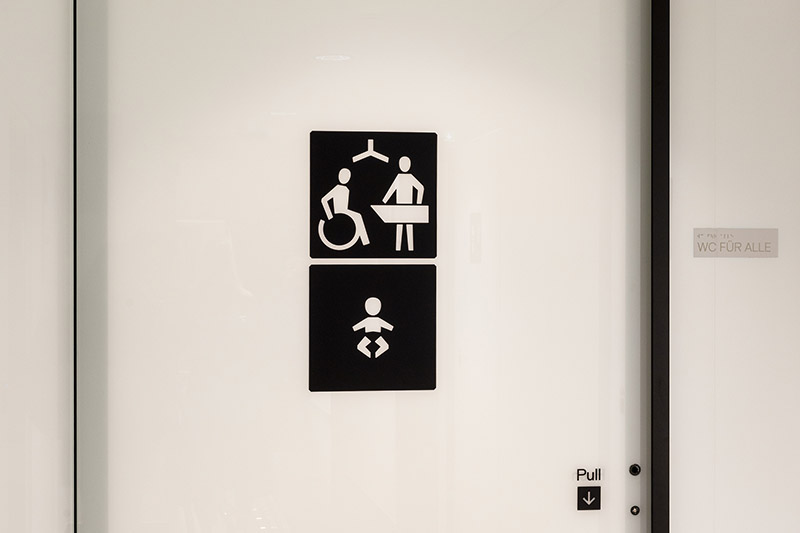
In Austria, there are only three such facilities; in Germany, there are 170; and in the United Kingdom, there are 2,660: Changing Places—these are specially equipped restrooms for people for whom a standard accessible restroom is not sufficient.
What this means in practical terms is that anyone who needs help with personal care or who relies on a ceiling lift to use the restroom simply cannot plan a trip to a concert, a visit to a museum, or a shopping trip if the necessary infrastructure is lacking. This requires a height-adjustable care bed, a ceiling lift, and sufficient space to move around. Without this specialized infrastructure, public life is simply not possible for them, as there is no way to maintain personal hygiene outside their home.
As society ages, this issue is gaining broader attention: in addition to younger people with disabilities, the needs of older adults are increasingly coming into focus. We therefore spoke with two women who helped shape Changing Places in Austria: Jennie Carvill Schellenbacher, Inclusion Officer at the Wien Museum, and Roswitha Prantl from the construction management team at Tiroler Versicherung V.a.G. (Mutual Insurance Association).
Why these restrooms are needed
There are some things people are very reluctant to talk about—they’re taboo subjects. Changing diapers or the need for a lift when using the restroom are among them. And that is precisely why Changing Places facilities are so important, yet so little known. Yet there are more and more people with extensive support needs: for those with multiple disabilities, spinal cord injuries, muscle and nerve disorders, or multiple sclerosis, a standard accessible restroom is no longer sufficient.
The initiative was launched in the United Kingdom in 2006 to address the shortage of adequate public restrooms. In 2019, new building codes came into effect there, requiring such facilities in public buildings with high visitor traffic. As a result, 2,660 such facilities are already in operation in the UK—including an online route planner. In Germany, the equivalent is known as “Toiletten für Alle” (Toilets for Everyone). The first Changing Place opened in downtown Munich in 2013; according to online research, there are currently 170 facilities. In Austria, there will be three by mid-2026: at the Fonds Soziales Wien on Guglgasse in Vienna, at the Wien Museum, and in Innsbruck in the new building of Tiroler Versicherung.
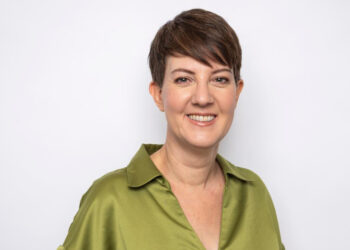
Our interviewee: Jennie Carvill Schellenbacher, Inclusion Officer at the Wien Museum (Credit: Wien Museum/Kollektiv Fischka)
The restroom for everyone at the Wien Museum (Credit: Wien Museum/Kollektiv Fischka)
Vienna Museum: An Opportunity for Inclusive Renovation
The Wien Museum on Karlsplatz took advantage of its major renovation to place a focus on inclusion. As the Wien Museum’s first inclusion officer, Jennie Carvill Schellenbacher was largely able to define her role herself. She structured it around three pillars: physical accessibility—from wayfinding within the building to the tactile floor guidance system and ticket counter design—content accessibility in terms of language, multisensory design, and tactile objects; and finally, representation: How do the stories and biographies of people with disabilities find their way into the exhibitions?
The idea for the Changing Place came from a look at the UK. As a British citizen and member of the UK’s Museums Association, Schellenbacher came across the new building code, which requires such facilities in public buildings that receive a certain number of visitors. “It will eventually come to Austria too,” Schellenbacher thought at the time—“and maybe we can set a precedent here.” It became the first public Changing Place in Austria.
The planning process was broad-based from the very beginning. Since 2020, the Austrian Federal Association for People with Disabilities (ÖZIV) has been providing ongoing construction consulting to the Wien Museum—for both the building’s design and that of the exhibitions. The Association for the Blind was also closely involved, as were focus groups of people with lived experience and expertise. “Over the years, a great many people have been involved in the development,” says Schellenbacher. Today, she sees the Changing Place not only as a service offered by the museum itself, but as a hub in the city. “This enables people to shape their own lives—and to find a suitable restroom with dignity even when they’re out and about. A visit to the Christmas market, a pop festival, or Kärntner Straße—that should be possible for everyone.”
Everything was funded from the current construction budget. No special grants, no inclusion budget—and for Schellenbacher, that’s a matter of principle: “I get the money from where it belongs—the respective project budget. Inclusion isn’t a special line item; it’s part of every project.” The facility is freely accessible during the museum’s opening hours—no Euro-Key, no registration required. “You just walk right in; you don’t even need a ticket. And you don’t have to learn anything to use our restroom,” says Schellenbacher.
How has the museum’s comprehensive renovation made it more inclusive? Since its reopening in 2023, the Wien Museum’s audience has become visibly more inclusive and diverse, according to Schellenbacher: “When you walk through the exhibition, you can see that it’s much more diverse and mixed than before.”
Innsbruck: 24/7 access with Euro-Key
Tiroler Versicherung also took advantage of the construction of its new headquarters in Innsbruck to implement an inclusive design. The project began in early 2022, and by the end of 2024, the new headquarters in the city center was complete. Accessibility was a requirement throughout the building from the very beginning: height-adjustable desks, induction loop systems in training rooms, automatic doors, an accessible shower in the fitness room—and an accessible restroom on every floor.
A Changing Place was also installed, which is accessible 24/7 from outside using a so-called Euro-Key. “It was our department head, Georg Griedling, who initiated this, and he found a receptive audience on the board. Accessibility is an issue that has been important to our organization for years,” says accessibility officer Roswitha Prantl.
The Euro-Key is a universal key that grants access to facilities designed for people with disabilities—such as accessible restrooms and elevators in cities, municipalities, universities, department stores, and along highways—exclusively to authorized individuals. The key ensures that these facilities remain clean and functional and are protected from unauthorized use. In Austria, the Euro-Key is available from the Austrian Council for People with Disabilities—usually free of charge for people with a valid federal disability pass. In Germany, it can be obtained through the Club of People with Disabilities and Their Friends (cbf-da.de/leistungen/euroschluessel ) as well as, for example, through social welfare organizations for a fee.
The facilities at the Innsbruck Changing Place are top-notch: The facilities include a height-adjustable treatment table, a ceiling lift, a height-adjustable toilet, an intimate shower and a shower with a seat, a height-adjustable sink with an integrated mirror, and a height-adjustable changing and reclining table. The architectural firm gabana, which specializes in accessibility, provided support during the planning and implementation phases. “We wanted this restroom to be suitable for all user groups,” says Prantl. Emergency assistance is also guaranteed 24 hours a day through an external company with medically trained staff who can be on site within minutes if needed.
What has happened since the opening of the Innsbruck restroom has surprised—and touched—the team. “We’ve received feedback from people in wheelchairs who are simply happy that they can now attend events. Because before, there were always questions hanging in the air: Can we get a drink? How long can we stay?”
And then there’s another observation that gives pause: “A man regularly comes to us with his wife, who needs care, so we can help her shower. ‘Because he doesn’t have the means to do so at home,’ says Prantl, ‘This shows how far barrier-free housing is still from the reality people face.’”
Why Inclusion Is Becoming More Important for an Aging Society
Both interviewees come from completely different backgrounds: a museum that has reinvented itself and an insurance company that views accessibility as a social commitment. And yet they describe the same fundamental problem: accessible restrooms and Changing Places are hardly known or implemented in Austria, while they are much more widespread in other countries such as the United Kingdom and Germany.
Approximately 1.3 million people in Austria—about 18 percent of the population—live with some form of disability, including over one million with mobility impairments. At the same time, the population is aging rapidly, and disabilities are a reality of life for a growing segment of the population. Changing Places are therefore not a niche solution for a small group. They are a barometer of how seriously a society takes the inclusion of all its members.
The additional costs for the special equipment—around 36,000 euros net, according to Tiroler Versicherung—are manageable when compared to the total construction costs of a building. What they make possible outweighs any cost calculation: that people can attend events, explore cities, and participate in public life—without having to base their decision on whether they can find a suitable restroom while out and about.
Inclusion isn’t a matter of goodwill; it’s a matter of infrastructure. And that doesn’t just happen on its own—it results from the decisions that companies, local governments, and developers make today.
Changing Places in Vienna:
- Vienna Museum, Karlsplatz– available during opening hours, no Euro Key required
- Vienna Social Fund, Gugelgasse
Changing Place in Innsbruck: Tiroler Versicherung V.a.G., 10 Wilhelm Greil Street (Euro-Key required)
Here you will find an overview of Changing Places facilities in Germany (toiletten-fuer-alle.de) and the UK Changing Places UK
Author: Anja Herberth
Chefredakteurin