
Sunday, February 22, 2026
  • en English
  • de Deutsch
SmartBuildingsCompass
Header SBC English
  • Home
  • Home & Living
  • Tech / Tools
  • Healthcare & Dementia
  • Care & Relatives
  • Download: 10 tips
  • Why we care
No Result
View All Result
  • Home
  • Home & Living
  • Tech / Tools
  • Healthcare & Dementia
  • Care & Relatives
  • Download: 10 tips
  • Why we care
No Result
View All Result
SmartBuildingsCompass
No Result
View All Result
Home Crisis management

Crisis requires community: “Only when a few people consciously consider others can it truly be sustainable.”

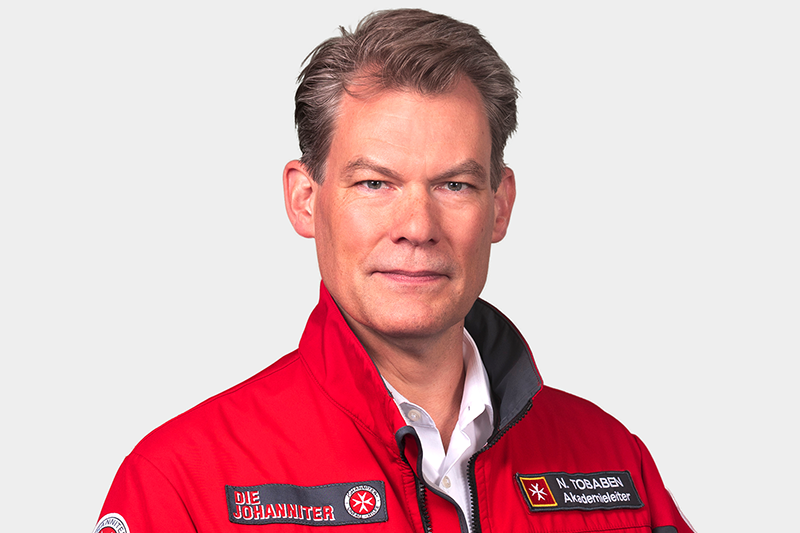
Our interview partner Nicolas Tobaben is Head of Disaster Management at the German Johanniter Regional Association North (Credit: Johanniter)

Our interview partner Nicolas Tobaben is Head of Disaster Management at the German Johanniter Regional Association North (Credit: Johanniter)

Dieser Beitrag ist auch verfügbar auf: Deutsch

Many people associate crisis preparedness with major disasters. In practice, a small event is often enough: A fire in the distribution box around the corner – and the power goes out in the neighborhood. In this interview, Nicolas Tobaben, Head of Civil Protection at the German Johanniter North regional association, explains why the big blackout should not be the benchmark for crisis preparation. It is the small, realistic scenarios right on our own doorstep that we should be prepared for.

A conversation about the basics of remaining capable of acting in the first 24 to 48 hours – and why crisis management only becomes viable when we think for others.

SBC: How can crisis preparedness be communicated in such a way that it really reaches end consumers? In many interviews, I hear that this is precisely the biggest hurdle: As long as nothing happens, preparation seems abstract, costs time and money – and is therefore rarely addressed in everyday life. What approaches do you think are effective here?

Tobaben: I believe that people need a clear indication to even begin to address the issue of prevention. Because you don’t need a power station to burn down to take preventive measures. It’s enough if a power distribution box in the neighborhood fails. Incidentally, things like this happen every day—they just don’t make the news because they might affect five houses and not an entire region. But for those affected, it’s still real. And that’s exactly why it can basically happen to anyone at any time.

Header SBC English

I also say quite openly: Nobody can be prepared for everything. But you can be prepared for a few simple things. And that is often the difference between being ‘completely overwhelmed’ and being ‘able to act’.

And I’m realistic about this: Not every household – especially not a one-person household in a small apartment – can store ten days’ worth of supplies. The recommendation is: Two liters of water per person per day for ten days, plus food. In practice, this is often difficult to accommodate.

But whatever is possible should be done. For example, prepare yourself mentally: What could happen in my everyday life and how can I deal with it on site? What do I do if the power goes out? What if the gas fails? And what many people underestimate: When the electricity is out, the water often fails too, at least in Germany, because the pumps stop working. Then it’s not just about drinking, but also about hygiene. Quite banal: How do I flush the toilet? How do I prevent hygiene problems from developing in just a few days? I need water for this – and it doesn’t always have to be drinking water. You can also use service water solutions for such purposes. The main thing is to think about it beforehand instead of having to improvise in an emergency.

And the second point: How can I cope if I have to leave my home? These are precisely the scenarios that people think about far too rarely, even though they are the most likely to happen in everyday life: There’s a fire at the neighbors’, smoke drifts into your own home and you have to get out for a day or two. Or there is a fire on the floor above, the fire department puts it out and the water runs into the apartments below. Suddenly your home is temporarily uninhabitable. Many people immediately associate emergency preparedness with blackouts or major emergencies. However, everyday events are often enough to force you to leave your home at short notice.

SBC: What basics should not be forgotten in an emergency – i.e. if I have to leave the apartment?

Tobaben: For situations like this, we recommend a small emergency pack, which we call an escape backpack. Not because it’s about escaping, but because you have to move at short notice. It’s about the first 24 to 48 hours when you need to be able to act quickly without having to quickly gather everything together in a stressful situation. And that’s exactly why you need a few basics: The essential documents and important data, medication, some cash, charging and light sources, toiletries and a set of clothes – in other words, everything that will help you bridge these first few days without complications until the situation is back in order.

For me, one point is really central for the target group of older people: Medication. Older people in need of care with disabilities in particular cannot simply ‘improvise for two days’. If you have to leave your home at short notice, it helps enormously if the most important medication is prepared in the emergency backpack so that it will last for the next four to five days – not perfectly sorted, but reliably available in sufficient quantities.

I don’t expect anyone to have a fully stocked medicine box for morning, noon, evening and night in their backpack. But I do think that the medication you need regularly should be prepared for at least one or two days – ideally longer. Because evacuations don’t just happen during major crises: A fire in the house can mean that you have to leave very spontaneously for 10, 12, 24 or 48 hours.

And another thing: Even if help is well organized, it is not there immediately at the beginning. We must not forget: Many people work on a voluntary basis, are just leaving the world of work and may even be affected themselves. Help only builds up step by step. This is precisely why it is so important that those affected can bridge the first one or two days – and that their personal needs, above all their medication, are prepared for this.
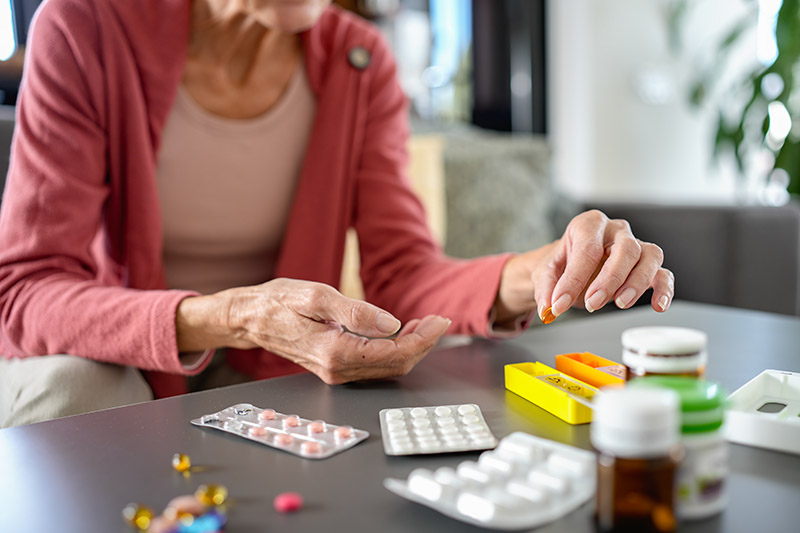

Key for older people: Always have enough of the most important medication with you (Credit: Shutterstock)
SBC: Older people are a very vulnerable target group in crises. Apart from emergency backpacks and supplies: What else should they and family caregivers look out for?

Tobaben: Another topic is very important: Networks. The starting point is simple, but crucial: There are people who have relatives who take care of them. And there are people who have relatives who could take care of them, but are simply overwhelmed in everyday life or are juggling other priorities. I’m not excluding myself from this: You’re often busy enough in your own life trying to get everything together. Then there are people who have a care service because their need for care is recognized. And then there are those who don’t have any of that. And it is precisely this group that is particularly vulnerable in crises. It is not automatically the elderly who are particularly at risk – but those older people who have no care service, no relatives nearby and no one who has a key or regularly checks on them in case of emergency.

It is not automatically the elderly who are particularly at risk – but those older people who have no care service, no relatives nearby and no one who has a key or regularly checks on them in case of emergency.

For these people, the key question is: How do I get in touch and how do I get information if I can’t do it myself? And here we see in Germany – and I suspect it is similar in Austria – that many older people live alone, especially in urban areas. Relatives have died or live far away, the circle of friends is getting smaller, mobility is decreasing – and suddenly you are more isolated in everyday life. If someone is restricted, can’t get to the door easily and at the same time no one is organized, things quickly become critical.

This is why the immediate environment is so crucial. And not just because those affected should become active, but because it helps enormously when people consciously take on responsibility in the neighborhood. It starts at a very low level: ‘Should I bring you the heavy shopping?’ – ‘Should I help clear the sidewalk in winter?’ – ‘If you like, I can take over the stairwell service’ – but it can also go further, towards crisis situations: ‘What do we do if the power goes out? How can we reach you? Do you have a signal when you need help? Can we come to you in case of doubt – and do you trust that we can?

Some people like to say that neighborhoods used to be better. I think it’s less nostalgia than math: we have more older people and fewer younger people moving up. That doesn’t automatically make networks worse. But it does make them something that you have to actively maintain and organize instead of hoping that it will happen by itself.

And if we manage to do that, then I have a sentence that sums it up well: If each person only thinks of themselves, they are far from thinking of everyone. Only when a few people consciously think about others does it become truly sustainable. In practice, this is precisely where it is decided whether someone will be supported – or whether someone will simply be overlooked in the crisis.

SBC: Do you experience a difference here between urban and rural areas?

Tobaben: I now also live in a more rural area – but what I find really exciting is that this feeling of ‘knowing each other’ arises above all in the districts. We have five districts, and there neighborhoods often still function very naturally. In our estate, which has around 60 parties in one street, we know each other pretty well. In the best sense: the children know each other from school and everyday life, people talk to each other and help each other.

There are very practical things that you notice immediately in an emergency: Who has a house that is halfway self-sufficient because it has electricity from the roof? If in doubt, where can you ring at night if you need something urgently? And if something medical happens in our house, my phone rings – simply because the network is there and works.

But as soon as I walk just a little further, towards the high-rise buildings in the next part of town, things change significantly. This matter-of-factness works much less there. And to be honest, my experience is similar everywhere. The more anonymous and dense the structures, the more neighbourliness has to be actively organized, and it doesn’t just happen on its own.

The more anonymous and dense the structures, the more neighborhoods have to be actively organized, and they don’t develop on their own.

SBC: Let’s move on to communication: How do I find out if nothing works, if the power is out?

Tobaben: When it comes to information, my clear advice is to listen to the radio. In most European countries, warning messages are now also sent via mobile radio – cell broadcast – but you can’t rely on that alone. (Note: Cell Broadcast is a disaster warning system that sends emergency messages directly to cell phones. It works without an app download and often cannot be deactivated at the highest warning level). Not everyone has a cell phone, and certainly not everyone has a smartphone. Older people in particular often use simple push-button telephones and sometimes such warning messages are not received at all or not in the same form. This is why a second, robust channel is needed.

A radio is just such a channel. Ideally one that is battery-operated and in the best case even works with a crank . What is exciting is that many people who are now 90 years old are still familiar with these solutions. This generation has experienced major crises. They know what it feels like, and they often panic less than you would expect when sirens go off or the power goes out. I experienced this myself with my grandmother, who was born in 1930. When we were clearing out her apartment, things came up that even I didn’t know about, even though I know my way around. This generation has a certain resilience because they have been through situations like this before.

I see the bigger challenge for our generation and for younger people: Many have never experienced anything like this before. When sirens suddenly go off, the heating fails and the grid becomes unstable, they often don’t know what to do and therefore don’t have the peace of mind to make the right decisions. We saw this very clearly during events like the one in Berlin.

SBC: In my conversations, I have noticed that volunteers are very committed professionally, but in the event of a crisis, they often appear to be only partially prepared for the special needs of older, frail and mobility-impaired people. It is often emphasized that everyone is treated equally – which in my view is not enough in such situations, because different conditions also require different support.
Are there any specific courses or programs in Germany that you would recommend to volunteers so that they can receive targeted training in their region – especially with regard to evacuation and supporting vulnerable groups?

Tobaben: People often look at emergency services from the outside and think: “They’re the helpers – they have to be able to do everything in an emergency.” I understand this reflex, but it’s not true. Nobody can do everything, and that’s exactly why we work with specialist services and clear roles in civil protection.

The ‘white’ aid organizations – i.e. medical and rescue services – generally approach people from the perspective of a patient or someone in need of care. Anyone with physical limitations is quickly seen as someone who needs care or support. In care, people are referred to as residents or – in outpatient care – sometimes technically as clients. In the ambulance service, things are different again: it’s not about customers, but about medical care. And the fire department has different tasks and competencies. This differentiation is important because it explains why cooperation is so important: each organization brings its own expertise to the table.

In addition to the traditional blue light structures, there is a second group that plays an enormous role in crises: spontaneous helpers. These are people from the region – and sometimes far beyond – who say: “I can cope on my own and I want to help. Just tell me how.” During the flood disaster in the Ahr valley, these helpers came from all over Germany. If this help is well coordinated, it is a huge benefit. However, if people just do anything without coordination, it can also be difficult, as we have also seen very clearly in past events.

This is precisely why the Federal Office of Civil Protection and Disaster Assistance (BBK) has developed a course system in Germany that aims to strengthen people’ s own resilience – and at the same time enable them to help others in a meaningful way in the first place. The program currently consists of several modules for different target groups and age groups, from short units in kindergartens and elementary school to courses for young people and specific formats for people with special needs.

Two modules are particularly relevant in your context: One for family caregivers and one for professional caregivers. These deal very specifically with how to act when infrastructure fails – such as electricity, heating, communication – and how to remain capable of acting in care and support situations.

And for me, that’s the practical takeaway: if you want to prepare yourself, you don’t have to turn your whole life upside down straight away. A good first step is to look around to see where such courses are available in your region – and to use them. Basically, what you need to bring to the table is time and the willingness to deal with it. Everything else then comes step by step.

Thank you for the interview!

Checklist & information on emergency preparedness: “Preparedness for crises and disasters”

More about the courses from the German Federal Office of Civil Protection and Disaster Assistance

Anja Herberth
Author: Anja Herberth

Chefredakteurin

Previous Post

“In my world”: A children’s book on coping with grief

Related Posts

No Content Available

Leave a Reply Cancel reply

Your email address will not be published. Required fields are marked *

  • Deutsch
  • English

.

loader

Newsletter

What tools and concepts are available for senior living, care and support - and where can they be found? Our newsletter provides answers!

I accept the terms and conditions

Recent News

Our interview partner Nicolas Tobaben is Head of Disaster Management at the German Johanniter Regional Association North (Credit: Johanniter)

Crisis requires community: “Only when a few people consciously consider others can it truly be sustainable.”

22. February 2026
"In my world" is published by Thienemann Verlag

“In my world”: A children’s book on coping with grief

17. February 2026
The Care Development Commission will meet on Friday to decide how to proceed with 24-hour care in Austria. Credit: Shutterstock

24-hour care: When the money doesn’t follow the need

17. February 2026
Interview: Leading complexity researcher Prof. Peter Klimek (Photo credit: CSH Eugenie Sophie)

Early warning system for heat waves: How an Austrian research project detects hotspots – and makes protective measures more targeted

29. January 2026
Women's hearts beat differently—and need more attention. (Credit: AHA/American Heart Association)

Go Red for Women 2026: Why women’s heart health needs more visibility

17. January 2026
SmartBuildingsCompass

Made with care. For you.

Our research and interviews on safe and independent living in old age are written by our team with a great deal of energy and passion. We hope you enjoy reading them!

Do you need more information? If so, you are welcome to contact us at redaktion@sbc.co.at.

All rights reserved (2025).

  • Deutsch
  • English

Follow us

Instagram
  • Home
  • Subscribe to our newsletter
  • Glossary
  • About us
  • Contact
  • Marketing: Information for businesses
  • Download your 10 tips for independent, safe living in older age
  • Presentations & workshops for local authorities & nonprofits
  • Contact & Legal Notice
  • FAQs
  • Disclosure Statement
  • Nettiquette
  • Data protection
  • General Terms and Conditions (GTC)

© 2025 by owl lab e.U. Wir navigieren Wandel.

We use cookies on our website. Some of them are essential, while others help us improve this website and your experience.
Cookie SettingsAccept All
Manage consent

Privacy Overview

This website uses cookies to improve your experience while you navigate through the website. Out of these, the cookies that are categorized as necessary are stored on your browser as they are essential for the working of basic functionalities of the website. We also use third-party cookies that help us analyze and understand how you use this website. These cookies will be stored in your browser only with your consent. You also have the option to opt-out of these cookies. But opting out of some of these cookies may affect your browsing experience.
SAVE & ACCEPT
No Result
View All Result
  • Home
  • Home & Living
  • Tech / Tools
  • Topic search
    • Topic: Orientation
    • Topic: Dementia
    • Topic: Building & Renovating
    • Topic: Healthcare
  • Local authorities & Nonprofits
  • Download: 10 Tips
  • Deutsch
  • English

© 2025 by owl lab e.U. Wir navigieren Wandel.

Safe & independent living in old age

27 pages of tips for independent, safe living in old age—download now!

Download our PDF with tipps now!
loader

Email addresse*
I accept the privacy policy and agree that SmartBuildingsCompass.com may contact me beyond this request to send me its regular newsletter. I can unsubscribe at any time.

Sicher & selbstbestimmt Wohnen im Alter!

27 Seiten Tipps für sicheres, selbstbestimmtes Wohnen im Alter - jetzt downloaden!

Jetzt gleich downloaden!
loader

Email addresse*
I accept the privacy policy and agree that SmartBuildingsCompass.com may contact me beyond this request to send me its regular newsletter. I can unsubscribe at any time.