
Dieser Beitrag ist auch verfügbar auf:
Deutsch
Christoph Sterbenz, regional secretary of the Carinthian Civil Protection Association, has seen for years how many people struggle with prevention. In this interview, he explains why a family emergency plan must always be tailored to individual life situations and why neighborliness is an often underestimated safety factor.
SBC: I researched and looked through a lot of crisis plans. The Carinthian Civil Defense Association’s emergency plan is called “Crisis-proof household” and is intended as a family emergency plan. This makes it very different from other emergency plans. Can you explain this approach to us in more detail?
Sterbenz: An emergency plan is not a standard form that fits everyone. It has to fit your own reality, because it is precisely these details that matter in an emergency. Do the family members work in the same city where I live, or do I live further away? What is my environment like? Are there people I can rely on? Do I live in a three-person household where someone is almost always at home, or am I on my own? Do I live in an apartment or a house – and what does my everyday life depend on?
It is precisely these questions that make every provision individual. And from this we derive a basic premise that we always take with us: Stay in active contact with your own environment. Because no matter how well structures are planned, there may be situations in which outside help does not arrive immediately. This is when local support counts: the environment is a stabilizing factor when nothing else works.
>> The environment is a stabilizing factor when nothing else works. <<
If you have relatives who commute two hours a day for work, you need different arrangements than a three-person household where someone is almost always at home. If you live in an apartment building, you have other dependencies – such as the elevator, the heating, do I have water – than someone in a detached house with alternatives. People who live alone also need to protect themselves differently than people with close surroundings.
People with disabilities in particular benefit enormously from having a network in their immediate environment that doesn’t just come into being in an emergency. And you don’t have to have coffee with everyone on a regular basis. It is often enough if people know each other, are aware of each other and are easy to talk to when needed. And we believe this is even more important than going through checklists, checking flashlights or supplies: the basic rule is Relationships before equipment.
>> The principle of relationships before equipment applies.<<
Because in a crisis, outside help may be delayed – or temporarily not come at all. The immediate environment then determines whether someone receives support quickly.
SBC: In your opinion, what is central to crisis preparation as a family caregiver?
Dying: For older people, the general checklists should be supplemented with the most important medical information. Simply write them down briefly and ideally keep them in a document folder or a sturdy transparent cover. It is best to organize the central medication so that it is to hand in everyday life.
I wouldn’t store these things permanently in an emergency backpack. Otherwise you’ll forget them and they won’t be updated – and in the end the emergency pack will be counterproductive. An emergency rucksack is particularly useful if you live in a flooded area and know that things have to be done very quickly in case of doubt.
And to be honest: I suspect that very few households actually have a ready-packed emergency kit like this at the moment. So it’s best to keep everything to hand.
SBC: Let’s move on to the topic of communication: If the lights go out, mobile communications and the Internet fail, you need a plan B. Where can I get reliable information about the situation first in an emergency?
Sterbenz: Communication is a recurring weak point in crises. Many people rely entirely on smartphones and the internet, which doesn’t work in an emergency. The older generation is certainly ahead of us when it comes to communication, as many have experienced what it’s like to get by without a digital infrastructure. They know little tricks from earlier times, are less dependent on smartphones – and sometimes still have things at home that are no longer on the radar today. Such as a battery-powered radio.
Here in Carinthia, you should tune in to Radio Carinthia in the event of a crisis; it will continue to operate in an emergency. But who still knows the frequency by heart today? The older generation still knows it because they have tuned it in many times using the dial. The younger generation can only try it out slowly if it is not written somewhere on the display.
What you should not forget: Many people believe that they are completely cut off without a battery radio. This is not necessarily true. If you have a car, you also have a mobile power generator and an information channel via the car radio. And yes, in normal times we would be discussing environmental aspects. But we are talking about a crisis here, an exceptional situation. Starting the car two or three times a day for a few minutes to get up-to-date information on the situation is useful and can help enormously in an emergency.
>> If you have a car, you also have a mobile power generator and an information channel via the car radio. <<
SBC: One important point is being prepared with the most important foods. I’m prepared for myself and my family, but I realize that the checklists just don’t work for me. I admit: I’m not good at cooking, so what do I do with kilos of flour and lentils in a crisis?
Sterbenz: To be honest, it’s not always easy. These recommended storage quantities are large – and even in a house it’s a logistical task. It’s even more challenging in an apartment because space and storage conditions are limited.
One point is important to me: every day helps. The optimum is 10 to 14 days, yes – but if it’s ‘only’ three days, that’s still better than nothing. Because when a blackout or other disruption occurs, you simply don’t know at the beginning whether it will last ten minutes or ten days. It is also often unclear whether only your own street is affected or an entire region. This only becomes clear over time – and until then, every reserve counts.
The actual idea behind this is to make households as capable of acting as possible so that authorities and emergency organizations can concentrate on the really critical tasks – namely rebuilding basic services and infrastructure in a stable manner. And in a digitalized world, this is more complicated than many people think. Even when the power is back on, it can take time for systems to fully boot up – especially if cooling, logistics and supply chains were affected. It can take a week before everything is back to normal. That’s why we recommend preparing for 10-14 days.
>> The actual idea behind this is to make households as capable of acting as possible so that authorities and emergency organizations can concentrate on the really critical tasks – namely rebuilding basic services and infrastructure in a stable manner. <<
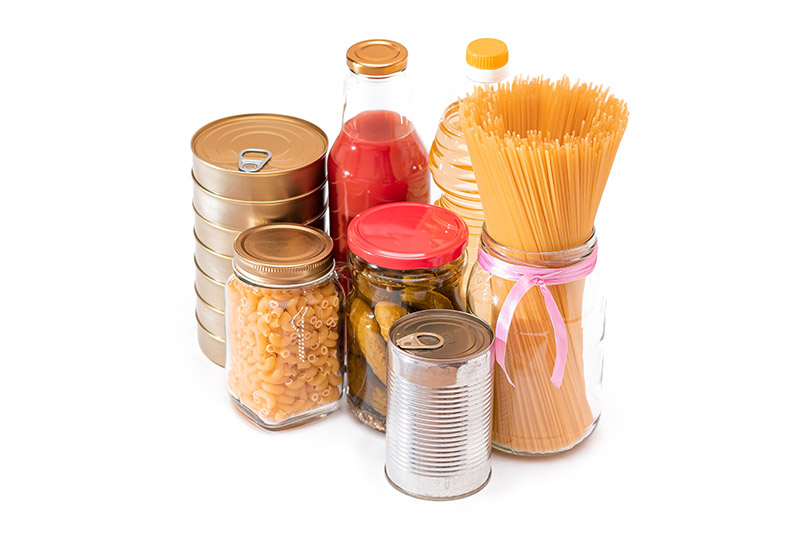
As far as food and checklists are concerned: I see checklists as a guide, but you shouldn’t get bogged down in them. Supplies have to match your own needs. Older people may have diets to follow. Others simply don’t eat certain things. In my experience, it works best if you don’t stockpile ’emergency food’, but buy what you use regularly anyway – and take a little more with you each time. That way, your stock gradually grows without ending up with lots of products that expire on the same day.
This requires a simple principle on the shelf: rotation. New items to the back, older items to the front. That sounds banal, but it’s the difference between a ‘cellar full of stuff’ and a stock that really remains usable. At our house, the children now reliably let us know when ketchup, mayo or Nutella are running low – that’s basically a functioning system.
And then comes the very practical question: what can I prepare in an emergency? Many recommendations sound good, such as flour and pulses, but if your cooking options are limited, it quickly becomes impractical. Pasta and rice are easier to cook than complicated ingredients that require an oven or long cooking times. I’ve noticed this for myself too and have adjusted my supplies accordingly.
There are also regional differences: Water is often a separate issue in rural areas. There are often still wells that can be used. And when it comes to heating, the situation is also completely different: in rural areas, you are often more independent than someone who is dependent on district heating.
Important: If alternatives are used, they must be safe. Not everything that heats in some way is safe indoors – keyword carbon monoxide. And even gas or kerosene stoves certified for indoor use require maintenance and occasional testing. Storing an appliance in the cellar for ten years and hoping that it will work in an emergency is rarely a good idea. A civil protection-proof household is not just about materials, but also about a certain mindset.
>> Not everything that heats in some way is safe indoors – keyword carbon monoxide. <<
SBC: What exactly do you mean by mindset?
Sterbenz: Above all, it means being aware of potential dangers – and recognizing typical sources of danger in good time. In a crisis, the aim is not to have everything perfectly under control, but to remain as capable of acting as possible and to relieve the burden on authorities and emergency services. If communication fails or is overloaded, it quickly becomes difficult to reach help – and valuable time can pass before support actually arrives.
That’s why it’s worth thinking about a few very practical things in advance. For example, lighting candles in a log cabin is certainly romantic – but it is also a fire risk. In such a situation, flashlights or LED candles with batteries are usually the much safer choice. And this is also part of the crisis logic: if it’s a beautiful day outside and you suddenly have time, you shouldn’t necessarily use it for high-risk work – such as pruning fruit trees. In an exceptional situation, it is wise to deliberately keep the risk of injury low.
>> If it’s a beautiful day outside and you suddenly have time, you shouldn’t necessarily use it for high-risk work – such as pruning fruit trees. In an exceptional situation, it is wise to deliberately keep the risk of injury low. <<
It is also helpful to have a minimum set of skills to hand: a first aid course and the confidence to know how to use a fire extinguisher – simply so that you don’t start from scratch in stressful situations and can help yourself in an emergency, at least in the short term. And down to earth: A well-stocked first-aid kit is also part of the precautionary measures.
SBC: Let’s stay on the subject of the household pharmacy: how can older people who rely on refrigerated medication – such as insulin – prepare for a crisis?
Sterbenz: In winter this is often still reasonably manageable – but in midsummer it quickly becomes critical. And that doesn’t just apply to insulin. I also know this from my own personal experience: if someone is dependent on a ventilator or other power-dependent aids at night, a power cut immediately becomes a real stress test.
To be honest: in such cases, you can hardly avoid organizing a certain amount of emergency power capacity. Fortunately, there are now practical solutions – such as power stations with large batteries. These can at least bridge a certain period of time: You gain one or two days in which cooling and necessary equipment can continue to run – and it is precisely this time that can be crucial for organizing support or, if necessary, preparing an evacuation in an orderly manner.
Thank you for the interview!
Click here for the “Crisis-proof household” homepage with lots of tips and checklists from the Carinthia Civil Defense
Author: Anja Herberth
Chefredakteurin