This article is also available in:
Deutsch
When a parent is diagnosed with dementia, family members often look for programs that not only make daily life easier but also bring back a sense of purpose and joy.
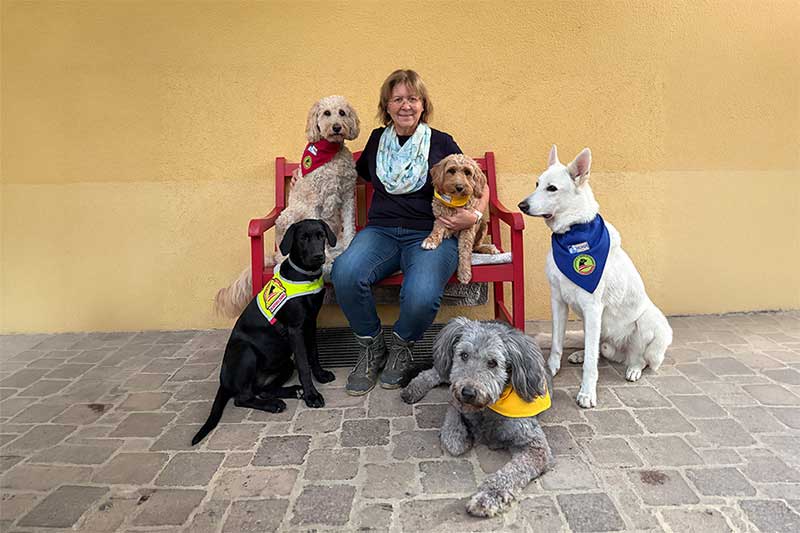
Birgit Monschein combines MAS dementia training with the use of certified therapy dogs. She works with people with dementia in care facilities as well as in their homes. In this interview, she explains what a dog contributes to a training session, where the boundaries lie for both people and animals, and how families can recognize a reputable program.
You might also be interested in
SBC: Let’s start by defining a term: What is an assistance dog, and how does it differ from a therapy dog?
Monschein: An assistance dog lives with a person with a disability and supports them in their daily life. To be certified as an assistance dog, it must demonstrate at least three assistance tasks during the state certification exam. In the case of dementia, for example, this could involve the dog fetching the phone while the caregiver is occupied with the person with dementia. It could also involve the dog pressing an emergency button to alert a neighbor so they can provide assistance in an emergency. Or that it reminds the person to take their medication by fetching the bag containing the pills. These are typical tasks for an assistance dog.
However, there isn’t a single certified assistance dog for people with dementia in Austria yet. I checked with the certification agency, and it’s conceivable that such a dog could be certified as a team of three: the dog, the person with dementia and a caregiver. The basic requirement is a disability ID card.
A therapy companion dog, on the other hand, is trained as part of a team with a healthy person, and the two visit people together—for example, in nursing homes or in their homes.
SBC: So today we’ll be focusing primarily on therapy companion dogs. How are these dogs trained and certified?
Monschein: The training program lasts about one year and concludes with a state-administered exam at the Messerli Research Institute, which must be renewed every year. The dog may take the first exam no earlier than 24 months of age.
These dogs are already more emotionally stable, since young dogs can become traumatized very quickly by stressful experiences. This is important because working with people with dementia doesn’t always go smoothly. As many family caregivers know, aggression can also be an issue with dementia. Simply because those affected realize that they can no longer manage everyday tasks that used to come naturally to them, and they become angry at themselves as a result.
As a dog handler, I must ensure—for animal welfare reasons—that this aggression is not directed at the dog. This applies both in the nursing home and during one-on-one training at home.
SBC: What does a dog do for people with dementia that training without an animal cannot achieve?
Monschein: Above all, the dog makes it easier to establish contact. The people I work with focus their attention on the dog. While they might run away from me as a stranger, they’re more likely to stay with me because of the dog. In the nursing home, many don’t know my name, but they know the dog’s name—partly because there are photos of my dogs with their names on them hanging there.
The dog also gives the exercises a purpose. People with dementia want to know why they should do something. And when the dog brings an object that they’re supposed to unpack or sort, they have a reason to do so. It motivates them, and they then become active on their own.
Then there are the memories. Dogs very often spark conversations about the past. People talk about their own dogs or about living with animals in general. One client always talks about her goats, and former hunters proudly recount how well their hunting dogs supported them.
SBC: You offer preventive training and training tailored to the specific stage of dementia. How do the two differ?
Monschein: The main difference lies in how much guidance a person needs. At the beginning, people take the bag from the dog themselves, open it, and take something out. The more advanced the dementia is, the more I have to guide them step by step. Perhaps someone is still able to take the bag from the dog, but can no longer open the clasp.
Retrogenesis describes how people with dementia, stage by stage, regress, as it were, to earlier stages of development. In Stage 2, no one notices this yet; it’s not until Stage 3 that those around them begin to notice the forgetfulness—for example, when the keys are left in the refrigerator. And in Stage 7, people are bedridden and can hardly do anything on their own anymore.
SBC: You offer one-on-one training sessions at home as well as training sessions at care facilities. Let’s start with the one-on-one sessions: How does a session at someone’s home typically unfold?
Monschein: We often start by taking the dog for a walk. Exercise is particularly important for people with dementia because it supplies the brain with oxygen, maintains motor skills, and reduces stress. Incidentally, this applies to the dogs as well. Along the way, we talk about the dog, the scenery, or whatever we’re noticing at the moment. And that often brings back memories.
Even getting ready for the walk is part of the training: putting the dog’s harness on, leashing him, dressing yourself appropriately for the weather, tying your shoes, and locking the front door as you head out. These are routines that are lost if you don’t practice them. Otherwise, people with dementia might go out into the cold without a jacket when it’s snowing or wear three or four layers of clothing on top of each other in the summer. While you can’t “practice” wearing clothing appropriate for the weather, you can guide people with dementia to wear the right clothes for the season.
Many of my clients also enjoy holding the dog’s leash themselves. However, trained dogs learn to walk between two people, which is actually unusual for dogs. I always secure the dogs with a second leash attached to their chest harnesses, which I hold as the trainer. In fact, I’ve had instances where someone let go of the leash right in the middle of the street because there were grapes hanging by the side of the road that they wanted to pick.
After the exercises, the dog gets to rest on its blanket, and we prepare a snack together. Setting the table, making coffee or tea, and then washing the dishes, drying them, and putting them away: Part of the training involves maintaining these skills for as long as possible. Often, someone stands in front of an open kitchen cabinet and can’t remember what they came to get.
SBC: Let’s talk a little more about maintaining everyday skills: What other skills are there? And how do you practice these skills so they can be maintained for a long time?
Monschein: These are skills that underpin daily life and one’s personality. At the end of each session, for example, I have them sign something so that their signature is preserved. Because it’s a part of their identity, and you never know when you might need it again. Family members often underestimate this. One gentleman I’ve been working with since the summer used to have a very beautiful signature. Today, you have to tell him his name, and he writes only in block letters. It really shows how much can be lost in such a short time.
Another gentleman really enjoys drinking coffee, but he can no longer manage to make it himself. So we do it together every time. And every time, he says he hasn’t had coffee in such a long time. In his kitchen, there are five open packages of coffee and three open cans of cat food because he no longer remembers that one is already open. Because he sorts his trash incorrectly, the paper recycling isn’t picked up. At another gentleman’s house, cheese, bread, and nuts from the previous day’s shopping were still sitting in the kitchen because he no longer remembered that cheese belongs in the refrigerator—or where he usually stores the other groceries so he can find them again.
So when someone lives alone, I help out a little and see what can be done to improve their situation. A large calendar is very important for writing down every appointment and keeping track of what day it is. We practice the most important skills, and the dog helps motivate them.
I saw just how quickly knowledge can be lost when I was with a client with whom I had agreed, that he would take an empty oil bottle to the glass recycling bin across the street. As I sat in the car and drove away, he was still waving at me with the bottle in his hand. But just seconds later, he no longer knew what to do with it.
SBC: In addition to training sessions at home, you also offer activity-based and group games with the dogs, which you also run in care organizations. What do these games involve?
Monschein: Many of the exercises help develop fine motor skills. For example, I put something inside a washcloth and secure it with a clothespin. The dog brings it to me, and just taking it off without dropping anything and opening the clothespin with a pincer grip an be a real challenge for some participants. Removing the contents often requires a lot of guidance. It’s similar with bags that have a zipper or Velcro closure, or with a chest harness that has a pocket with a button or zipper attached to it.
When I notice people in a circle sitting together who are fidgeting with their clothes in the same repetitive patterns, I offer them a sensory blanket, which the clients are happy to accept.
During sorting activities, we match shapes and objects. For example, we place a yield sign with the triangles or a stop sign with the shape that has matching corners. This might seem pointless to healthy people, but it helps people with dementia in their daily lives. Using a treat slide, participants blow treats down to the dogs with a straw, which strengthens their lungs.
For example, in a group setting, we also like to calculate how old the dog would be in human years. This is a memory exercise, and I never ask individual participants directly because that might make them feel uncomfortable. We work through it together, and there are no wrong answers.
SBC: If readers who have family members or loved ones with dementia are considering booking training sessions with a dog: Does every person with dementia enjoy having a dog? What should you keep in mind beforehand?
Monschein: For the most part, the people involved are very happy, but not always. Some have never had a dog and are thrilled, while others prefer to keep their distance. I’m currently working with a man who used to have a German Shepherd himself but still avoids my dog. One woman is afraid of dogs. My dogs ignore people who don’t actively approach them. And that helps her because she notices that the dog keeps its distance.
For bedridden people in a very advanced stage of illness, the dog can lie down next to them. But then I have to pay close attention to their facial expressions, because many of them can no longer express themselves in words. In the past, dogs were often farm dogs that weren’t allowed inside the house. And not everyone feels comfortable when a dog suddenly lies down in their bed. This work is very much driven by emotions.
SBC: What are the limits—for people with dementia and for the dogs?
Monschein: As a dog handler, you have to keep an eye on everything at once: the dog and the people with dementia. You can’t overwhelm anyone, and sometimes you have to remove the dog from certain situations. Some people get tearful, hug the dog, and crowd it, which can lead to conflicts. During group training, a soft ball meant to be thrown into a ring might occasionally hit another participant in the head or end up with the dog. That’s why it’s so important that the dogs are well-trained for this type of training.
During greeting rounds at the nursing home, each person receives a small bowl of treats. I make these myself so I know exactly what’s in them. But I still have to make sure no one eats them themselves. Once, while I was feeding the dog, a caregiver came by with the medications. And suddenly, the residents were holding food in one hand and their pills in the other. However, trained dogs learn that they must not take food that’s offered to them without being asked. That’s why I insist that someone from the facility always be present during visits to the nursing home. This is important, in part so that participants who need to use the restroom can find their way there and back.
When I’m out walking with people who have advanced dementia, I sometimes experience a kind of “movement frenzy.” People start moving faster and faster—faster than their bodies are actually capable of—and they can’t slow down. Then we take a break on a bench where we can sit down.
There are very clear legal limits for the dogs: A therapy dog may work for no more than 45 minutes and may be deployed only twice a week—or three times in exceptional cases. This is documented. The Messerli Research Institute also monitors this. That’s why I have four dogs, and yet the number of clients I can accept is still limited.
A MAS dementia training session actually lasts one and a half to two hours, which is often too exhausting for a single person, so I usually limit it to one hour.
After 45 minutes, I remove the dog from the situation. In the nursing home, where everyone is calling the dog’s name and it’s constantly exposed to new stimuli, the dogs are often very tired after just ten minutes.
SBC: What else should families keep in mind when looking for a dog-assisted program for a family member with dementia?
Monschein: I don’t know of anyone else right now who offers MAS dementia training with dogs. However, there are programs involving dogs that haven’t been certified. Given the highly responsible nature of this work, I don’t think that makes sense, and it’s also a matter of insurance coverage.
Therefore, it is most important not to rely solely on a certificate presented to you, but to check the Messerli Research Institute’s website. There, all therapy dogs are listed by federal state, along with the duration of their authorization to work. The information is available for each dog, including the name of the handler and the name of the dog. These two always go together, because a dog may not be lent to anyone else. This is also a matter of insurance, since the institute checks every year to ensure that insurance coverage has been renewed.
I would also never book ten sessions right away; instead, I’d start with a trial session to see if we click. It’s important to determine whether the person is afraid of the dog—though the dog’s size and color can also play a role. Family members should be present during this trial session. After all, the dog handler is also a stranger, and they must be able to treat people with respect—not just the dog. Feel free to trust your gut feeling in this situation.
A professional approach involves discussing beforehand how the session will proceed and reflecting on it together afterward. This also includes clarifying which rooms the dog is allowed in and which it isn’t, whether anyone has allergies, and whether there are other animals in the household. My thirteen-year-old dog is very well-behaved, but when visiting clients with a birdcage, she would fix her gaze on the birds inside. The family thought it was cute, but as a professional, I could see that it was a hunting instinct. It’s therefore essential to clarify these points in advance.
Thank you very much for the interview!
Here’s how to evaluate a program that uses therapy dogs:
- Check the Messerli Research Institute’s website to see if the dog is listed for your state and is currently authorized for service. Also verify that the name of the dog handler matches the listing.
- Start by scheduling a trial session where you, as a family member, are present, rather than booking a package with multiple sessions right away.
- Clarify in advance which rooms the dog is allowed to enter, whether there are any allergies, and what other animals live in the household.
- Make sure the session is explained to you beforehand and discussed with you afterward, and pay attention to how respectfully your family member is treated.
About Birgit Monschein: Birgit Monschein is a therapy dog handler and MAS dementia trainer who works with four certified dogs to support people with dementia, both in care facilities and in their homes. She serves the northern part of Lower Austria, specifically the areas around Krems, Langenlois, and Ziersdorf. Learn more at assistenzhundeschule.at/
Note: This interview was conducted on November 12, 2026, and reflects the current legal status. All information regarding certification, hours of service, and assistance dogs applies to Austria. You can check whether a therapy dog is currently certified and authorized for service by state on the Messerli Research Institute’s website: vetmeduni.ac.at/messerli-forschungsinstitut
FAQs
What is the difference between an assistance dog and a therapy dog?
An assistance dog lives with a person who has a disability and holds a disability ID card, and performs specific tasks in daily life—such as bringing the phone or making an emergency call.
A therapy dog is trained alongside a healthy person and accompanies that person on visits to people in nursing homes or in their homes.
Are there assistance dogs in Austria for people with dementia?
Currently, there are no certified assistance dogs for people with dementia in Austria.
However, the certification body is open to conducting an assessment together with a caregiver if the individual has a disability ID card and the assessment takes place in a triad setting.
How can I tell if a therapy dog in Austria has been adequately trained and certified?
The Messerli Research Institute’s website lists certified therapy dogs by state, including the dog’s name, the handler’s name, and the duration of the certification. The certification must be renewed every year, and the dog and handler must always work together as a team.
What is the maximum amount of time a therapy dog is allowed to work?
In Austria, a therapy dog may work for no more than 45 minutes at a time and normally twice a week; only in exceptional cases may it work three times a week.
What role does a dog play in dementia training?
The dog makes it easier to establish contact because people with dementia focus their attention on him. He gives meaning to everyday activities, motivates them to be active, and often triggers memories of their own pets from the past.
What kinds of exercises with dogs help people with dementia?
Typical activities include retrieval exercises, in which participants open, for example, a bag, a washcloth fastened with a clothespin, or a pocket on the dog's harness — activities that promote fine motor skills. In addition, there are walks, sorting shapes and objects, and everyday routines such as getting dressed for a walk.
What should I keep in mind before booking a training session with a dog?
First, schedule a trial session where you, as a family member, are present. Find out in advance if there are any allergies, whether there are other pets, and determine which rooms the dog is allowed to enter.
Pay attention to how respectfully the dog handler treats your family member.