Thursday, June 11, 2026
  • en English
  • de Deutsch
SmartBuildingsCompass
Header SBC English
  • Home
  • Housing
  • Everyday aids & Technology
  • Dementia & Health
  • Care & Relief
  • Download: Housing Tips
  • Topic search
    • Dementia
    • Special Feature: Age-friendly Construction & Renovation
    • Tools & Solutions
    • Home & Living
    • Crisis-resilient caregiving household
    • Stay healthy
No Result
View All Result
  • Home
  • Housing
  • Everyday aids & Technology
  • Dementia & Health
  • Care & Relief
  • Download: Housing Tips
  • Topic search
    • Dementia
    • Special Feature: Age-friendly Construction & Renovation
    • Tools & Solutions
    • Home & Living
    • Crisis-resilient caregiving household
    • Stay healthy
No Result
View All Result
SmartBuildingsCompass
No Result
View All Result
Home everyday aids & technology

Getting Dressed in Seconds: How Magnetic Clothing Helps Older Adults Stay Active

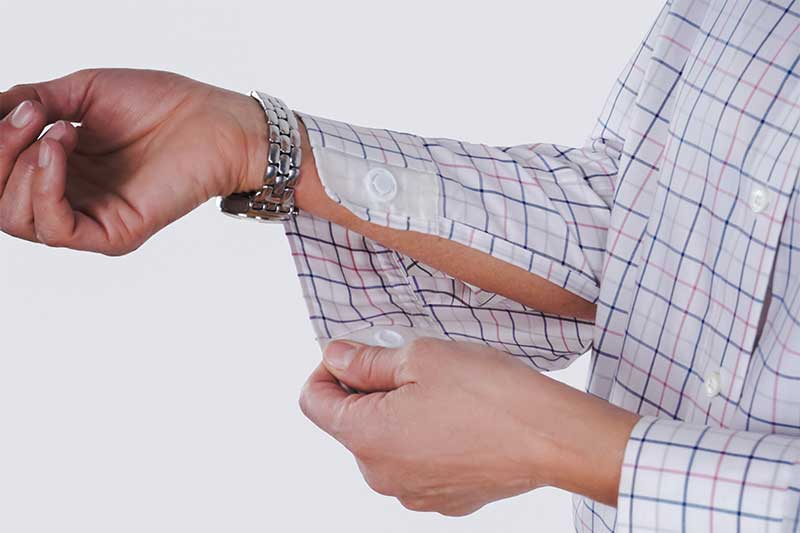
Put it on yourself without struggling with the buttons: just overlap the fasteners, apply a little pressure—and you're done. Credit: Yorokani

Put it on yourself without struggling with the buttons: just overlap the fasteners, apply a little pressure—and you're done. Credit: Yorokani

This article is also available in: Deutsch

Magnetic clothing is exactly what the name suggests: clothing in which traditional buttons, zippers, or hooks are replaced by small, discreetly sewn-in magnets. You place the plackets on top of each other, apply a little pressure—and the shirt closes. No threading, no fumbling, no struggle with buttonholes that are too small.

This is a huge relief for people whose dexterity has declined or who suffer from osteoarthritis, tremors, or the aftereffects of a stroke.

In this interview, Franziska Rauch, the founder of Yorokani, explains how she went from studying sociology to end-of-life care and eventually to magnetic clothing—and why unattractive medical devices rob people not only of their dignity but also of their ability to participate in life.

Header SBC English

SBC: Ms. Rauch, magnetic clothing is an unusual business idea. How did you come up with it?

Rauch: The idea came to me when our son was born. That’s when I started thinking: What kind of world will my son find himself in? What kind of society are we envisioning and shaping?

As a new mom, I was well taken care of: there were clothes that grew with the child, strollers with electric motors for steep paths, beds that grew with the child, and special cutlery and cups that wouldn’t tip over. Really clever products that made you feel: People had really thought through exactly what this target group needs.

And then I asked myself: What’s actually available for people who are nearing the end of their lives? What has been taken into account for 80-year-olds? The answer was sobering.

Our interviewee: Franziska Rauch, founder of Yorokani - Photo credit: Hannah Mayr
SBC: What did you discover during this phase—and what particularly moved you?

Rauch: I was on maternity leave at the time and completed training in end-of-life, dying, and grief counseling at the Kardinal-König-Haus. I then added further training in dementia care and began volunteering in a palliative care unit. And everywhere I looked, it was the same picture: everything people encounter in this phase of life is purely functional. Not a shred of aesthetics, not a single moment of joy.

I experienced this firsthand, too. During this training, we spent a whole day caring for one another. We sat in wheelchairs and helped each other get dressed. We breathed through thin straws to get a sense of what it feels like to struggle to breathe. We put on weighted vests to simulate reduced muscle tone. It was physically intense, sometimes uncomfortable—and very revealing. And it made me realize: Everything surrounding these people is focused on illness and disability. But not on a long, meaningful phase of life.

In our society, aging is viewed as an illness. Not as what it can also be: a really long phase that we could help shape accordingly. That thought wouldn’t leave me alone back then.

SBC: You originally wanted to open a medical supply store and started gathering products and solutions?

Rauch: Yes —and to be honest, that was a really nice phase. I ordered things from all over the world. Walkers, stainless steel tremor cutlery that looks like high-quality silverware. Glasses with a small magnet on the bottom so they don’t slide around on the nightstand. Reaching aids that look nice. Little helpers that have dignity.

We set everything up at our place, and whenever we had visitors, we’d just walk them through it. How does it feel? What do you think about it? What comes to mind? So, these were just little, open-ended interviews—among sociologists, you might call them structured focus groups.

What fascinated me right from the start was that I couldn’t buy any of these products locally in Vienna. Everything had to be ordered from England, the U.S., or Scandinavia. Not a single one of these items was available in a Vienna store. That was actually the first, tentative business idea.

That’s why, from the very beginning, I was determined to open a medical supply store with aesthetically pleasing products. I was so convinced that I knew what was right for this target audience. It seems a bit naive when I think about it now—but maybe that was necessary in order to even get started.

So I went to the Chamber of Commerce, took the certification exam for regulated trade in medical devices, and then started talking to people in a structured way. I established partnerships with senior living facilities and residential care homes. My husband and I set up a fully stocked medical supply store there on several occasions so that the residents could try everything out. And in every single focus group—without exception—they got stuck on the clothing.

Clothing that’s easy to fasten, designed with great attention to detail: Yorokani received the German Design Award for its magnetic clothing. Credit: Andreas Waldschütz
SBC: So the magnetic clothing has naturally come to the forefront?

Rauch: Yes , definitely. We brought clothing with Velcro fasteners from England and shirts with magnetic closures from the U.S. And in every focus group, that was the moment when everyone really took notice.

Everyone immediately made the connection: you can rip the clothes right off your body. Of course, that had a certain entertainment value as well. Suddenly, people were talking quite openly about sexuality and physical intimacy in old age. That was lovely—and very human.

But then things got really serious. People started saying that putting on shirts was a huge problem. That every button felt too big for the buttonhole. That their fingers just couldn’t do what they’d been able to do effortlessly for decades. Someone there told me, “I’d rather withdraw and stop attending social events than show up there in a hoodie.”

Would you rather skip dinner than show up in a T-shirt or hoodie? Simply because a shirt is part of your personality, part of your self-image. That sentence really struck a chord with me and has stayed with me ever since.

SBC: What do you think is the real message behind this?

Rauch: That ugly aids aren’t used. This isn’t just a hunch—it’s something I’ve learned time and again in my practice. If something is ugly, stigmatizing, or looks like a hospital, people will avoid it. They’d rather not go out anymore; they withdraw and become isolated.

Almost everything in this market is designed in such a way that, to be honest, I understand why. That is the real damage that ugly assistive devices cause—not just to dignity, but to participation in life. Loneliness often doesn’t arise out of nowhere. It arises when the hurdles become too high. And sometimes one of those hurdles is a shirt with buttonholes that are too small.

That’s also why we named our brand Yorokani—a made-up word combining “joy” and “lightness” in Japanese. Not as a marketing promise, but as what people described when they explained what they wanted. The feeling of being able to get dressed in seconds, no longer struggling with buttons. That’s where the name comes from.

Our products are lifestyle items, not care products. They’re garments you love to wear—not ones you put up with because you have no other choice. Our company is meant to radiate joy, not pity. That may sound obvious, but in this market, it’s a revolution.

Credit: Yorokani
Credit: Yorokani
SBC: How did you go from the idea to its implementation?

Rauch: We sought extensive advice from the Vienna Business Agency. They found the concept—innovative fasteners for clothing, developed with and for older adults—highly interesting and worthy of funding. With this funding, we were able to work on product development for a year and a half and bring a designer on board as a co-partner. We started taking people’s measurements and talking to them. We had the first prototypes sewn, gathered feedback, and then used that feedback to revise the designs.

That was important, because mature bodies behave completely differently from young bodies. The industry standard is based on 18- to 25-year-olds. When you buy a blouse at H&M, it’s made for a body that has virtually nothing in common with a mature woman’s body. The bust darts sit 10 centimeters too high, and the shoulders are too narrow. The back has room for an upright posture, but not for a rounded one.

We also acquired a large dataset containing 13,000 data points on seated and standing postures, including our own cohort of older adults. And the result of that analysis is still what I’m most proud of: we have a return rate of just 1%. The shirts simply fit because we really listened.

SBC: How do your customers react to the magnetic clothing these days?

Rauch: At first, many people wanted the closure system to be completely invisible from the outside. There was a strong fear of stigma: they didn’t want anyone to notice that they needed assistance. The shirt was supposed to look just like any other shirt.

Things have changed since then. Today, people proudly wear their shirts, show them off, and say, “Look at this cool thing I’m wearing.” This was made for us—this is innovation. It has gone from being something to hide to something to show off—and for me, that’s the best sign that we’re doing the right thing.

And then there are those moments that really keep us going. A customer wrote to us: “It’s Dad’s birthday soon, and we’re getting him another shirt.” That’s so heartwarming. That’s exactly why we do all this.

SBC: What is your biggest challenge?

Rauch: The fact that there isn’t much demand for the product. Not because there isn’t a need for it—quite the opposite, in fact. But because many people aren’t aware that our solution exists.

That is the fundamental problem facing many companies in this market. You have to actively promote the products and communicate their value to the market, because people aren’t aware that new, innovative solutions exist. We have to create many touchpoints before someone even makes a purchasing decision. And that takes time, money, and a great deal of patience.

On top of that, there are the material costs: We use neodymium magnets—which contain rare earth elements, the same ones found in electric cars. The materials are getting more and more expensive. But we can’t switch to iron magnets, because they need to be ten times larger to achieve the same magnetic strength. Then we’d suddenly have huge fastening mechanisms on the shirts—and that’s exactly what we don’t want.

SBC: What do you expect from society?

Rauch: What I’d like to see is a positive, honest conversation about aging. I’d like us to finally stop equating old age with illness. There are many people who are old and remain healthy, active, and curious. People who have worked, learned, made mistakes, and built up expertise throughout their lives. The older someone is, the longer they’ve been an expert in so many different fields. That’s something valuable, and it’s something a society should make use of.

No exceptions, no part-time retirees who are still spry—but rather the simple fact that people in their 70s, 80s, and 90s lead lives worth living. And that we provide them with the means to do so: the right products, the right structures, the right clothes.

Self-efficacy—that was the word that came up again and again in our focus groups. People want to feel capable. They want to be able to go out; they want to dress the way they’ve always done. That’s not a luxury; it’s dignity.

And that, ultimately, is what Yorokani stands for: not just a shirt, but the chance to simply get up in the morning, get dressed—and head out the door.

Thank you for the interview!

Franziska Rauch is the founder of Yorokani, the Austrian pioneer in magnetic clothing. Yorokani has received the German Design Award and the Innovation Award WINNER. The shirts and blouses, featuring concealed neodymium magnetic closures, allow you to get dressed and undressed in seconds—developed with and for people who want to experience dressing as an easy and self-determined process again. Learn more at yorokani.com

Anja Herberth
Author: Anja Herberth

Chefredakteurin

Previous Post

Communal Living: What lessons have you learned from your project, Michael Flemmich?

Related Posts

Assistance solutions are very unobtrusive and can be seamlessly integrated into a home. Credit: WOQUAZ Weiterstadt
Special Feature: Housing & Renovation

More safety, more overview: Why digital assistance systems are becoming relevant now

22. March 2026
Eating aids: Small everyday helpers, big impact. Credit: Ornamin
Dementia

Eating aids: Gentle everyday aids for pleasurable eating

22. October 2025
Credit: Navel Robotics GmbH
Dementia

Robotics in care: When technology creates proximity

19. October 2025
The ‘T1’ from Trump Mobile in subtle gold is expected to be available from August - Credit: Trump Mobile
everyday aids & technology

Trump Mobile: Telemedicine included in mobile phone tariff

17. June 2025
One of the consequences of smart assistance technology: users were able to sleep better. Credit: Shutterstock
everyday aids & technology

“I feel safe – even when I’m alone.”

16. June 2025
Drinking enough water is essential, especially as we age. If having a water carafe on the table as a kind of “reminder” isn't enough, there are tools available to help you remember to drink.  Credit: Shutterstock
everyday aids & technology

Drinking reminders: Solutions against dehydration in old age

5. June 2025

Leave a Reply Cancel reply

Your email address will not be published. Required fields are marked *

  • Deutsch
  • English

.

loader

Newsletter

What tools and concepts are available for senior living, care and support - and where can they be found? Our newsletter provides answers!

I accept the terms and conditions

Recent News

Put it on yourself without struggling with the buttons: just overlap the fasteners, apply a little pressure—and you're done. Credit: Yorokani

Getting Dressed in Seconds: How Magnetic Clothing Helps Older Adults Stay Active

11. June 2026
Michael Flemming worked on this project for 12 long years (Credit: Verein Silberstreif)

Communal Living: What lessons have you learned from your project, Michael Flemmich?

11. June 2026
Our interviewee: Alexander te Best, Managing Director of the stairlift supplier Lifta in Austria (Credit: Alexander Solc Photography)

When is a stairlift the right decision, Mr. te Best?

22. May 2026
What should I consider when choosing a bath lift? Find out in this interview with Nico Rosenstädt, Managing Director of Idumo Austria (Image credit: Idumo Austria)

How do I choose the right bath lift, Mr. Rosenstädt?

22. May 2026
Our interview partner: Sonja Schiff - gerontologist, coach, seminar leader - and DJ. Credit: Rochus Gratzfeld

How can we rock our lives in old age, Sonja Schiff?

22. May 2026
SmartBuildingsCompass

Made with care. For you.

Our research and interviews on safe and independent living in old age are written by our team with a great deal of energy and passion. We hope you enjoy reading them!

Do you need more information? If so, you are welcome to contact us at redaktion@sbc.co.at.

All rights reserved (2025).

  • Deutsch
  • English

Follow us

Instagram
  • Home
  • Subscribe to our newsletter
  • Glossary
  • About us
  • Contact
  • Marketing: Information for businesses
  • Download your 10 tips for independent, safe living in older age
  • Presentations & workshops for local authorities & nonprofits
  • Contact & Legal Notice
  • FAQs
  • Disclosure Statement
  • Nettiquette
  • Data protection
  • General Terms and Conditions (GTC)

© 2025 by owl lab e.U. Wir navigieren Wandel.

We use cookies on our website. Some of them are essential, while others help us improve this website and your experience.
Cookie SettingsAccept All
Manage consent

Privacy Overview

This website uses cookies to improve your experience while you navigate through the website. Out of these, the cookies that are categorized as necessary are stored on your browser as they are essential for the working of basic functionalities of the website. We also use third-party cookies that help us analyze and understand how you use this website. These cookies will be stored in your browser only with your consent. You also have the option to opt-out of these cookies. But opting out of some of these cookies may affect your browsing experience.
SAVE & ACCEPT
No Result
View All Result
  • Home
  • Home & Living
  • Everyday Aids & Technology
  • Care & Relief
  • Dementia & Health
  • Download: 10 tips
  • Topics
    • Special Feature: Age-friendly Construction & Renovation
    • Dementia
    • Tools & Solutions
    • Crisis-resilient caregiving household
    • Stay healthy
  • Deutsch
  • English

© 2025 by owl lab e.U. Wir navigieren Wandel.

Safe & independent living in old age

27 pages of tips for independent, safe living in old age—download now!

Download our PDF with tipps now!
loader

Email addresse*
I accept the privacy policy and agree that SmartBuildingsCompass.com may contact me beyond this request to send me its regular newsletter. I can unsubscribe at any time.

Sicher & selbstbestimmt Wohnen im Alter!

27 Seiten Tipps für sicheres, selbstbestimmtes Wohnen im Alter - jetzt downloaden!

Jetzt gleich downloaden!
loader

Email addresse*
I accept the privacy policy and agree that SmartBuildingsCompass.com may contact me beyond this request to send me its regular newsletter. I can unsubscribe at any time.