This article is also available in:
 Deutsch
When a person dies, many loved ones suddenly find themselves in a role for which no one has prepared them. The fear of saying the wrong thing or of not being able to cope with the situation prevents many from truly being there for their loved ones, especially during this time.
Frank Pape has been accompanying people who are dying for 26 years and serves as an emergency chaplain as well as a counselor for the fire department and police. Together with Nicole Pape and Manuela Schmidt-Schoonhoven, he runs a hospice where people can find shelter during the most difficult time of their lives.
You might also be interested in




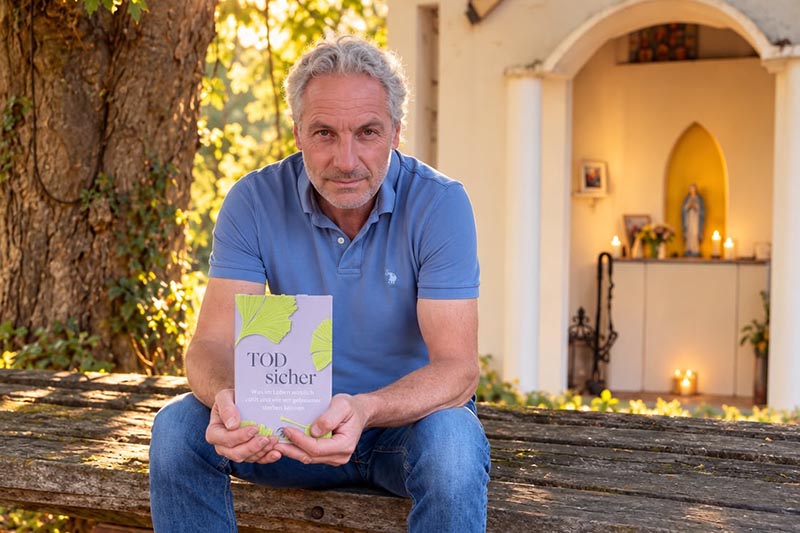
In his recently published book, *Todsicher*, he shares his expertise as a hospice caregiver. He explains why closeness makes saying goodbye easier, why each way of dying requires a different approach to care, and what families should start planning today.

What to Expect in This Interview
- Why the phrase “I couldn’t do that” usually stems from fear, and how you can overcome that fear,
- why we like to pretend to each other that we’re doing fine, and how you can put an end to this charade,
- what different ways of dying there are and why each requires a different kind of support,
- how closeness develops in caregiving and where you can set your own boundaries,
- why advance directive (living will) and wills provide enormous relief for loved ones.

SBC: Mr. Pape, you’ve been accompanying people who are dying for 26 years. How did you come to engage so deeply with this topic and write about it?
Pape: Over the years, I’ve noticed how difficult it is for people to engage with this topic. The most common thing I hear in conversations is: “What you do is really great, but I couldn’t do that.” I always think to myself, “Yes, you can do it—and as a family member, you’re actually particularly well-suited to it.”
Because being there for someone creates an incredible sense of closeness. By that I mean a very intimate bond in which you become allies. When you join forces with someone and say, “We’ll walk this path together,” it’s an incredibly enriching time. Probably the most challenging, no question, but also the most loving time of all. People are denied this time the moment they say they can’t do it.
This “I couldn’t do that” really stems only from the fear of not knowing what to expect, whether you can handle it, and whether you’re doing the right thing. That’s exactly the fear I want to take away from people.
My latest book addresses what I myself have been missing all these years. When the pager goes off and I have to go out as a pastoral counselor. Or when the police come because a family has to be told that someone has died. Every time, I’m faced with a different situation. These are all different kinds of deaths. What I lacked was guidance on what might offer even a little help.
SBC: Was there an experience that had a particularly profound impact on you?
Pape: There are a few experiences that, looking back, have really moved me. The first child I accompanied had been run over by a truck. In hindsight, you realize that the child is dead and there’s nothing you can do about it. But in that moment, when I placed that dying child in his mother’s arms, at least he was no longer lying on the cold ground. That’s very little comfort. And yet it is a comfort, because no one wants to see their child lying on the pavement under a truck.
At that moment, it dawned on me that each of us can do our part. It doesn’t have to be much. But that small gesture made such a big difference that sometimes you just have to muster the courage to say, “I’m going to do this now.”
Many years later, accompanying one particular person led to the book “God, You Can Be a Jerk”. At some point, the idea occurred to me that it might help to simply write about what went well in all those years of accompanying people, what didn’t go so well, and when you actually realize that just being there is already a huge help. There aren’t always the right words, and some situations are just so sad that they’re allowed to be sad. You don’t have to sugarcoat them — and that’s when simply being there is what counts.

SBC: Many family members are caught off guard by this kind of situation, while others know from the start that they will be supporting someone. How can they find guidance so they can take on this role, even if they don’t get everything right?
Pape: I’d like to take a step back. The more guidance we have ourselves, the more guidance we can offer to people who are in need of reassurance right now and whose whole world is falling apart. For those who are ill, the experience is drastic. You receive a diagnosis that you yourself can barely bring yourself to understand. And there you are, sitting across from a doctor, when perhaps you’d already been Googling something completely different or self-diagnosing yourself beforehand.
Then comes the meeting with the family members. The family member wants to provide answers and may already have information that the patient does not yet have—or vice versa. Both want to please each other, and neither wants to burden the other. I can only provide reassurance and guide others if I myself am clear about what lies ahead. And that depends very much on the cause of death.
SBC: That’s why you discuss the eight ways of dying in your book: because each way of dying requires a different approach.
Pape: There’s a big difference between accompanying a very elderly person who knows their time is running out. They’ve already buried their relatives and friends, and with each person who passes away, they become a little more lonely. When I’m with someone like that and they fall asleep, that’s okay. These people are more afraid of being forgotten. Of course they want to live, but not in loneliness.
When you’re elderly, not every day is easy or cheerful. And when they eventually say, “It’s enough now,” they usually mean it. They’re at peace with death. And that’s why “accompaniment” here means: being there, having coffee together, talking, and simply listening to each other’s stories. It’s a truly wonderful task, one in which I usually don’t have to offer comfort.
When it comes to death from illness, it’s completely different, because illness doesn’t take age into account at all. Here, I’m dealing with people who didn’t expect their lives to be significantly shorter. They emerge from adolescence at some point and think, “Life is waiting for me.” And suddenly, it’s a few years shorter than expected. It doesn’t matter whether they’re 18, 25, 45, or 50.
Accompanying someone in this situation means saying, “We can’t sugarcoat the situation. But we can get through this time of uncertainty together.” We don’t really know what lies ahead, but we’ll get through this together now. That’s the great challenge of being honest with one another—namely, to say: Just trust me to handle this and stay by your side. And be as honest with me as I am with you.
SBC: Is the desire not to burden others one of the biggest hurdles in end-of-life care?
Pape: In the book, I describe my experience caring for a 23-year-old woman whom I cared for and supported around the clock, every two hours, for three months. At first, she was a young woman who didn’t want to be a burden to others under any circumstances. She had learned that in the hospital and at the nursing home. Because whenever she needed something there, they’d say, “I’ll be right there.” So she waited until someone took care of it. She learned to wait and to be content with little.
We don’t want to be a burden to others. And we certainly don’t want others to be sad because of us. So we pretend that everything is fine. Then a visitor arrives, and he, too, doesn’t want the other person to see how sad he is. So he, too, pretends that everything is fine. And so a charade unfolds at a time when the last thing we need is pretense. Closeness, intimate togetherness, and mutual support don’t happen simply because no one wants to be a burden to the other. And that’s sad, because it’s precisely at a time like this that we’re allowed to be a burden to one another.
The most important insight, therefore, is to figure out how much of a burden I can be to the other person and whether they can handle it. In my work with the young woman, this was quite simple because we discussed it. I told her very clearly that I would stay by her side no matter what. But she had to trust me to handle it, and I would let her know if there was anything I couldn’t handle. It took quite a bit of reassurance to get her to understand that it’s okay for her to rely on me and that it’s all right. But after a few days, she was completely comfortable accepting help, being a burden, and also seeing that we were both sad.

SBC: But someone has to take the first step and say, “Let’s talk openly. I know that not everything is okay, and I can handle it.” How do you take that first step in everyday life?
Pape: The most important thing is to first understand what really matters. Namely, that fear is a driving force and that the worry of being a burden can also be a driving force. I can only clear the way if I know what’s standing in the way. That’s why it’s worth taking the time to explore the different ways people die, which reactions are natural, and what to expect.
The more I know about what lies ahead, the easier it is for me to deal with it. That doesn’t necessarily mean the moments will be any better, but they become manageable. When I know what’s coming, I also know that what I’m doing is already all that’s possible. And I don’t have to keep looking for other options. I gain a sense of security because I know that what’s being done right now is exactly what needs to be done.
Take silence, for example: when there are no words to describe how terribly sad something is. Then I can find the courage to say that I’m at a loss for words right now. And sometimes, sharing that silence is enough. That, too, can be a truly beautiful moment—when you say, “You know what? We’re both at a loss for words right now.” Then I’ll just light a candle and be there, without desperately searching for solutions when there aren’t any.
I’d like to draw a distinction between those who help voluntarily and those who are compelled to do so. In end-of-life care, we participate voluntarily, and we’re happy to stand by a person so they don’t have to go through what may be the most difficult time of their life alone. As family members, however, you are involuntary caregivers. You are generally not prepared for what lies ahead. And you’ll be confronted with moments that can be truly heartbreaking and in which you may feel helpless. All I can say is that being prepared for what’s to come helps.
SBC: The eight ways of dying require different coping strategies. How significant are the differences, and what are the consequences of taking the wrong approach?
Pape: The differences are enormous. Take suicide, for example: There are no words of comfort for the loved ones who have to go through this. They’re angry; they’re disappointed. Their world comes crashing down, and they’re completely unprepared. All you can do is just be there. I once sat next to a woman for eight hours whose husband had taken his own life. She didn’t say a word. A year and a half later, she thanked me for being there. And that was all I could do, because there are no words that can truly express what she was going through.
In hindsight, what’s needed is a high degree of understanding for why someone is angry. When a family member acts this way, you might ask yourself, “Why didn’t they talk to me?” It’s also normal for family members to wonder why they didn’t notice anything. If I know that this is normal in this situation, I can respond with the necessary understanding.
Let’s consider death before birth, and you’ll see what a difference that makes. A mother who loses a child has built a bond over months. She has very high levels of oxytocin and loves the baby. Standing beside her is a father who has barely had a chance to form that bond. And that’s why he has a completely different perspective on what’s happening than the woman who is going through a severe trauma. And then, perhaps a week, two weeks, or a month later, someone might say—with the best of intentions—“Let’s try again.”
The man means well when he says that. But this statement is extremely hurtful given what the woman is going through right now. If you understand what the other person is going through, you realize that this isn’t something that can be healed in four weeks—or even four months. A woman who goes through this will carry it with her for the rest of her life. It won’t always be on her mind, but it will resurface every time she sees a baby.
Or take a violent crime. Losing a loved one to a homicide not only confronts the family with the fact that someone is suddenly gone, but also with the reality that their loved one had to endure so much violence—and that another person was capable of inflicting so much violence. This gives rise to anger and a desire for revenge. And if I know that this person will be driven by a desire for revenge over the next few months, then I also know that the most dangerous moment of all comes after the perpetrator’s sentencing. Because that’s when the mission that kept him going is fulfilled.
Do you see how big the differences are? If we really want to help and understand what’s in the newspapers, how people react, and how we interact with people on the street, we should understand what’s going on inside those involved in such situations. And by that I don’t just mean first responders—I mean each and every one of us. So if you want to know how to interact with someone who has lost a loved one, it helps to know how they lost that person.

SBC: What advice would you give to family members who are currently caring for a dying loved one?
Pape: This support doesn’t happen overnight—it’s a process. When trust and closeness are present, they continue to grow. You just have to have the confidence to take the first step and say, “We can do this.” That’s the basic attitude: We’ll get through this together.
Here’s an example: When you’re supporting someone and want to be there for them, you can decide for yourself how much closeness you need to provide and how much closeness you want to provide. When I’m caring for or supporting someone, there’s a certain level of closeness that’s necessary. Anyone who wants to provide a sense of security needs a certain level of presence, and anyone who provides care cannot avoid physical contact.
I became particularly aware of this while caring for the young woman. Helping someone else shower is a real challenge because many people are afraid of it. One person is naked, the other isn’t—and at first glance, that’s perfectly normal and natural. So we brought it up and thought about how to go about it. She did say that she’d been washed by men at the nursing home, too. So why not here as well? But I noticed that there was still a certain amount of fear and uncertainty—for both of us. It wasn’t because I didn’t know how to provide care. It was because you are touching another person for the first time.
Because I could sense how tense the situation was, I asked what music we should listen to while I washed her today and what scent the shampoo should have today. And with that, the first hurdle was already cleared. While washing her, I noticed that she had no problem with me washing her. What troubled her was that her underwear might not always look clean because of her serious illness.
We then figured out how to handle it: We just lay down a towel; the clothes fall onto it when she takes them off, then we fold up the towel and put it right into the laundry. And just like that, the situation is saved. Taking that first step also means we’ll be able to handle the second and third steps. And after that, she had no problem at all with being washed anymore.
And what about blow-drying her hair, for example? Even if there isn’t that much hair left, you can still take care of it. Then I noticed that her heels were getting sore. So I gently asked if we should wash them and put some cream on them. Strangely enough, she let me wash everywhere else, but her heels were too intimate for her. Many people feel uncomfortable when someone washes their feet, either because they might smell or because no one has ever done it before. Still, it was good to do it because her heels were slowly getting sore.
When someone washes and moisturizes another person’s feet, they offer a closeness that isn’t necessary—but one they choose to give in order to be there for that person. That is when care becomes truly loving, just as it should ideally be: one in which one person allows something and the other is willing to give it.
SBC: In your view, what should families take care of even during good times?
Pape: When we admit people here, the first thing we ask is: How would you like to go? Do you have any wishes? Is there anything else we should do, or anything else we should take care of? I think it’s great when we take care of things while we’re still alive—things that would otherwise fall on our loved ones’ shoulders. Writing a will takes a quarter of an hour. But it’s wonderful once it’s done, because then no one has to argue. An advance directive doesn’t take long either, and it takes a huge weight off the shoulders of loved ones. Because they know what’s wanted and what isn’t, and they don’t have to wrestle with their conscience.
Just a few days ago, I experienced firsthand what can happen without a living will. If a person needs medical care, refuses it, but is no longer able to communicate in a way that allows me to know whether they are of sound mind at that moment, a procedure under Germany’s state mental health laws (PsychKG)must be initiated in Germany. This means that I must do everything necessary, even if it goes against the patient’s current wishes.
The fire department is notified, and the ambulance arrives. And I have to offer the patient transport to hospital. If he refuses and has a living will, that’s not a problem. If he doesn’t have one, I have to involve the public order office. The public order office assesses whether the situation is as I’ve described it. And if they determine that the person needs medical assistance that he is refusing, a psychiatrist is called in to confirm this on the spot. If the patient still refuses to go, the ambulance has to come back and the offer has to be made again. And if he continues to refuse, the police must be called in. In the end, the person receives medical treatment against their will—and all because no one took the time beforehand to spend just fifteen minutes writing down what they actually want to happen if something goes wrong.
As a caregiver, I can handle it. I know what’s coming, and I also know that in that moment, I’m acting in the best interest of the person sitting across from me who is afraid—and who wants anything but exactly what’s happening right now. But now I imagine a family member, a spouse, who has to watch as their partner is treated against their will. And that’s not a pleasant moment. Taking care of these things in advance is actually a small matter. Because if you get all the necessary documents in order, it’s just an hour’s work.
SBC: Over the course of these 26 years of your work, has there been any trend that has surprised you?
Pape: We’ve seen a massive shift in the causes of death. We no longer die the same way we did 20 years ago. Deaths from old age are naturally on the rise because society as a whole is getting older. And the total number of deaths is also increasing. In Germany, 20 years ago, we had just under 810,000 deaths per year; today, the figure has stabilized at slightly over one million. So significantly more people are dying than in the past.
The number of accidental deaths is declining significantly, but we’re seeing about 60,000 more deaths from dementia each year. And that’s changing the nature of care, because people with dementia are being cared for at home for much longer. There has also been a significant increase in fatal falls—that is, people falling down stairs or off ladders. These numbers have risen sharply. While the overall number of accidents is declining, this is being offset by an increase in accidents occurring in the home.
Because all of this is shifting, we shouldn’t just talk about the fact that society is aging. We should also talk about what’s changing overall.
SBC: When we look beyond personal relationships to society as a whole, what do you think needs to change in the way we deal with dying and death?
Pape: I hope that, as a society, we’ll allow a person to leave this world the way they want to—without any debate. If, after a long battle with illness, someone says, “I don’t want to go on anymore,” then they have the right to make that decision. Because we don’t know what’s going on inside them, how lonely they are, or what fears and suffering may remain unspoken.
Then it’s not something to argue about, but to accept. And you need the courage to say: “This is hard for me, but I’ll stay by your side; I accept this.” If someone asks if they can hold on for another month because there’s a special occasion coming up, that’s okay, too. But pretending that you have to hang on indefinitely just because you yourself find it hard to let go—I think that’s selfish. Because then the other person has to struggle longer, just because we don’t want to let go, even though they may not have been doing well for a long time.
I would be truly happy if we could give the dying this freedom and allow them to express their wishes without fear of being a burden to us. I consider this one of the most important insights of all. After all, the statement “When I die, this is how I want to die” is perhaps the most intimate wish a person can have.
Thank you very much for the interview!
About Frank Pape: Frank Pape has been a hospice caregiver for 26 years and serves as an emergency chaplain for the fire department and police. His book *God, You Can Be a Jerk* has been adapted for film and television. Together with Nicole Pape and Manuela Schmidt-Schoonhoven, he runs the nonprofit organization “Ein Lächeln für Dich e.V.”, which has operated a 7-bed hospice since 2014. The organization is funded by donations, as well as proceeds from book sales and the coffee roastery and chocolate shop of the Pape family business.
His latest book: Todsicher (roughly: “Dead Certain”). Published by Penguin Random House in 2026; more information is available here: https://www.penguin.de/buecher/frank-pape-todsicher
Note: The procedure described above—which does not involve a living will—refers to the legal situation in Germany.
If you are going through a crisis yourself or are concerned about someone else, you can reach the telephone counseling service in Austria by dialing 142 (available 24/7, toll-free, no area code required; for more information, visithttps://chat.onlineberatung-telefonseelsorge.at/hc/de) and in Germany at 0800 111 0 111, 0800 111 0222, or 116 123:https://www.telefonseelsorge.de
FAQs
How can family members support someone who is dying?
For end-of-life companion Frank Pape, it’s less about finding the right words and more about being there and enduring the situation together. Companionship develops as the process unfolds, and the underlying attitude is that we can get through it together.
The foundation is being well-informed: When you know what to expect, you gain a sense of security and can pass that sense of security on to the dying person.
What can I do if I'm at a loss for words at a deathbed?
Frank Pape advises people to openly admit when they’re at a loss for words, rather than desperately searching for solutions.
Shared silence can then be a precious moment. You can light a candle together, just be there. Some situations are so sad that they’re allowed to be sad and don’t need to be sugarcoated.
Why is it so hard for the dying and their loved ones to talk openly with each other?
In Frank Pape’s experience, the dying and their loved ones don’t want to burden one another and therefore pretend that everything is fine.
But this mutual pretense actually prevents the very closeness that is needed most during this time. It helps to explicitly discuss that it’s okay for the other person to be a burden and to speak up when something becomes too much to bear.
Why does each type of death require a different kind of support?
In his book "Todsicher", Frank Pape distinguishes between eight ways of dying, each of which requires a different kind of support. The very elderly are often afraid of being forgotten and need companionship and conversation, while people with a terminal illness need honesty and someone who can endure the uncertainty with them.
After a suicide or a violent crime, family members often react with anger.
If you understand the circumstances, you can better respond to these different situations and offer help.
How do I deal with being close to someone I'm caring for?
Frank Pape distinguishes between the physical closeness that is necessary in caregiving—such as when bathing a patient—and the closeness that one might wish to provide beyond that.
Family members can decide for themselves how much of this additional closeness they want and set their own boundaries. Difficult situations, such as taking a shower together for the first time, become easier if you address them openly and work together to figure out how to make it comfortable for both of you.
What should families take care of well in advance, before someone dies?
Frank Pape recommends drawing up a will and a living will while you are still alive, because both greatly ease the burden on your loved ones.
A will prevents family disputes, and a living will specifies which treatments are desired and which are not.
What happens in Germany if someone refuses treatment and does not have a living will?
If a person refuses medical care but is no longer able to express themselves clearly, a procedure under Germany's state mental health laws (PsychKG) must be initiated in Germany. This process involves, in sequence, the emergency medical services, the public order office, a psychiatrist, and, if necessary, the police; ultimately, the person may be treated against their will.
An advance directive can prevent this because it records the person's wishes in binding form.