Dieser Beitrag ist auch verfügbar auf:
Deutsch
Parkinson’s is the second most common neurodegenerative disease after Alzheimer’s – and the fastest growing. An estimated 12 million people are affected worldwide, and the trend is rising rapidly. There is insufficient data available in Austria, but experts estimate that between 20,000 and 25,000 people suffer from the disease.
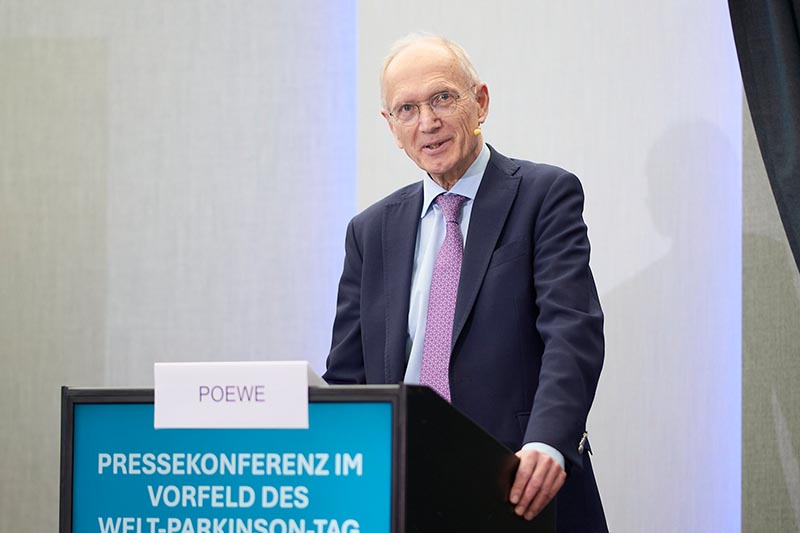
I spoke to the renowned neurologist Prof. Werner Poewe, Professor Emeritus of Neurology at the Medical University of Innsbruck and one of the leading international figures in Parkinson’s research. The conversation focuses on early signs of the disease, current treatment options and the question of where international research stands today.
SBC: Prof. Poewe, what is Parkinson’s – and why is the disease becoming more common?
Poewe: Parkinson’s is a neurodegenerative disease – this means that certain nerve cells in the brain no longer function properly and eventually die. It mainly affects nerve cells that produce the messenger substance dopamine, which is essential for our automatic movement control.
Parkinson’s is the second most common neurodegenerative disease after Alzheimer’s – but it is the fastest growing. While new cases of Alzheimer’s have tended to stagnate since the 1990s, Parkinson’s is increasing exponentially worldwide. The World Health Organization estimates that there are currently around twelve million sufferers, and projections suggest that there could be over 20 million within a generation.
Why is it becoming more common? This is partly explained by the older age of the population – because the incidence of the disease increases significantly with age. Among 60- to 70-year-olds, it is around one percent, and among 75- to 85-year-olds it is almost three percent. But ageing alone does not fully explain the increase. Environmental factors and pollution are also considered possible causes – even if this has not yet been conclusively proven.
Parkinson’s is also not just a disease of old age: although the average age of onset is 65, up to 15 percent of those affected develop the disease before the age of 50. The disease can therefore affect people at a relatively young age, with particular consequences for life, family and career planning.
SBC: What does it mean to have Parkinson’s disease – what are the symptoms?
Poewe : The classic picture, which James Parkinson described back in 1817, is the so-called resting tremor: a hand trembles when it rests on the table or thigh – i.e. at rest, not when moving. In addition, there is a typical slowing of movement: those affected walk with a stooped, small-step, shuffling gait. Everyday activities such as fastening buttons or signing become increasingly laborious. Handwriting also changes – the letters become smaller and smaller towards the end of a line.
In textbooks, Parkinson’s is often defined as a movement disorder, but it is much more than that. Almost 90 percent of those affected lose their sense of smell during the course of the disease – often gradually and without realizing it themselves. It is often the partners who are the first to notice that someone no longer smells anything.
In addition, there are other so-called non-motor symptoms, such as a dream sleep disorder in which those affected act out dream content using motor skills. There is also a tendency to constipation, blood pressure fluctuations and, in the course of the disease, mood and drive disorders as well as impaired brain function.
SBC: Not every tremor is Parkinson’s – how do you tell the difference?
Poewe: That is a very important point. The reflex “trembling = Parkinson’s” is widespread – but wrong. Firstly, not every Parkinson’s patient trembles; only around 70 percent have this classic tremor. Secondly, there are many other causes of tremors. The most common tremor in the population is the so-called essential tremor. It affects around four percent of people and manifests itself when holding or moving, not at rest. Parkinson’s tremor is the opposite: the hand trembles at rest and stops when you grasp it. It is also typically unilateral and has a characteristic frequency of five to six Hertz.
Anyone who notices tremors should undergo a neurological examination. In most cases, an experienced neurologist can quickly clarify which form of tremor is present.
SBC: How important is early diagnosis – and what early signs should we be aware of?
Poewe: Early detection is one of the central topics of Parkinson’s research today – for one important reason: it is assumed that treatment aimed at stopping or slowing down the disease process is most effective if it starts as early as possible. Preferably before the classic symptoms break out.
There are early signs that can precede motor Parkinson’s disease by years or even decades: A gradually deteriorating sense of smell, the dream sleep disorder described above and a family history – in other words, if parents, siblings or other relatives have had or have Parkinson’s disease. If all three criteria are present, the risk of developing Parkinson’s disease is significantly increased.
Anyone who notices such early signs in themselves or their relatives should discuss this with their family doctor or directly with a specialist neurological outpatient clinic.

SBC: What treatment options are available today?
Poewe: Parkinson’s has a special position among neurodegenerative diseases: there are highly effective drugs to treat the motor symptoms. As the movement disorder results from a dopamine deficiency, this can be compensated for very well with medication – with the result that those affected can often function normally for years, especially at the beginning of the disease.
Physiotherapy and exercise therapy are also important, as is speech therapy in the case of voice changes. In more complicated stages of the disease, there is even the option of deep brain stimulation – a neurosurgical procedure – which can achieve astonishing improvements.
With good treatment, Parkinson’s patients can expect to maintain their quality of life for at least 15 years after the onset of the disease. If the onset of the disease occurs at a younger age, it can last significantly longer. Physical activity, mental alertness and a balanced diet play an important role in this. That is why we now offer sound education on a healthy lifestyle. The Mediterranean diet is recommended here. Even if not everything has been conclusively proven in this area, there are indications that such measures can have a positive effect.
The connection with physical activity is particularly well documented: people who exercise regularly have a lower risk of Parkinson’s than very inactive people. Exercise is therefore one of the factors that we can already draw attention to with good reason. Unfortunately, we are not yet able to do so: Stop the underlying process of nerve cell loss. The disease progresses despite all measures. But this is precisely what is being researched intensively worldwide.
SBC: Then let’s talk about the current state of research: What’s happening in research right now?
Poewe: Parkinson’s, like Alzheimer’s, is a protein disease. In Alzheimer’s, it is two misfolded proteins – amyloid and tau – that are deposited in and between the nerve cells and ultimately destroy them. In Parkinson’s, it is a different protein: alpha-synuclein.
Alpha-synuclein is found in healthy nerve cells and has a normal function there. In Parkinson’s disease, however, it begins to fold abnormally. These clumps accumulate in the nerve cells, disrupt their function and ultimately lead to their death. Incidentally, this misfolded protein appears to have similar properties to the prion protein in Creutzfeldt-Jakob disease – it can “reprogram” healthy synuclein into its defective form and thus gradually spread throughout the brain. It is precisely this property that makes early detection possible: the faulty folding can be detected in the cerebrospinal fluid even before the first symptoms appear.
Studies show that around eight to ten percent of the population test positive. We are currently researching what this means in the long term. We know that some of these people will develop Parkinson’s – but not all of them, and we don’t know when.
At the same time, studies with antibody therapies against this defective synuclein are being conducted worldwide in the hope of slowing down the disease process. There are no clear results yet, but there are indications that it could work. We are at the beginning of a new era.
SBC: You yourself are involved in an international research project on early detection. Can you describe the project?
Poewe: We are working together as part of a network of five European clinics – Innsbruck, Kassel-Göttingen, Barcelona, Luxembourg and London – under the name “Healthy Brain Aging”. So far, we have invited and examined around 1,200 people in order to better understand what certain risk constellations mean in the long term.
The Michael J. Fox Foundation’s “Smell Test Direct” project, in which we are also involved, is running in parallel. People with a poor sense of smell are invited to take part in an online questionnaire and are then sent an odor test. Anyone who stands out can come to Innsbruck for further tests.
Prof. Brit Mollenhauer in Kassel-Göttingen is coordinating the project for interested parties in Germany. Participation in the study is possible via the MyPPMI portal of the Michael J. Fox Foundation – also in German.
SBC: What would you like to see in the future – what is needed in Austria and Germany to provide better care for Parkinson’s sufferers?
Poewe: We urgently need better data. The Austrian Parkinson’s Society has started a national Parkinson’s register – this is an important first step, but still a long way from what would be possible. In Sweden, a national register now records almost 60 percent of all Parkinson’s patients in the country. This allows for real science and health policy planning.
My second big wish is for early detection to be systematically integrated into preventive healthcare at some point. A simple odor test – inexpensive, low-threshold, for everyone over 50 – would be a realistic first step. Combined with a blood test for people who are conspicuous. However, the prerequisite for this is that we can also offer something: In other words, an intervention that actually protects. Until then, lifestyle advice remains the most important form of prevention: physical activity, a Mediterranean diet, staying mentally active.
We are currently experiencing a real paradigm shift: after decades of treating symptoms, we are for the first time on the threshold of risk detection, early diagnosis and prevention. This is no longer a utopia – it is coming slowly, but it is coming.
To the study: How you can participate
The Michael J. Fox Foundation’s “Smell Test Direct” project is open to both Austria and Germany. Participation starts online via the MyPPMI portal(www.ppmi-info.org => https://www.ppmi-info.org/participants).
The questionnaire is available in German and takes about 45 minutes. You will then be sent an odor test. The University Clinic for Neurology Innsbruck is responsible for further examinations in Austria; Prof. Brit Mollenhauer (Paracelsus-Elena-Klinik Kassel-Göttingen) coordinates participation in Germany.
About Prof. Werner Poewe
Prof. Werner Poewe was Director of the University Clinic for Neurology Innsbruck for 25 years. He was President of the International Parkinson and Movement Disorder Society and the Austrian Parkinson Society and is one of the leading international experts on Parkinson’s and movement disorders. Even in retirement, he is actively involved in research projects.
You may also be interested in this article: Brain stimulation: How AI enables new treatments for neurological diseases
Author: Anja Herberth
Chefredakteurin