Friday, August 14, 2026
  • en English
  • de Deutsch
SmartBuildingsCompass
Header SBC English
  • Home
  • Housing
  • Everyday aids & Technology
  • Dementia & Health
  • Care & Relief
  • Download: Housing Tips
  • Find a solution
    • Dementia
    • Special Feature: Age-friendly Construction & Renovation
    • Home & Living
    • Tools & Solutions
    • Crisis-resilient caregiving household
    • Stay healthy
No Result
View All Result
  • Home
  • Housing
  • Everyday aids & Technology
  • Dementia & Health
  • Care & Relief
  • Download: Housing Tips
  • Find a solution
    • Dementia
    • Special Feature: Age-friendly Construction & Renovation
    • Home & Living
    • Tools & Solutions
    • Crisis-resilient caregiving household
    • Stay healthy
No Result
View All Result
SmartBuildingsCompass
No Result
View All Result
Home Care & relief

Alternatives to traditional nursing beds: When you don’t want it to look like a hospital

Photo credit: m2 mühle nursing beds

Photo credit: m2 mühle nursing beds

This article is also available in: Deutsch

For most people, the term “hospital bed” conjures up the same image: a metal hospital bed—technical, cold, with raised side rails. No wonder many people are inwardly resistant to the idea. After all, seeing such a bed in one’s own living room quickly brings to mind the “charm” of a hospital.

Yet the bed itself plays a crucial role in daily life: whether someone can get up and go to the bathroom on their own or has to wait for help, and whether they can participate in family life.

You might also be interested in

Our interviewee: Nursing expert Dr. Susanne Karner (Photo credit: Tanja Kibogo)

Care despite distance: How can we organize support from afar, Susanne Karner?

14. August 2026
Our interviewee: Peter Bischoff, General Manager of Küffner (Credit: Küffner)

Is the role of the door underestimated in accessible renovations, Peter Bischoff?

3. July 2026
Large windows and direct sunlight can cause apartments to heat up significantly in the summer. For older adults, prolonged heat can pose a health risk. (Credit: Shutterstock)

When the apartment becomes a heat trap: What can older people do now, Roland Wallner?

12. June 2026
Michael Flemming worked on this project for 12 long years (Credit: Verein Silberstreif)

Communal Living: What lessons have you learned from your project, Michael Flemmich?

11. June 2026

What types of nursing beds are there? What matters most when choosing one—and why does appearance play a bigger role than you might think? Two interviewees—who have spent decades doing nothing but developing beds—answer these questions for us: They work at the family-run Mühle company in the Limburg an der Lahn region of Hesse. The company specialized early on in custom solutions for the care sector—setting itself apart from the major hospital bed manufacturers.

Header SBC English

A conversation about the possibilities—with Nadine Mühle and Dennis Ontyd, who has been working in engineering and sales since 2008.

Unsere InterviewpartnerInnen: Nadine Mühle und Dennis Ontyd von m2 mühle pflegebetten (Credit: m2 mühle pflegebetten)
SBC: How has the market for nursing beds changed in recent years? Are you already seeing the effects of demographic change in your sales?

Ontyd: Yes , significantly. Care is increasingly shifting to the home. In the past, more people went to nursing homes—today, many care for their loved ones in their own homes—partly because nursing homes are simply no longer affordable for many. In Germany, the out-of-pocket cost is now around 3,800 euros per month, while pensions can’t keep up. In Austria, this type of copayment doesn’t exist—but 24-hour care comes at a similar cost.

Mühle: The real hurdle lies elsewhere: Many people aren’t even aware that there are alternatives beyond the traditional nursing bed. And deep down, everything resists this one familiar image—because as soon as a bed like that is in the room, you immediately feel sick.

SBC: You place great importance on ensuring that your beds don’t look like hospital beds. Why is the appearance so important?

Mühle: Because nobody wants a hospital in their own home. Very often, the bed is in the living room—not tucked away in a bedroom on the first floor, but right in the middle of family life. And if everything looks like a hospital, it’s downright overwhelming: the technology, a feeding tube. These aren’t exactly pleasant things—and they don’t belong in the living space without some kind of filter.

Ontyd: Especially for people who spend a lot of time in bed, comfort and attractive design aren’t a luxury: they preserve a sense of normalcy instead of reducing a person to their illness.

That’s why you can choose the decor freely with us—from warm wood tones to modern colors, exactly as you wish. I’ve even built a pink, magenta-colored bed frame for a young customer who wanted it exactly that way.

SBC: What types of nursing beds are available—and which one is right for which situation?

Ontyd: It always depends on the situation. For people who are prone to falls or who have dementia, low beds are a good option: You lower the bed to its lowest position, less than 20 centimeters above the floor. That way, almost nothing can happen if someone rolls out—and no one has to be confined anymore, as was the case in the past behind raised side rails.

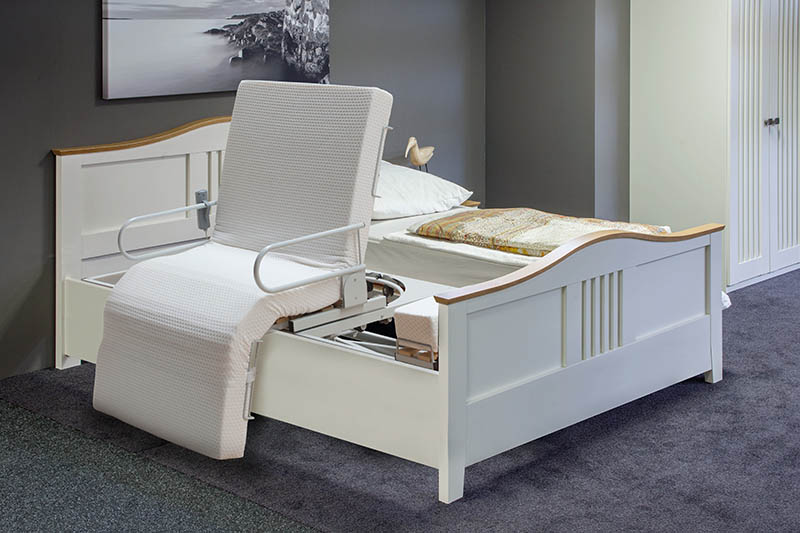
A sit-to-stand bed is designed for people who can no longer get out of bed on their own. It basically works like a recliner that raises itself upright. Many people eventually end up sleeping only in an armchair because they can no longer make it to bed—and are relieved when they can return to the bedroom this way. And finally, there are repositioning beds to prevent pressure sores: They automatically reposition the patient by tilting continuously to a preset angle at intervals of 30, 60, or 90 minutes—and they do so quietly, without the loud compressor that many people dread in alternating-pressure mattresses.

The key factor is always the medical indication: What exactly is the problem? In cases of muscle or nerve disorders, patients often lack the strength to get out of bed—which calls for a different type of bed than, for example, a situation involving a high risk of falling.

Here's an example of a low bed—so nothing can happen if you roll out of bed. Credit: m2 mühle pflegebetten

Stand-up beds help you get out of bed—Credit: m2 mühle pflegebetten

Care beds—beyond the classic models: for when you don’t want it to look like a hospital. Credit: m2 mühle pflegebetten

SBC: A nursing bed usually means that long-married couples can no longer sleep in the same bed. Are there solutions for a double bed as well?

Ontyd: In this case, there’s an integrated solution: The lift mechanism is built into the existing double bed in such a way that it’s not visible. For many people, this makes a big difference. The familiar bed doesn’t have to be cut up or thrown away, and the partner continues to sleep right next to it.

For planning, a sketch with the required dimensions is sufficient; based on this information, we’ll tailor the quote to fit perfectly.

SBC: Is there any assistance available with the selection process? There are many factors to consider before making a purchase.

Mühle: My most important advice: Don’t buy blindly. Especially at the beginning, many people have spent a lot of money on the wrong product because they didn’t know what matters—and often didn’t even realize that their health insurance might cover part of the cost.

The first question should always be: What does the person really need? That’s exactly what can be clarified in advance: In Germany, the medical supply store or our own sales representatives will come to your home free of charge and bring the bed for you to try out. In Vienna, too, our beds can be viewed and tested at the Vienna Red Cross.

After all, nothing is more frustrating than delivering a bed that doesn’t end up being the right fit. So be sure to try it out beforehand—at a showroom or in your own home.

SBC: Are there any structural considerations in the room that need to be taken into account?

Ontyd: Yes, a few. You’ll need several outlets because the features require power. There shouldn’t be a sloped ceiling above the installation site because these beds can be raised.

Where the bed swings out to the side, there should be about 60 centimeters of clearance, and there also needs to be space between the bed and the wall. To ensure everything fits right from the start, we use a measurement form: Once the dimensions are entered, we tailor the quote precisely to the room.

SBC: What about financing?

Mühle:In Germany, a lot of it is covered by health insurance. In Austria, subsidies vary from state to state—which makes it more complicated.

What bothers me about this is that people who’ve been paying into the system for years and then need something often face resistance and a lot of red tape—it starts with respite care and ends with the bed. If you’re elderly and alone, with no one by your side, it’s nearly impossible to navigate that system. Yet in the end, it’s actually more cost-effective for the insurance provider if a person remains mobile and requires less additional care.

SBC: The number of very elderly people is growing rapidly. Is this changing your products—and what are your hopes for the future?

Ontyd: There will be significant developments, especially in terms of accessories. The motors are getting better, and operation is moving toward Bluetooth as well as eye and ambient controls—so that even seriously ill people can still control their beds on their own.

And that’s also my hope: that more is invested in care, that people are better informed, and that applications are approved more quickly. Getting a nursing bed and support should become easier and more transparent—without having to fight your way through all the red tape. The bed, in particular, determines how mobile you can be despite your limitations.

The market will grow; there are more and more older people. But it must not be the case that those with limited financial means end up without the care and support that could actually be provided.

Thank you very much for the interview!

The family-owned Mühle company, based in the Limburg an der Lahn region of Hesse, specializes in custom and comfort solutions for the healthcare sector—ranging from low-profile beds to sit-up beds to repositioning beds, which can also be integrated into an existing double bed upon request. The beds can be viewed and tested at several locations in Germany as well as in Vienna (at the Vienna Red Cross). For more information, visit the website https://www.muehle-mueller.de.


Anja Herberth
Author: Anja Herberth

Chefredakteurin

Tags: accessibility2Home careRefurbishment & renovation
Previous Post

Care despite distance: How can we organize support from afar, Susanne Karner?

Related Posts

Our interviewee: Nursing expert Dr. Susanne Karner (Photo credit: Tanja Kibogo)
Care & relief

Care despite distance: How can we organize support from afar, Susanne Karner?

14. August 2026
Our interviewee: Peter Bischoff, General Manager of Küffner (Credit: Küffner)
Special Feature: Housing & Renovation

Is the role of the door underestimated in accessible renovations, Peter Bischoff?

3. July 2026
Large windows and direct sunlight can cause apartments to heat up significantly in the summer. For older adults, prolonged heat can pose a health risk. (Credit: Shutterstock)
Constructing & Renovating

When the apartment becomes a heat trap: What can older people do now, Roland Wallner?

12. June 2026
Michael Flemming worked on this project for 12 long years (Credit: Verein Silberstreif)
Constructing & Renovating

Communal Living: What lessons have you learned from your project, Michael Flemmich?

11. June 2026
Our interview partner: architect, expert and wheelchair user Kornelia Grundmann - Credit: Martin Raffeiner
Special Feature: Housing & Renovation

How do you approach a renovation project the right way – and what are the mistakes you make right from the start?

9. May 2026
Temperature control means that the water temperature is controlled and limited so that it remains constant and cannot exceed a safe level. Thanks to CoolTouch technology, the surfaces do not heat up either. Credit: GROHE
Special Feature: Housing & Renovation

Age-friendly bathroom fittings: Temperature limitation & ease of use

9. May 2026

Leave a Reply Cancel reply

Your email address will not be published. Required fields are marked *

  • Deutsch
  • English

Solutions for specific Situations

  • Adapt your apartment/house
  • When Dementia is a factor
  • Organizing Care & Support
  • Tools & Solutions
  • Crisis-resilient caregiving households
  • Municipalities

.

loader

Newsletter

What tools and concepts are available for senior living, care and support - and where can they be found? Our newsletter provides answers!

I accept the terms and conditions

Recent News

Photo credit: m2 mühle nursing beds

Alternatives to traditional nursing beds: When you don’t want it to look like a hospital

14. August 2026
Our interviewee: Nursing expert Dr. Susanne Karner (Photo credit: Tanja Kibogo)

Care despite distance: How can we organize support from afar, Susanne Karner?

14. August 2026
Our interviewee: Anthropologist Margret Jäger (Credit: Private)

Is healthy aging really solely our own responsibility? Anthropologist Margret Jäger on the factors we overlook

14. August 2026
Our interviewee: Peter Bischoff, General Manager of Küffner (Credit: Küffner)

Is the role of the door underestimated in accessible renovations, Peter Bischoff?

3. July 2026
Interview partner: Architect Ursula Spannberger (Credit: Renata Schatz)

Does your home still serve you—or are you serving it? Ursula Spannberger on the right moment to rethink living

3. July 2026
SmartBuildingsCompass

Made with care. For you.

Our research and interviews on safe and independent living in old age are written by our team with a great deal of energy and passion. We hope you enjoy reading them!

Do you need more information? If so, you are welcome to contact us at redaktion@sbc.co.at.

All rights reserved (2025).

  • Deutsch
  • English

Follow us

Instagram
  • Home
  • Subscribe to our newsletter
  • Glossary
  • About us
  • Contact
  • Marketing: Information for businesses
  • Download your 10 tips for independent, safe living in older age
  • Presentations & workshops for local authorities & nonprofits
  • Contact & Legal Notice
  • FAQs
  • Disclosure Statement
  • Nettiquette
  • Data protection
  • General Terms and Conditions (GTC)

© 2025 by owl lab e.U. Wir navigieren Wandel.

We use cookies on our website. Some of them are essential, while others help us improve this website and your experience.
Cookie SettingsAccept All
Manage consent

Privacy Overview

This website uses cookies to improve your experience while you navigate through the website. Out of these, the cookies that are categorized as necessary are stored on your browser as they are essential for the working of basic functionalities of the website. We also use third-party cookies that help us analyze and understand how you use this website. These cookies will be stored in your browser only with your consent. You also have the option to opt-out of these cookies. But opting out of some of these cookies may affect your browsing experience.
SAVE & ACCEPT
No Result
View All Result
  • Home
  • Home & Living
  • Everyday Aids & Technology
  • Care & Relief
  • Dementia & Health
  • Download: 10 tips
  • Find a solution
    • Special Feature: Age-friendly Construction & Renovation
    • Dementia
    • Crisis-resilient caregiving household
    • Stay healthy
  • Deutsch
  • English

© 2025 by owl lab e.U. Wir navigieren Wandel.

Safe & independent living in old age

27 pages of tips for independent, safe living in old age—download now!

Download our PDF with tipps now!
loader

Email addresse*
I accept the privacy policy and agree that SmartBuildingsCompass.com may contact me beyond this request to send me its regular newsletter. I can unsubscribe at any time.

Sicher & selbstbestimmt Wohnen im Alter!

27 Seiten Tipps für sicheres, selbstbestimmtes Wohnen im Alter - jetzt downloaden!

Jetzt gleich downloaden!
loader

Email addresse*
I accept the privacy policy and agree that SmartBuildingsCompass.com may contact me beyond this request to send me its regular newsletter. I can unsubscribe at any time.