This article is also available in:
Deutsch
When people hear the terms “age-appropriate” or “accessible,” an image immediately comes to mind: grab bars, a hospital-like atmosphere, an apartment that looks like it’s designed for people with special needs. No wonder so many people put off dealing with this issue—and only take action when the situation has long since become urgent and needs to be resolved quickly.
Yet most of these solutions have been around for a long time: They can be incorporated in such a way that no one recognizes them as assistive devices—on the contrary, you might even be proud to show them off. So how do you make a home age-friendly without it looking like one? How can you adapt the living space to meet the needs of people who use wheelchairs or walkers, or who have visual impairments or other disabilities?
You might also be interested in
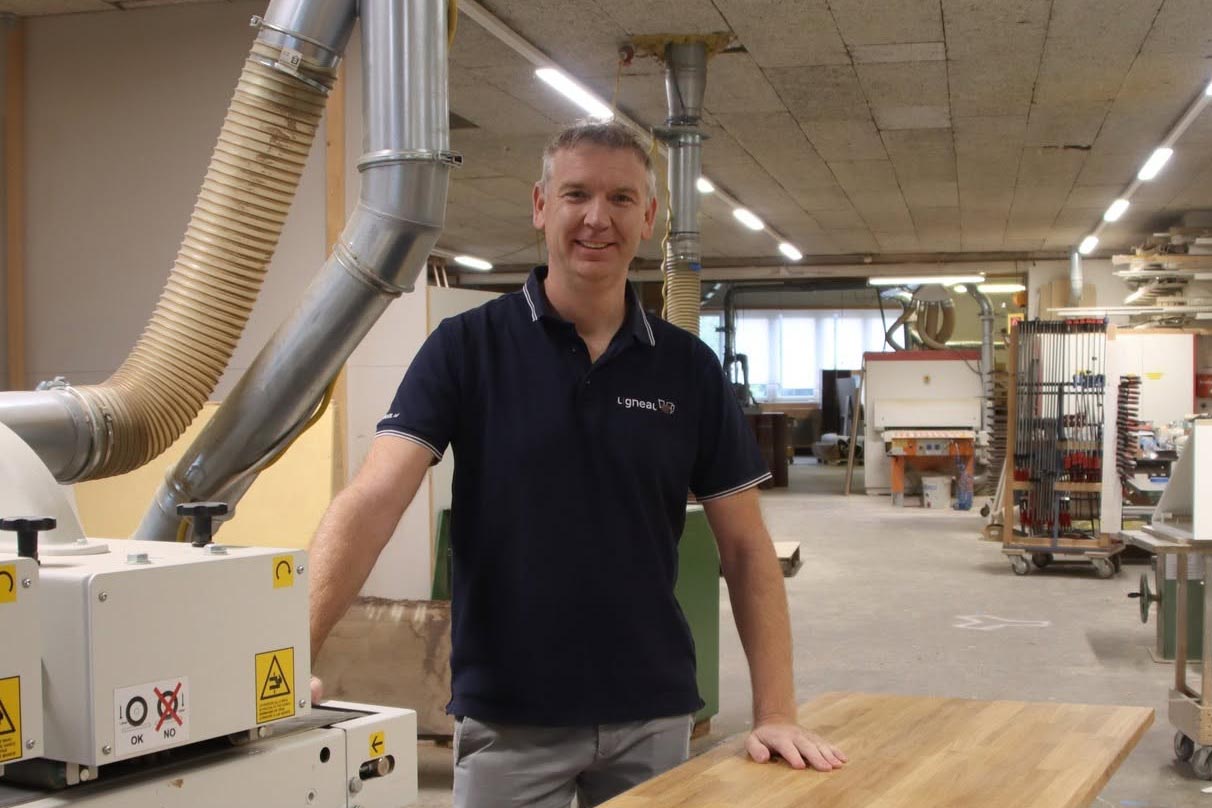
Rene Pecovnik answers these questions from a practical perspective: He comes from a Styrian carpentry and woodworking business—his father was a carpenter, and the company has been manufacturing furniture and interior design elements for decades. This led to the creation of the Hilma brand, which specializes in age-appropriate furnishings. For Hilma, Pecovnik has brought together expertise from the Styrian woodworking and medical clusters and recruited a healthcare professional to join the team—to gain a precise understanding of which medical conditions entail which limitations and which design solutions address them.
In this interview, Rene Pecovnik explains why an age-appropriate kitchen should look just like a regular kitchen, what can already be done affordably today—and why he doesn’t consider the bathroom to be the most important room.
SBC: Mr. Pecovnik, you place great importance on ensuring that your solutions do not look “age-appropriate.” Why is that?
Pecovnik: Because no one wants an apartment that looks like it’s designed for people who need care. As soon as something looks like a hospital, everyone resists it—it makes you feel sick and in need of care yourself. That’s why our goal is for an age-appropriate kitchen to simply look like a beautiful, modern kitchen. The functionality is there, but the limitations aren’t the focus.
The great thing is: When it’s done right, it even becomes a selling point. People love to show it off—“look what my kitchen can do”—just like how you show off all the features of a new car. That’s exactly the direction we want to go in. The focus isn’t on the appliance itself, but on comfort and design. And if someone doesn’t want to show it off, you simply can’t tell. Both options need to be possible.
SBC: Which room is most important for an age-friendly home? In your opinion, where should one start when dealing with physical limitations?
Pecovnik: The bathroom is indeed an area where many accidents happen—no question about it. But at the same time, it’s the room where people spend the least amount of time. You wash up and then leave. Furthermore, the market already offers a relatively good selection of products for making bathrooms accessible or age-appropriate.
That’s why we focus primarily on the rooms where life takes place: the kitchen and the living room. That’s where people spend their whole day, and that’s where they move around. And the kitchen, in particular, is crucial—not just for safety, but for independence. When cooking is easier, people do it longer. And those who stay active remain fit, agile, and mentally sharp for longer. The generation now entering retirement grew up cooking for themselves. Maintaining that ability for as long as possible is incredibly valuable.

An age-friendly kitchen doesn't have to have that "hospital" feel: Height-adjustable cabinets and countertops, as well as sliding countertops that can be accessed by a wheelchair, make cooking easier even for those with physical limitations. (Credit: Hilma)
The interior of the cabinet slides down at the push of a button (Credit: Hilma)
Wall Cabinet Lift: The entire cabinet lowers at the push of a button (Credit: Hilma)
SBC: What does that mean specifically—what solutions are available for the kitchen?
Pecovnik: Much of it is unspectacular, and that’s precisely why it’s effective. A stove monitor with an automatic shut-off feature, for example: By the way, this also sells well to younger families because it gives them peace of mind when their children or grandchildren are alone in the kitchen. Then there are height-adjustable work surfaces, a sliding countertop you can sit on, or base cabinets that can be removed so you can slide a built-in seating aid—or, later on, a wheelchair—underneath.
Wall-mounted cabinet lifts—where the cabinet comes down at the push of a button—are very popular; our customers love showing these off to their guests. They also feature ergonomic handles that are easy to grip and matte rather than reflective surfaces. Some people with dementia no longer recognize their own reflection as themselves and may react with confusion. Good lighting is important because vision deteriorates with age, and small details—such as an outlet that automatically ejects the plug with just a light touch when hand strength wanes—are helpful in everyday life. And if a grab bar is necessary, it should be made of wood and designed to blend in as a decorative element. You’d hardly recognize it as a grab bar, but it provides a secure grip.
SBC: You say people should prepare as early as possible. What do you mean by that?
Pecovnik: There are basically two situations. One is an immediate concern: In that case, we take a close look at what limitations exist and find the best solution for the moment. The other is the proactive approach—and that’s particularly important to me. The best time is often during the last major renovation, when you’re retiring. That’s when you build in the essentials right from the start: sufficient space to move around, removable elements, and a subframe prepared for future grab bars.
It costs almost nothing right now, but saves you from expensive renovations later on. Here’s an example: If you’re renovating anyway, you should have empty conduits and a network cable installed at the same time. Then, later on, you can easily retrofit sensors—such as those for fall detection. I’m a fan of wired solutions because wireless solutions are prone to issues in everyday use: As soon as the Wi-Fi network or provider changes, all components suddenly have to be reconfigured. Planning ahead means setting things up out of sight, so that when the need arises, the most time-consuming part is already taken care of.
SBC: What solutions are available for other rooms—such as living rooms, bedrooms, entryways, and foyers?
Pecovnik: In the living room, for example, we use an ergonomic sofa with a built-in, height-adjustable, electric stand-up assist. The sofa looks completely normal, but it makes getting up much easier. It’s just as important to remove hazards: Before I sell someone a fall detection system, I go through the apartment with a checklist and remove anything you could trip over—loose rugs, sharp edges, door thresholds. If you don’t fall, you don’t need fall detection.
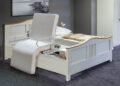
In the bedroom, it’s often very simple things: raising an existing bed to a comfortable height—which takes very little effort—a sturdy nightstand, and enough space next to it. A bedside light with a motion sensor that illuminates the path to the bathroom as soon as your foot touches the floor. That way, no one has to fumble in the dark for the light switch, which prevents many falls.
We’ve developed a multi-page home consultation checklist for the entire house—from the front door to handrails on stairs and ramps, all the way to the kitchen, living room, bedroom, and bathroom. We visit our clients, take a look at everything, and solve many challenges through our craftsmanship alone.
Retractable Clothes Rod (Credit: Hilma)
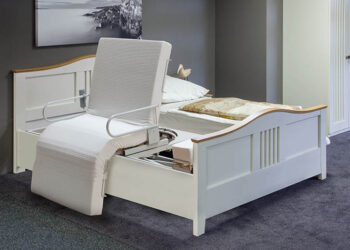
It doesn't always have to be a traditional nursing bed—there are alternatives (Credit: Hilma)
Examples of adjustments for the bedroom: Raise the bed to a comfortable height; install a bedside light with a motion sensor. (Credit: Hilma)
SBC: How do you see the coming years—specifically in terms of sensor technology, AI, and robotics?
Pecovnik: We’re heading into a period of skilled labor and resource shortages, and the baby boomers are currently retiring. Sensor technology—and later robotics as well—will play a role in this. In Europe, much of this is still unclear, but the potential is there. What’s important to me is the direction: These systems should support, not replace. It doesn’t make sense to automate everything.
The goal remains a self-determined life—being able to cook for oneself, stay active, and remain engaged for as long as possible. Because those who stay physically fit and agile also stay mentally sharp longer. The robot or sensor should take over tasks where necessary and, ideally, be integrated in a modular way—not take over one’s life. And it has to be affordable; otherwise, it won’t help the very people who need it most.
SBC: What are your hopes for the future?
Pecovnik: Two things: First, a different view of aging. Today, the film and advertising industries naturally depict a diverse range of people—different skin colors, including people in wheelchairs. Age and age-related needs should be portrayed just as realistically: not as something foreign or negative, but also not just as the eternally young, agile senior woman from the commercials. These images are deeply ingrained in people’s minds, and changing them is a societal task, not a purely political one.
Second, simple, reliable funding for age-appropriate home renovations. There have been straightforward grants for thermal insulation or heating system replacements—but nothing like that exists for accessibility. It doesn’t necessarily require more money, but rather funds that are better distributed and more easily accessible.
In Germany, this is easier because uniform guidelines apply nationwide; in Austria, funding varies from state to state, and often you can’t even get a clear answer as to whether a renovation is eligible for funding. My concern is that, in the end, only those who have money will be well taken care of. That’s why I deliberately focus on simple, affordable solutions—so that everyone can do something, regardless of their budget.
Thank you very much for the interview!
The Hilma brand emerged from a Styrian carpentry and woodworking business and specializes in age-appropriate and accessible furnishings—from forward-thinking renovations to the discreet integration of existing technology into kitchens, living rooms, and bedrooms. For more information, visit hilma.at.
Author: Anja Herberth
Chefredakteurin