• de Deutsch
  • en English
Smart Buildings Compass
  • Home
  • Living
  • Building & Renovation
  • Everyday aids
  • Care
  • Dementia
  • Health
  • Finance & Planning
No Result
View All Result
  • Home
  • Living
  • Building & Renovation
  • Everyday aids
  • Care
  • Dementia
  • Health
  • Finance & Planning
No Result
View All Result
Smart Buildings Compass
No Result
View All Result
Home everyday aids & technology

How can a rotating toilet support independence in the bathroom, Veronica Silden Orth?

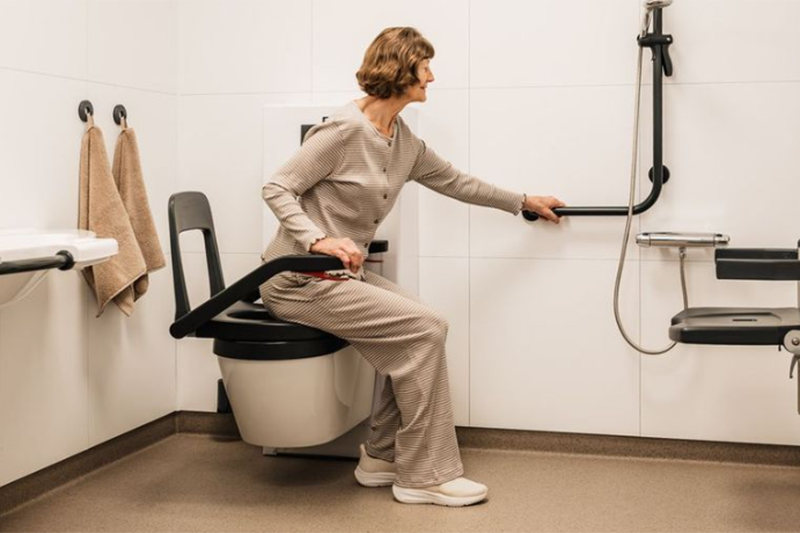
The rotating toilet by Bano (Photocredit: Bano)

The rotating toilet by Bano (Photocredit: Bano)

Whether someone can continue to live at home often comes down to the bathroom. Needing help with using the toilet means giving up a large part of one’s privacy, and for family members and care staff, transferring a person from a wheelchair is one of the most physically demanding tasks of the day.

Norwegian manufacturer Bano has developed a toilet that can be rotated towards the user, towards the washbasin or into the most suitable position for a transfer. In this interview with us, Veronica Silden Orth, Country Manager Norway, explains who the solution is suitable for, what to consider when retrofitting it in an existing bathroom, and what we can learn from Norways approach to demographic change.

You might also be interested in

How voice-activated devices can help us as we age—here, the Amazon Echo Dot (Credit: Amazon.com)

“Alexa, what time is it?”: How voice assistants can help in everyday life

16. September 2026
Our interview partner: Axel Albrecht, Managing Director of Assisted Home Solutions. Credit: Assisted Home Solutions

Care at home: What new solutions are needed, Mr. Albrecht?

23. April 2026
Assistance solutions are very unobtrusive and can be seamlessly integrated into a home. Credit: WOQUAZ Weiterstadt

More safety, more overview: Why digital assistance systems are becoming relevant now

22. March 2026
Credit: Navel Robotics GmbH

Robotics in care: When technology creates proximity

19. October 2025
What you will learn in this interview:
  • how the rotating toilet works in everyday life,
  • who it is suitable for and where its limits are,
  • what matters when retrofitting it in an existing bathroom, and
  • what Norwegian municipalities do differently when planning care facilities.
About our interviewee

Veronica Silden Orth is Country Manager Norway for Bano, a manufacturer of solutions for accessible bathrooms that also designs bathrooms for nursing homes and care facilities in Norway.

Header SBC English

Learn more about Bano: https://banoconcept.com

Photocredit: Bano

SBC: Using the toilet is one of the most personal moments in daily life. When older people increasingly need help with it, this changes their lives and those of their relatives. Which everyday challenges led to the development of the rotating toilet?

Silden Orth: We all want to remain independent for as long as possible. The bathroom can often be the deciding factor in whether a person can continue living independently at home or needs to move into a care facility. With the rotating toilet, our goal was to make everyday life easier and help people stay independent in their own homes for longer, without needing assistance from others.

One of the main challenges we also wanted to address was the physical strain placed on care staff when assisting people with transfers to and from the toilet. In traditional bathrooms, caregivers often need to help users turn, reposition and transfer, sometimes in very limited spaces. We wanted to make these everyday situations easier, safer and less physically demanding for everyone involved.

SBC: For which physical limitations is the rotating function particularly helpful, and what do users need to be able to do at a minimum to operate it safely?

Silden Orth: The rotating function is particularly beneficial for people with reduced mobility, limited walking ability, reduced muscle strength or difficulties turning and repositioning their bodies. For example, wheelchair users or people who rely on walking aids can benefit from having the toilet rotated into a position that makes transfers easier and more natural. To use the toilet independently, the person must have sufficient sitting balance, as well as the physical and cognitive abilities needed to operate it safely.

The rotating toilet also serves as an easily accessible and practical tool for care staff in their daily work. This means that people with more significant physical or cognitive limitations can also benefit from the solution, even when they depend on assistance from others.

The rotating toilet can also be rotated towards the washbasin, allowing the user to carry out personal hygiene activities while remaining seated. (Photocredit: Bano)
SBC: Could you describe with an example how the toilet is used in everyday life?

Silden Orth: Imagine an older person who uses walking aid, such as an rollator and needs assistance when going to the toilet. With a traditional toilet, the caregiver may need to help the person turn their body and reposition themselves during the transfer. This can be physically demanding for both the user and the caregiver.

With our rotating toilet, the toilet can instead be turned into a position that makes the transfer easier and more straightforward. Once the person is safely seated, the toilet can be returned to its normal position. The toilet can also be rotated towards the washbasin, allowing the user to carry out personal hygiene activities while remaining seated. This will reduce the need for transfers and heavy lifting. For the user, this can mean greater comfort, dignity and, in some cases, more independence.

By allowing caregivers to easily adjust the height and rotate the toilet, the need for heavy lifting and physically demanding transfers can be significantly reduced. Carers can work in better ergonomic positions, which reduces the risk of musculoskeletal injuries and may, over time, also contribute to less sick leave.

SBC: Where are the limits of the solution, for example with reduced strength, balance problems or dementia? And how do you prevent the seat from turning unintentionally during a transfer?

Silden Orth: If a person does not have sufficient sitting balance to sit safely on the toilet, a dedicated toileting chair or another suitable solution may be necessary, just as with a conventional toilet. For people with dementia or other cognitive challenges, independent operation may not always be possible. However, this does not mean they cannot benefit from the rotating function.

The seat can be particularly beneficial for people with dementia, where unnecessary physical handling may sometimes cause confusion, anxiety or distress. The rotating toilet allows caregivers to provide gentler, more comfortable care, helping the user feel calmer and more secure.

The rotation mechanism has locking positions at intervals of just a few centimeters. When the handle is held in, the toilet can rotate freely. The moment the handle is released, the rotation stops immediately and the toilet locks into position, preventing unintended movement during transfers.

SBC: Under which conditions can the toilet be retrofitted in an existing bathroom, and how much space is needed?

Silden Orth: One of the main advantages of the rotating toilet is the increased flexibility it offers in how a bathroom can be designed and used. Traditionally, accessible bathrooms require considerable space around the toilet, both to allow care staff to assist users from different positions and to provide sufficient space for wheelchair users to transfer sideways onto the toilet.

Based on our experience in designing bathrooms for Norwegian nursing homes and care facilities, we have seen that functional bathrooms can be designed with an area of approximately 4–5 m², depending on the layout and individual needs.

However, the size of the bathroom is only one part of the equation. The positioning of the door, washbasin, shower area and grab bars is equally important. For example, we often recommend positioning the toilet so that it is clearly visible when entering the bathroom. This can make it easier for users to find their way, particularly at night or for people with cognitive challenges.

Retrofitting a rotating toilet into an existing bathroom requires an individual assessment of the available space, plumbing, wall construction, and technical installation requirements. Interestingly, we often find that existing bathrooms require fewer modifications than initially expected. Because the rotating toilet can reduce the space needed around the toilet compared to a conventional solution, it can offer significantly greater functionality within the existing bathroom layout, without the need for extensive renovations.

SBC: Norway is regarded as a pioneer in welfare technology. What do Norwegian municipalities and care providers do particularly well, and what could Germany and Austria learn from them?

Silden Orth: In Norway, we see a growing understanding that welfare technology is not simply about introducing new products, but about finding smarter ways to provide care while preserving the dignity and independence of those receiving it.

One thing I believe Norwegian municipalities do particularly well is involving healthcare professionals in the planning of new care facilities. After all, they are the ones who will be working with these solutions every single day! Rather than focusing on individual products, there is often a greater emphasis on how the entire bathroom can be designed to support both residents and care staff in different everyday situations.

We are also seeing an increasing awareness of the importance of good ergonomics and solutions that reduce physical strain on care staff. Qualified healthcare professionals are already a scarce resource, and providing modern, functional and well-designed care environments can also make it easier to attract and retain skilled employees. With an ageing population and growing pressure on healthcare services, I believe this way of thinking will become even more important in the years ahead.

My advice to other countries would be to involve care staff early in the planning process, take a long-term approach to residents’ needs, and consider how smart bathroom solutions can support greater independence and more efficient, comfortable care, while also ensuring a safe and supportive working environment for caregivers. Ultimately, good functional solutions are about making everyday life easier, safer and better, both for those receiving care and for those providing it.

Thank you for the interview!

What is a rotating toilet?

A rotating toilet can be turned towards the user, towards the washbasin or into the most suitable position for a transfer. This makes it easier to sit down and get up, and it allows personal hygiene at the washbasin while remaining seated.

Who is a rotating toilet suitable for?

It is particularly helpful for people with reduced mobility, limited walking ability, reduced muscle strength or difficulties turning their bodies, such as wheelchair users or people with walking aids.

To use it independently, a person needs sufficient sitting balance as well as the physical and cognitive ability to operate it safely.

Can people with dementia benefit from a rotating toilet?

Independent use may not always be possible, but people with dementia can still benefit, because care staff can assist with less physical handling. This can reduce confusion and anxiety and help the person feel calmer and more secure.

How is the toilet prevented from turning during a transfer?

The rotation mechanism locks at intervals of a few centimeters. The toilet only turns while the handle is held in and locks into position as soon as the handle is released.

Can a rotating toilet be retrofitted in an existing bathroom?

Yes, after an individual assessment of space, plumbing, wall construction and technical requirements.

According to Bano, existing bathrooms often need fewer modifications than expected, and functional bathrooms in Norwegian care facilities have been designed with around 4 to 5 m².

Anja Herberth
Author: Anja Herberth

Tags: Assistive technology & systems
Previous Post

Death and Goodbyes: What conversations should families have ahead of time, Barbara Rolf?

Related Posts

How voice-activated devices can help us as we age—here, the Amazon Echo Dot (Credit: Amazon.com)
everyday aids & technology

“Alexa, what time is it?”: How voice assistants can help in everyday life

16. September 2026
Our interview partner: Axel Albrecht, Managing Director of Assisted Home Solutions. Credit: Assisted Home Solutions
everyday aids & technology

Care at home: What new solutions are needed, Mr. Albrecht?

23. April 2026
Assistance solutions are very unobtrusive and can be seamlessly integrated into a home. Credit: WOQUAZ Weiterstadt
everyday aids & technology

More safety, more overview: Why digital assistance systems are becoming relevant now

22. March 2026
Credit: Navel Robotics GmbH
everyday aids & technology

Robotics in care: When technology creates proximity

19. October 2025
So sieht EASEE, der intelligente Taktgeber für das Gehirn, bei Epilepsie aus. Credit: Precisis GmbH
Health & Prevention

Brain stimulation: How AI enables new treatments for neurological diseases

25. August 2025
One of the consequences of smart assistance technology: users were able to sleep better. Credit: Shutterstock
everyday aids & technology

“I feel safe – even when I’m alone.”

16. June 2025

Leave a Reply Cancel reply

Your email address will not be published. Required fields are marked *

  • English

.

loader

Newsletter

What tools and concepts are available for senior living, care and support - and where can they be found? Our newsletter provides answers!

I accept the terms and conditions

Smart Buildings Compass

Made with care. For you.

Our research and interviews on safe and independent living in old age are written by our team with a great deal of energy and passion. We hope you enjoy reading them!

Do you need more information? If so, you are welcome to contact us at redaktion@sbc.co.at.

All rights reserved (2026).

  • English

Follow us

Instagram
  • Home
  • Subscribe to our newsletter
  • Glossary
  • About us
  • Contact
  • Marketing: Information for businesses
  • Download your 10 tips for independent, safe living in older age
  • Presentations & workshops for local authorities & nonprofits
  • Contact & Legal Notice
  • Disclosure Statement
  • Nettiquette
  • Data protection
  • General Terms and Conditions (GTC)

© 2026 by owl lab e.U. Wir navigieren Wandel.

We use cookies on our website. Some of them are essential, while others help us improve this website and your experience.
Cookie SettingsAccept All
Manage consent

Privacy Overview

This website uses cookies to improve your experience while you navigate through the website. Out of these, the cookies that are categorized as necessary are stored on your browser as they are essential for the working of basic functionalities of the website. We also use third-party cookies that help us analyze and understand how you use this website. These cookies will be stored in your browser only with your consent. You also have the option to opt-out of these cookies. But opting out of some of these cookies may affect your browsing experience.
SAVE & ACCEPT
No Result
View All Result
  • Home
  • Home & Living
  • Everyday Aids & Technology
  • Care & Relief
  • Dementia & Health
  • Download: 10 tips
  • Find a solution
    • Special Feature: Age-friendly Construction & Renovation
    • Dementia
    • Crisis-resilient caregiving household
  • English

© 2026 by owl lab e.U. Wir navigieren Wandel.

Safe & independent living in old age

27 pages of tips for independent, safe living in old age—download now!

Download our PDF with tipps now!
loader

Email addresse*
I accept the privacy policy and agree that SmartBuildingsCompass.com may contact me beyond this request to send me its regular newsletter. I can unsubscribe at any time.