Friday, April 24, 2026
  • en English
  • de Deutsch
SmartBuildingsCompass
Header SBC English
  • Home
  • Housing
  • Everyday aids & Technology
  • Dementia & Health
  • Care & Relief
  • Download: Housing Tips
  • Topic search
    • Dementia
    • Tools & Solutions
    • Constructing & Renovating
    • Crisis-resilient caregiving household
    • Stay healthy
No Result
View All Result
  • Home
  • Housing
  • Everyday aids & Technology
  • Dementia & Health
  • Care & Relief
  • Download: Housing Tips
  • Topic search
    • Dementia
    • Tools & Solutions
    • Constructing & Renovating
    • Crisis-resilient caregiving household
    • Stay healthy
No Result
View All Result
SmartBuildingsCompass
No Result
View All Result
Home About us

Care at home: What new solutions are needed, Mr. Albrecht?

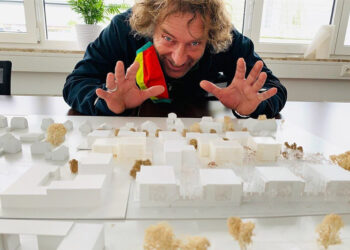
Our interview partner: Axel Albrecht, Managing Director of Assisted Home Solutions. Credit: Assisted Home Solutions

Our interview partner: Axel Albrecht, Managing Director of Assisted Home Solutions. Credit: Assisted Home Solutions

Dieser Beitrag ist auch verfügbar auf: Deutsch

Nursing homes are very expensive, especially in Germany, and the number of care beds is falling. There is a lack of staff and the costs are very high, even for minimal care. At the same time, we are ageing as a society: The proportion of people 65+ in Germany and Austria is around a fifth of the population – and rising to a quarter. And there is also a shortage of home care workers: In many regions – especially in rural areas – there is a lack of these structures. There is no alternative to care – so what to do?

We spoke to expert Axel Albrecht: He runs the WoQuaZ residential quarter center in Weiterstadt (Germany) and is Managing Director of Assisted Home Solutions, which developed the LISA digital assistance system. He works intensively on the question of how people can live independently at home for as long as possible – and still receive the help they need to live safely and comfortably.

In this interview, he explains why rapid assistance after a fall determines quality of life and the need for care, why an emergency button alone is not enough – and why so-called virtual care homes could be the answer to the major challenges.

Header SBC English
SBC: Mr. Albrecht, why has the issue of “staying at home in old age” become so urgent?

Albrecht: Nursing homes are really expensive – the personal contribution in Germany varies greatly depending on the federal state and the facility, ranging from around 2,900 euros to over 4,500 euros per month. Many people don’t have that money, and there simply aren’t enough beds available.

At the same time, the proportion of older people in our society is growing rapidly. There are currently almost 5.7 million people in need of care in Germany – 86% of whom are cared for at home. The pressure on the system is increasing incredibly. We used to have around one percent of people moving into a care home every year – we are now heading towards two percent. But the number of beds has not increased. On the contrary: Look at how many care homes have closed in recent years due to a lack of money and skilled staff.

SBC: To summarize: The demand for care is increasing, but the supply is not keeping pace.

Albrecht: And that is dramatic because there is no alternative to care and support. Often it’s not 24-hour care that’s needed, but individually adapted everyday support. The biggest challenge is that we live in buildings that are full of barriers and obstacles. There simply aren’t enough age-appropriate apartments. The figures clearly show: Germany currently lacks 2.2 million apartments suitable for senior citizens. There are just 600,000 apartments suitable for people with walking frames or wheelchairs – with a predicted demand of 3.3 million by 2040.

The result: People go into care homes without having any real need for care. According to German care statistics, around 50 percent of nursing home residents only have care level 2. They could stay in their own homes for a long time and would only need support and safety offers. We assume that around three quarters of care home admissions could be avoided. There is simply not enough support in the neighborhoods, i.e. at home. That’s why we also offer neighborhood management – in other words, support in everyday life.

And then there needs to be the certainty that someone will receive help within 30 minutes after a fall. This determines the need for care and the quality of life of an elderly person.

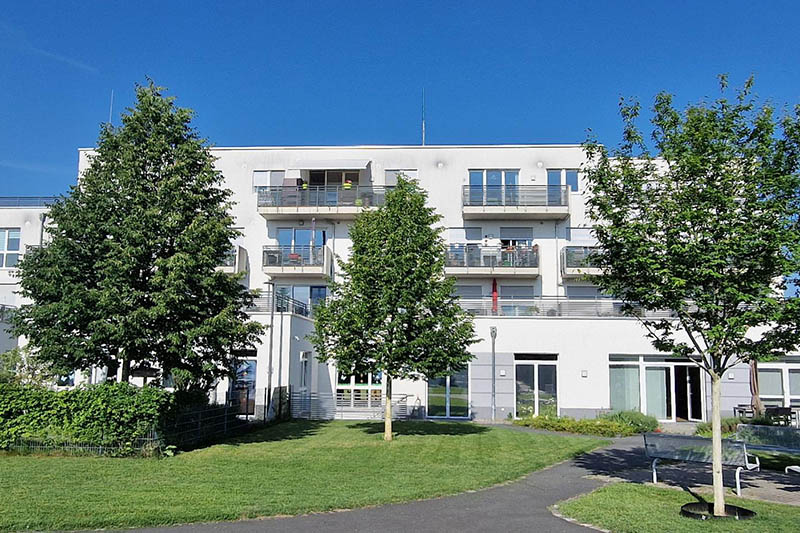
The Wohnquartierzentrum in Weiterstadt: CEO Axel Albrecht and his team are testing the newly developed solutions for care and relief in this senior citizens' residence. Credit: Woquaz
SBC: Could you explain that in more detail – what happens if someone falls at home?

Albrecht: A fall is often the turning point. The crucial number is 30 minutes. If I’m not found within 30 minutes after a fall, I become a nursing case. That doesn’t just apply to a fall – but also after a heart attack or stroke.

And this is precisely the problem with the classic home emergency call: After a stroke, I cannot press the button. And many people don’t even have it with them or forget that they could press it in an emergency. Sometimes there are only fixed buttons – if such a button is not nearby in an emergency, it is of no use to me. So we need solutions that automatically call for help – without me having to do anything myself. This is exactly what modern assistance systems do. The home as a safe space is reliable, unlike individually worn watches that you forget to wear or charge.

Accessibility reduces the risk – but even in an accessible home, people fall. The real question is: What happens if it happens anyway? Who will find me? And when?

SBC: How can this protection be created – and how does your concept actually work?

Albrecht: Imagine a residential building – often from the 1950s, full of barriers, without an elevator. Many people have had their tenancy agreements there for 60 years. On average, the residents in these estates are twice as old: The proportion of people over 65 is twice as high as in the population. When older residents die, younger ones follow, and the older ones become lonely. We can see that there are around 40 to 60 residents per 300 apartments in these housing estates who need real support.

Above all, these people need everyday support – adapted to their individual needs. This is exactly what a community nurse can provide: A specialist who coordinates, mediates and supports in this housing estate without everyone having to go into a home straight away. Despite this support, only a minimal proportion of one or two percent of these people need a nursing home. The rest can remain living at home with appropriate support.

SBC: How does a virtual care home work – and what role does technology play in this?

Albrecht: The virtual care home combines three components. Firstly, we use existing buildings in the neighborhood – people stay in their familiar surroundings instead of moving into a new building. Secondly, we rely on digital assistance systems: Our LISA system automatically detects falls and activity patterns – without a camera and with the highest level of data protection. All data remains in the home and is only communicated to the outside world when help is needed. The home becomes a “caring home” – another player in the care infrastructure.

In addition to the fall sensors, which call for help in an emergency, our assistance systems evaluate activity patterns and let you know if there are any deviations – in other words, if your everyday skills deteriorate. They function as a silent early warning system that calls for help before a crisis arises. Intervening early and reacting quickly to negative developments avoids a great deal of suffering and medical costs. The home emergency call cannot do this, because it is there for emergencies and not for proactive help.

And thirdly, this is where the caring community comes into play: We work with platforms such as Hub4Help and connect volunteers, care services and communities with everyday help needs. This creates a social network as an important condition for self-determined living. I would like to emphasize: Our technology helps people to stay in touch, but also to get targeted support.

The result is demonstrated by our reference location WoQuaZ in Weiterstadt: While the national average for assisted living is still at six percent per year, we have achieved a move-in rate in care homes of just one percent per year in twelve years. People live with us in a high level of comfort and security because we offer individual help and care with and via technology without expensive standby costs.

SBC: An objection I often hear about technology: I don’t want to have data collected.

Albrecht: For precisely this reason, we work with concepts that take these objections very much into account. For one thing, we work with radar sensors – not cameras. Our systems process point clouds, not image material. Secondly, everyone involved can decide for themselves what happens to the data. Our systems are also suitable for running completely locally in the home – without passing on data. In an emergency, LISA simply ensures that help is called quickly.

So I understand the objections, but I have seen so much suffering that could have been avoided with our technology. In our residential quarter center in Weiterstadt, the residents can no longer imagine everyday life without our solutions. That’s our advantage: We test new approaches with our residents and get unfiltered feedback very quickly if something doesn’t fit. As a result, we also have a very high acceptance rate – because we developed LISA together with those affected.

Our systems work in the background like a safety net – and local authorities are slowly realizing that this is exactly what is needed. We can’t help people with support needs sufficiently with old solutions. The old care concepts are simply no longer sufficient.

SBC: What needs to change politically and structurally for this model to have a broad impact?

Albrecht: We need to rethink on several levels. The federal and state governments must massively expand funding for senior-friendly housing – the current KfW 455-B budget of 150 million euros (funding in Germany) is too small by at least a factor of three. The money must be in line with demand – and at a time when 86% of people are supported at home, that demand lies in local, neighborhood-based assistance.

In times of a shortage of skilled workers and money, this local infrastructure is an inexpensive and at the same time highly effective response to one of the most pressing social issues of our time. And one thing should be clear to us all: If families are left alone when it comes to care, if help is lacking and support is not forthcoming, then populists will seek out precisely this issue. Care hits families right in the heart – emotionally, financially, in everyday life. Those who ignore this give the stage to others.

We need to be open to new concepts. For solutions that work despite the lack of money and skilled workers, that really support families and ensure security and a high quality of life in old age. The technology and concepts for this already exist. What is missing is the political will to implement them across the board. The problem we used to have with childcare is now a problem with care for the elderly.

Caring at home is mainly done by women – with all the consequences: Financial losses, a higher risk of poverty in old age and physical and mental overload are often the result when work, everyday life and care have to be managed at the same time. Women, like men, belong in society and not at the stove, looking after children or the elderly – we can no longer afford the family structures of the 1950s.

Thank you very much for the interview!

Axel Albrecht is Managing Director of Assisted Home Solutions GmbH and head of the residential quarter center WoQuaZ Weiterstadt. More information at assistedhome.de and woquaz.com.

Anja Herberth
Author: Anja Herberth

Chefredakteurin

Previous Post

Living together, the right way: The power of effective matching

Related Posts

Construction: Focus on renewable technologies
About us

Construction: Focus on renewable technologies

17. October 2023
Barrier-free living
About us

Why we care

15. September 2023
Subscribe to our newsletter
About us

Subscribe to our newsletter

21. June 2022

Leave a Reply Cancel reply

Your email address will not be published. Required fields are marked *

  • Deutsch
  • English

.

loader

Newsletter

What tools and concepts are available for senior living, care and support - and where can they be found? Our newsletter provides answers!

I accept the terms and conditions

Recent News

Our interview partner: Axel Albrecht, Managing Director of Assisted Home Solutions. Credit: Assisted Home Solutions

Care at home: What new solutions are needed, Mr. Albrecht?

23. April 2026
To many people, communal living arrangements sound like a nice idea at first. But there is often a long way to go between a good idea and a viable project.  (Credit: bring-together.de)

Living together, the right way: The power of effective matching

11. April 2026
Interview: Interior designer Melanie Mikalauskas, who works intensively on the interplay between dementia, perception and the living environment. Credit: Melanie Mikalauskas

When rooms confuse: What a dementia-friendly home needs

10. April 2026
Small solution, big impact: Ramps create more independence in everyday life. Credit: ALTEC

Ramp instead of retreat: How small solutions open up big paths

10. April 2026
Our interview partner: Austrian rheumatologist and immunologist Prof. Dr. Josef Smolen. He led the international working group of 50 experts to update the treatment recommendations for rheumatoid arthritis. (Credit: MedUni Vienna/feelimage)

New therapy recommendations for rheumatoid arthritis

10. April 2026
SmartBuildingsCompass

Made with care. For you.

Our research and interviews on safe and independent living in old age are written by our team with a great deal of energy and passion. We hope you enjoy reading them!

Do you need more information? If so, you are welcome to contact us at redaktion@sbc.co.at.

All rights reserved (2025).

  • Deutsch
  • English

Follow us

Instagram
  • Home
  • Subscribe to our newsletter
  • Glossary
  • About us
  • Contact
  • Marketing: Information for businesses
  • Download your 10 tips for independent, safe living in older age
  • Presentations & workshops for local authorities & nonprofits
  • Contact & Legal Notice
  • FAQs
  • Disclosure Statement
  • Nettiquette
  • Data protection
  • General Terms and Conditions (GTC)

© 2025 by owl lab e.U. Wir navigieren Wandel.

We use cookies on our website. Some of them are essential, while others help us improve this website and your experience.
Cookie SettingsAccept All
Manage consent

Privacy Overview

This website uses cookies to improve your experience while you navigate through the website. Out of these, the cookies that are categorized as necessary are stored on your browser as they are essential for the working of basic functionalities of the website. We also use third-party cookies that help us analyze and understand how you use this website. These cookies will be stored in your browser only with your consent. You also have the option to opt-out of these cookies. But opting out of some of these cookies may affect your browsing experience.
SAVE & ACCEPT
No Result
View All Result
  • Home
  • Housing
  • Everyday Aids & Technology
  • Care & Relief
  • Dementia & Health
  • Download: Housing Tips
  • Topic search
    • Dementia
    • Tools & Solutions
    • Constructing & Renovating
    • Crisis-resilient caregiving household
    • Stay healthy
  • Deutsch
  • English

© 2025 by owl lab e.U. Wir navigieren Wandel.

Safe & independent living in old age

27 pages of tips for independent, safe living in old age—download now!

Download our PDF with tipps now!
loader

Email addresse*
I accept the privacy policy and agree that SmartBuildingsCompass.com may contact me beyond this request to send me its regular newsletter. I can unsubscribe at any time.

Sicher & selbstbestimmt Wohnen im Alter!

27 Seiten Tipps für sicheres, selbstbestimmtes Wohnen im Alter - jetzt downloaden!

Jetzt gleich downloaden!
loader

Email addresse*
I accept the privacy policy and agree that SmartBuildingsCompass.com may contact me beyond this request to send me its regular newsletter. I can unsubscribe at any time.