Dieser Beitrag ist auch verfügbar auf:
Deutsch
It is often not the major barriers that suddenly make everyday life difficult. Sometimes a single threshold to the terrace, a small step in front of the house or a step on the balcony is enough to make a path less natural. For people who are dependent on a wheelchair or walker, this can determine whether they can remain active independently – or are dependent on help.
This is particularly noticeable now in spring: As it gets warmer outside, many people want to get outside more often. In the garden, on the patio or at least outside the house – it is precisely at times like these that it often becomes very clear where the home is no longer keeping up with everyday life.
We spoke to Raphael Zeller from ALTEC about what really matters when it comes to ramp solutions, why the 6 percent gradient often mentioned is not always realistic in practice – and why good advice in this area is almost as important as the product itself. Because a ramp is never just a piece of aluminum: at its best, it is a piece of everyday life that becomes possible again. And sometimes also the small difference between retreating or being able to take part in life outside again.
SBC: Mr. Zeller, in spring it is often particularly clear where a ramp is missing in everyday life, isn’t it?
Zeller: We are actually noticing this very clearly. In the middle quarters – from spring to fall – we see a noticeable increase in demand. When the birds start whistling outside again, many people or their supportive relatives want to get out into the garden, onto the patio or even outside the door again more easily. In winter, this question is often less acute because people don’t want to go out so quickly in the snow and cold anyway. But in spring, it suddenly becomes very clear what doesn’t work in everyday life – and that even a small threshold or a few steps can be a real obstacle.
SBC: What is the first thing someone looks for when searching for a suitable ramp?
Zeller: For me, it all starts with a very simple question: what height needs to be overcome? Whether it’s a step in front of the house, several steps to the terrace or just the height of a balcony threshold – this height is the basis for everything else. From there I derive the necessary length and the sensible gradient. Many people think of the product first, but you actually have to understand the specific situation first.
SBC: Many people quickly read about a 6 percent gradient when doing their research. What does that mean in practice?
Zeller: This 6 percent is an important benchmark, but you have to know where it comes from. In Germany, there is DIN 18040 for the public sector. It specifies how a wheelchair ramp should be designed. This 6 percent is so important because it is a value that a wheelchair user can usually manage themselves. This is therefore a sensible benchmark – but not automatically realistic for every private situation. There is often simply not enough space in the home. With just two steps, a ramp with a gradient of 6 percent can quickly become several meters long. And you often don’t have this space in front of a house, on a terrace or on a balcony.
SBC: Does that mean that you often have to think more pragmatically in the private sphere?
Zeller: Yes, exactly. I always say: six percent is a lofty goal. But in practice, you have to look at what is feasible on site. If I don’t have the space for such a long ramp, then I have to consider what gradient is still sensible and safe to use. In the private sector, we therefore often work with other values.
But at some point it becomes steep, uncomfortable and technically limited. That’s why it’s always about finding a solution that really works in everyday life – not just on paper.
SBC: What are the differences between wheelchairs, power wheelchairs and rollators?
Zeller: There are clear differences. If someone drives the wheelchair themselves, then we tend to be in the range of 6 to 10 percent, depending on how experienced the person is. With a pushed wheelchair, in many cases you can go up to around 15 percent. If an electric wheelchair is used, 18 to 20 percent is sometimes possible – although it has to be said: That’s quite steep.
Not every wheelchair can do this technically, and it is usually no longer comfortable for the person. With a rollator, you can move in a similar range to a pushed wheelchair. But here too, the specific person, the length of the ramp and support from a second person make a big difference.
SBC: So it’s not just the gradient that counts, but also the length?
Zeller: Exactly. The same incline feels completely different depending on its length. A short ramp with a noticeable gradient can still be manageable in everyday life. But if the same gradient goes over six meters, you notice it very quickly. That’s why it’s not enough to just look at percentages. I also always need to know: How long is the ramp? Who uses it? How often is it used? And is there someone there who can provide support? Only then does a guideline become a solution suitable for everyday use.
SBC: When is a ramp sufficient – and when do you need a lift?
Zeller: I like to put it like this: We stop where the lift starts – and the lift starts where we stop. Small differences in height, thresholds or a few steps can often be solved well with ramps. But if at some point I end up with a ramp length that no one can reasonably accommodate, then a ramp is simply no longer the right solution. Then you can get further with a lift solution.
In my view, lifts are not a competitor, but a complement. Nobody builds a lift for two steps. But if there are seven steps and I need a twelve-metre-long ramp, then you have to be honest: it no longer makes sense.
SBC: What does that mean for apartments and existing buildings?
Zeller: You have to take a very close look. You can often do more in a detached house with space in front of it than in an apartment, on a narrow balcony or in an old building with tight spaces. If there is a corner after two steps or the balcony is only one meter deep, this changes everything. That’s why blanket statements are of little help here. It’s always about the specific situation. This is precisely why photos and measurements are so important.
SBC: There is a wide range of ramp solutions. What should I look out for when ordering?
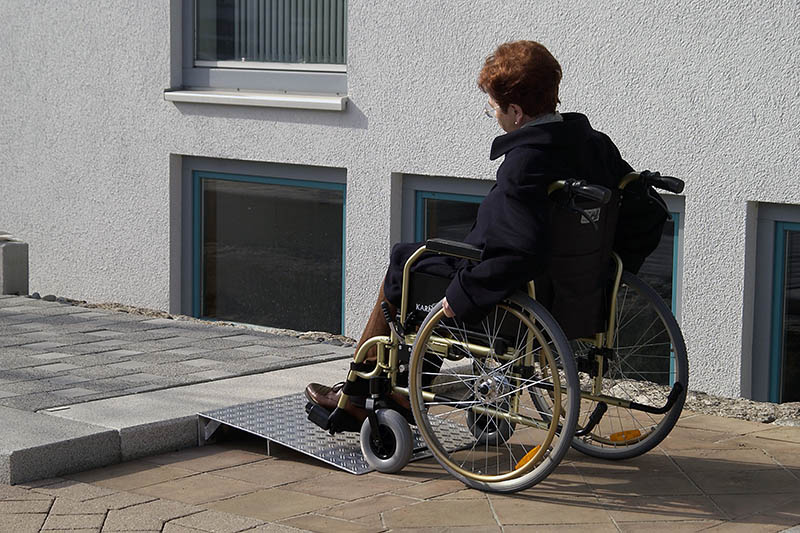
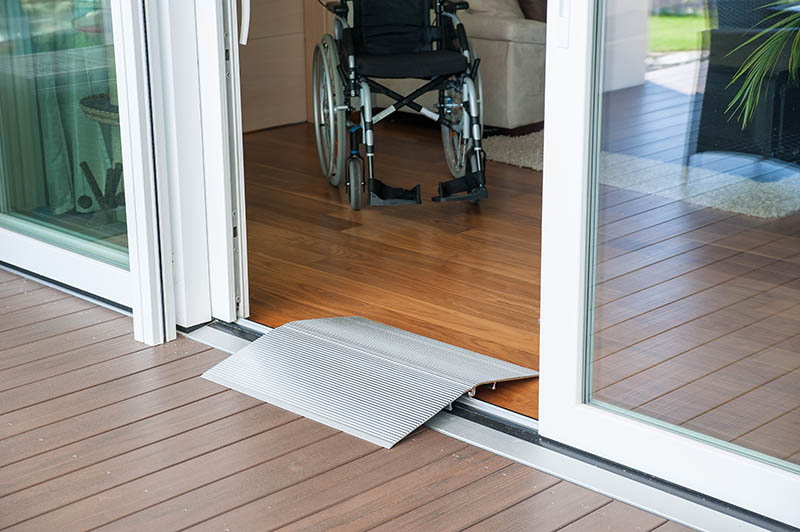
Zeller: We actually have a whole range of different solutions because everyday situations are very different. Many people first think of a larger ramp in the entrance area. In practice, however, it is often the small barriers that make everyday life more difficult: A patio threshold, a ledge by the balcony or a single step that is suddenly no longer so easy to manage. Such transitions can be very crucial, especially for people with a rollator or wheelchair. It is therefore important that there are different products for different situations.
We have a selection of products for very different heights, transitions and space conditions. This starts with small solutions for thresholds, balcony doors or patio exits and extends to longer ramps for several steps or more complex outdoor situations. There are also mobile, foldable or fixed versions – depending on what is needed on site.
Credit: ALTEC
Credit: ALTEC
Credit: ALTEC
Credit: ALTEC
Credit: ALTEC
SBC: The product range is broad, but the right choice is always individual.
Zeller: Ultimately, it’s not about the individual product, but about the question of what is really needed in everyday life. We always start with the situation: How high is the threshold? How much space is there? Who uses the ramp? Is it only used occasionally or every day? With doors, it can be important to be able to remove the ramp again quickly – for example, when I want to close the door again. The ramp should therefore not be too difficult to remove and should also be easy to store. Sometimes it also makes sense to leave a ramp in place for an entire gardening season.
The solution that makes sense depends on the situation. The breadth of the range therefore helps above all because requirements cannot be squeezed into a single scheme.
SBC: How does an order for private customers work?
Zeller: For private customers, orders are usually placed using structured inquiry forms. The most important details are entered there, such as length, width, height or the number of steps or the specific installation situation. On this basis, it is possible to check which solution is suitable – whether a standard product is sufficient or whether a customized version makes more sense.
If information is missing or something is unclear, we usually ask for it or discuss it over the phone. And if the dimensions indicate that a desired solution would be too steep or impractical for everyday use, this is also pointed out and a more suitable alternative is suggested.
SBC: What should I definitely prepare before placing an order?
Zeller: It’s best to provide as much information as possible. Photos help a lot, as do precise measurements, of course. How high is the threshold? How much space is there? What does the area in front of it look like? Is the ramp used with a rollator, wheelchair or power wheelchair? Is there an accompanying person? With information like this, you can assess many situations well. And if we notice that something is still missing, then we ask. It is particularly important that the information is accurate for a custom-made product, as the solution is made specifically for you. After all, we have nothing to gain if it doesn’t work in the end. And if something is not feasible, then we will tell you honestly.
SBC: So that means you should definitely seek advice.
Zeller: I would say that product selection and advice go hand in hand here. You don’t simply choose a ramp from a picture in a catalog. Situations are far too different for that. For me, good advice means looking together: What is available on site? What is realistic? What is safe? And what is actually useful in everyday life? It’s not about finding a theoretical solution, but one that really makes everyday life easier. And there is often a lot of pressure behind the requests we receive. A threshold is not just a detail, but a real problem.
SBC: Are there any subsidies for your products?
Zeller: Yes, in Germany there are definitely funding opportunities for such adaptations. Depending on the situation, the health insurance fund may be responsible for individual aids if a corresponding need is identified and the supply is approved. In addition, the care insurance fund plays a particularly important role: for so-called measures to improve the living environment, subsidies can be applied for if a care degree is available, currently in the order of around 4,000 euros per person.
Important: These funding opportunities relate to Germany. There are also subsidies in Austria, but they are regulated differently from region to region. In Vienna, for example, there are currently subsidies for age-appropriate conversions. It is therefore worth looking specifically in your own federal state to see which programs and requirements apply there.
SBC: What would you like to say to those affected and their relatives who are just starting to look for a solution?
Zeller: I would say: first take a close look at the situation and don’t order anything too hastily. Take measurements, take photos, get advice. It’s not about buying some ramp or other tool as quickly as possible, but about finding the right solution for your everyday life.
And sometimes it’s a ramp, sometimes it’s a different design and sometimes you have to be honest and say that you need a lift or a completely different solution. The decisive factor is that it works in the end – and doesn’t just look good.
Thank you very much for the interview!
Want to know more about the ramp solutions? Click here to go to ALTEC: altec.de.
Note: The company delivers throughout the DACH region and has partners in D, AUT and CH. The ordering and delivery modalities may therefore vary depending on which region you are based in.
Author: Anja Herberth
Chefredakteurin