Wednesday, January 14, 2026
  • en English
  • de Deutsch
SmartBuildingsCompass
Header SBC English
  • Home
  • Home & Living
  • Tech / Tools
  • Healthcare & Dementia
  • Care & Relatives
  • Download: 10 tips
  • Why we care
No Result
View All Result
  • Home
  • Home & Living
  • Tech / Tools
  • Healthcare & Dementia
  • Care & Relatives
  • Download: 10 tips
  • Why we care
No Result
View All Result
SmartBuildingsCompass
No Result
View All Result
Home Home & Living

Study on retirement provision 2026: The fear of the future

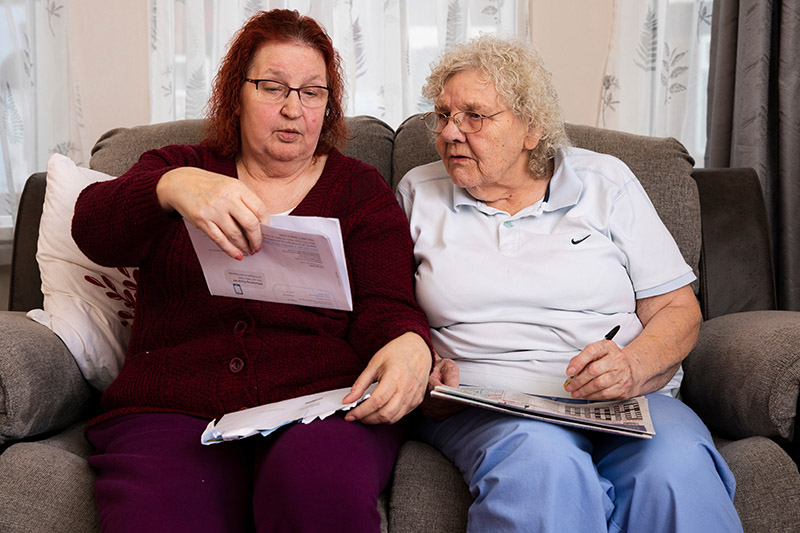
The pension study clearly shows that Austrians are very worried when they think about their pension - 40 percent rate their own risk of poverty in old age as high. Credit: Alexander Caminada/Ageing without limits

The study clearly shows that Austrians are very worried when they think about their pension - 40 percent rate their own risk of poverty in old age as high. Credit: Alexander Caminada/Ageing without limits

More and more Austrians are having doubts about a sufficiently high state pension: this is the mood of the new “Pension Study 2026”, conducted by IMAS International for Erste Bank/Sparkassen and Wiener Städtische. The topics of housing in old age, care and support are highly relevant – even if care itself is surprisingly low on the list of priorities. 1,000 people in Austria aged between 16 and 65 were surveyed.

Why we find this study so important:

It reveals a precautionary logic in which health, housing and financial security are at the top of the list – and at the same time it shows that many people are more concerned with this “in principle” than in concrete terms. People often only become aware of long-term care as a pension issue when it suddenly arises. Until then, people tend to avoid the topic – out of uncertainty, shyness and sometimes simply because there is no room for it in everyday life.

It is precisely in this gap that orientation can make a difference. Care needs can rarely be planned, but the conditions for how well you can deal with them can be influenced: by dealing with the housing situation in good time (e.g. accessibility and safety), by providing clear information at an early stage, by providing greater support for family caregivers – and by providing solutions that are suitable for everyday use and that do not have to be laboriously sought out at the moment of crisis, but can be found quickly.

Header SBC English
Financial provision “very” or “rather” important

First of all, the broad basic consensus is striking: financial provision is “very” or “fairly” important for 90% – a record high in recent years. At the same time, the study describes a growing uncertainty: three quarters of respondents do not believe they will receive a sufficiently high state pension later on. This is a significant increase compared to 2024, when 62% responded accordingly. This is explained by demographic pressure and geopolitical uncertainties. It is also pointed out that discussions about the financial viability of the pension system are noticeably eroding confidence.

This mood is also reflected in the fact that many respondents take a rather gloomy view of their future: 61% expect the economy and quality of life to deteriorate in the coming months. In this climate, provision is perceived less as a “luxury” and more as an attempt to create stability.

In terms of content, two topics clearly dominate: health and pensions. According to the press release, 67% are prepared to make private provisions for health and 61% for their pension. There is also a strong desire for a financial reserve in the event of a crisis (60%), followed by housing (55%) and family (50%). The topic of care ranks a distant second with only 27%.

Old-age poverty: major concern, classic countermeasures

The study shows how great the concern about poverty in old age is – and how unequally this concern is distributed between the sexes. As many as 39% rate their personal risk of being affected by poverty in old age as high. The proportion is higher for women than for men. On average, the 1,000 survey participants estimate the amount of their future gross pension at 2,023 euros per month. Men expect an average of 2,254 euros, women 1,748 euros. The pension gap in Austria remains as high as ever: On average, women receive almost 40 percent less pension than men. Financial security is a particular issue for the younger population group between the ages of 16 and 29, who think about their future financial security more often than they did 5 years ago.

Respondents see two main levers as plausible countermeasures to the threat of poverty in old age: making private provision as early as possible and providing more state support for private provision. 86% see early private provision as effective, while 77% would like to see greater state support for this. A high 63% of respondents assume that they will have to work in retirement in order to maintain their desired standard of living in old age.

Those who take precautionary measures often remain traditional: on average, EUR 225 per month is spent on private pension provision – despite the economic strain, this figure remains at a high level. At EUR 265, men invest significantly more than women at EUR 179. The most frequently used instrument is the savings account (51%), followed by life insurance (38%) and securities and fund savings plans (25%). For the first time in years, savings accounts are less in demand, while life insurance policies and securities & fund savings plans are becoming more popular. Just under half of Austrians in the age range surveyed have not yet taken out a pension or life insurance policy.

Another finding fits in well with the everyday lives of many people: planning security is lacking not only because of “system debates”, but also on a small scale. Only around half (51%) are aware of the current balance in their personal pension account; within this group, only around half are satisfied with their balance. This is an indication that although many people talk about pensions and are concerned, they are only partially aware of their own starting position.

You can find out more about the study here: https://www.wienerstaedtische.at

Anja Herberth
Author: Anja Herberth

Chefredakteurin

Previous Post

Emma Heming Willis: “The unexpected journey”

Related Posts

Bruges, West Flanders: With its Dementievriendelijk Brugge project, this Belgian city in the northwest of the country is demonstrating what active inclusion and quality of life in urban areas can look like. Photo: Shutterstock
Dementia

Bruges shows how it’s done: A city becomes dementia-friendly

3. July 2025
Free assistance service for boarding, changing trains, and alighting (at around 600 stations in Germany and 150 stations in Austria). Registration at least 24 hours in advance (by telephone or online). Credit: OEBB/Harald Eisenberger
Home & Living

Accessibility on vacation: How to travel safely and comfortably

3. June 2025
Hitze muss kein Risiko sein – wenn man weiß, wie man sich schützt. Wer frühzeitig Vorkehrungen trifft, auf Warnzeichen achtet und bei Bedarf moderne Hilfsmittel einsetzt, kann den Sommer auch im Alter genießen.  Credit: Shutterstock
Building & Renovating

Stay cool: How older people can get through the summer safely

27. May 2025
Remote monitoring
FAQs

Care and support in rural areas: Between challenge and opportunity

26. May 2025
Barrier-free living: Solutions for independent living
Building & Renovating

Barrier-free living: Solutions for independent living

7. April 2025
Senior living: How to maintain quality of life in old age
Building & Renovating

Senior living: How to maintain quality of life in old age

4. April 2025

Leave a Reply Cancel reply

Your email address will not be published. Required fields are marked *

  • Deutsch
  • English

.

loader

Newsletter

What tools and concepts are available for senior living, care and support - and where can they be found? Our newsletter provides answers!

I accept the terms and conditions

Recent News

The pension study clearly shows that Austrians are very worried when they think about their pension - 40 percent rate their own risk of poverty in old age as high. Credit: Alexander Caminada/Ageing without limits

Study on retirement provision 2026: The fear of the future

14. January 2026
The book "The unexpected journey" is a special kind of travel guide: For people who accompany a loved one with dementia. Book cover: Kailash

Emma Heming Willis: “The unexpected journey”

12. January 2026
The Picasso "Tête de Femme" (1941) - a gouache on paper, with an estimated value of around 1 million euros - will be raffled off. Credit: Picasso Estate, Paris, 2025

1 Picasso for 100 euros: A French idea that finances hope

12. January 2026
Community nurses are regional (health) caregivers who provide support so that people can remain healthy and independent at home for as long as possible. With the end of EU funding and despite a positive evaluation, the project is being reduced, restructured or discontinued in some federal states.  Credit: Shutterstock

Community Nursing: What happens when support and prevention become a source of savings?

20. November 2025
Sophie Rosentreter (right) with her mother Katrin and grandmother Ilse: "Grandma Ilse's" dementia is overwhelming the family. Today, Sophie Rosentreter is developing solutions for caring for and dealing with dementia. Credit: Katrin Schöning/Sophie Rosentreter

Care & dementia expert Sophie Rosentreter: “The heart does not become demented”

18. November 2025
SmartBuildingsCompass

Made with care. For you.

Our research and interviews on safe and independent living in old age are written by our team with a great deal of energy and passion. We hope you enjoy reading them!

Do you need more information? If so, you are welcome to contact us at redaktion@sbc.co.at.

All rights reserved (2025).

  • Deutsch
  • English

Follow us

Instagram
  • Home
  • Subscribe to our newsletter
  • Glossary
  • About us
  • Contact
  • Marketing: Information for businesses
  • Download your 10 tips for independent, safe living in older age
  • Presentations & workshops for local authorities & nonprofits
  • Contact & Legal Notice
  • FAQs
  • Disclosure Statement
  • Nettiquette
  • Data protection
  • General Terms and Conditions (GTC)

© 2025 by owl lab e.U. Wir navigieren Wandel.

We use cookies on our website. Some of them are essential, while others help us improve this website and your experience.
Cookie SettingsAccept All
Manage consent

Privacy Overview

This website uses cookies to improve your experience while you navigate through the website. Out of these, the cookies that are categorized as necessary are stored on your browser as they are essential for the working of basic functionalities of the website. We also use third-party cookies that help us analyze and understand how you use this website. These cookies will be stored in your browser only with your consent. You also have the option to opt-out of these cookies. But opting out of some of these cookies may affect your browsing experience.
SAVE & ACCEPT
No Result
View All Result
  • Home
  • Home & Living
  • Tech / Tools
  • Topic search
    • Topic: Orientation
    • Topic: Dementia
    • Topic: Building & Renovating
    • Topic: Healthcare
  • Local authorities & Nonprofits
  • Download: 10 Tips

© 2025 by owl lab e.U. Wir navigieren Wandel.

SMART LIVING IN OLD AGE BEGINS HERE!

Which concepts for senior living are on the market – and where can you find them? Our newsletter provides answers!

Sendinblue Newsletter
loader

Email addresse*
I accept the terms and conditions

HIER BEGINNT Smartes Wohnen im Alter!

Welche Konzepte für altersgerechtes Wohnen gibt es - und wo findet man diese? Unser Newsletter gibt Antworten! ​

Sendinblue Newsletter
loader

Email addresse*
I accept the terms and conditions