This article is also available in:
Deutsch
People who have loved to travel all their lives don’t want to give it up—even if their bodies are slowing down, they’ve started using a wheelchair or walker, or care and support have become part of their daily routine.
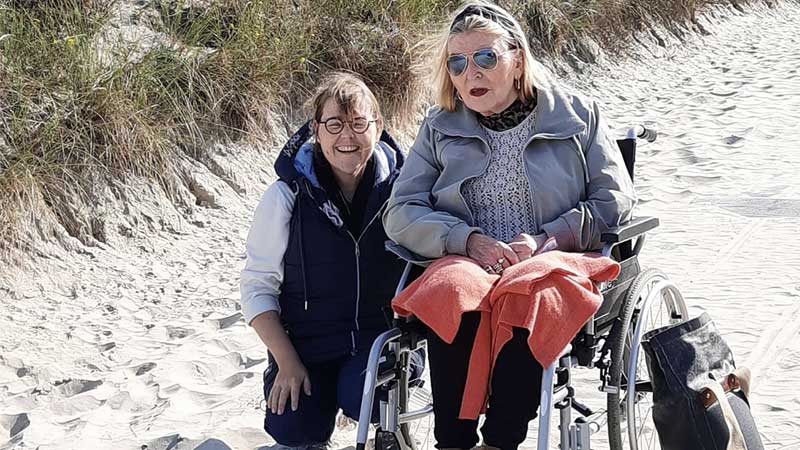
For years, Sonja Fröse has been accompanying people who require care on trips throughout Germany and Europe. A conversation about the unexpected resilience and zest for life found in travel groups—and why the tourism industry still fails to fully recognize one of the largest target groups of the coming decades.

SBC: Ms. Fröse, how did you get into accompanied travel for people who require care?
Fröse: Actually , it was a kind of exhaustion that led me to this. I worked in home care for years and at some point I was just worn down. Not by the people—but by the system. By the endless paperwork, the bureaucratic hurdles, the effort required for things that should really be so simple. If someone needs a contractor to install a ramp—it’s already a huge effort. If someone can no longer go to a furniture store to pick out an armchair—that involves a lot of effort. Often, people in need of care, seniors, or people with disabilities aren’t yet seen as clients. That burden often falls on family members and caregivers, who are already at their limit. And that wears people down over time.
And then I had my first opportunity to accompany a tour group. It was a completely different experience. You meet people in a beautiful setting, far from the daily grind, far from the challenges of everyday caregiving. And suddenly you experience everyday life on vacation with people who need care—their joys, wishes, and longings. They have a sense of humor; they want to experience new things.
It’s a whole new world in itself, and it’s been on my mind ever since.
SBC: What exactly do you mean when you say that you meet people “in a completely different way”?
Fröse: In outpatient care, you almost always see people in their most difficult situations. They’re stressed, pushed to their limits, and often living in a home that no longer suits their circumstances. You see the cramped conditions, the loneliness, and sometimes the resignation. When traveling, it’s completely different.
I remember a woman who had barely left the house in years. At the first dinner on the second day of the trip, she was cracking jokes. She was telling stories and laughing. I hadn’t seen that side of her before. People suddenly find joy in being able to control the speed themselves in an electric wheelchair. As a caregiver, you can’t even keep up.
And you see it time and time again: when the setting is right, when you get out into the world, when you see something new—that’s when people open up. Even those from whom you would never have expected it.
SBC: What criteria must be met in order to participate?
Fröse: We don’t have a rigid checklist, but we do have one basic requirement: Guests should be able to sleep in the hotel, even if they need assistance to do so. And they should be able to get around with assistance—at least with a walker or a wheelchair. What we can’t provide is round-the-clock intensive care that requires one-on-one assistance.
But what never ceases to amaze me is just how much is possible. Of course, the bus is equipped to accommodate wheelchairs and people with disabilities. But many people also board by climbing the steps—people you might have thought beforehand wouldn’t be able to manage it. That’s empowerment; that’s mobility.
SBC: What does a trip like this actually entail?
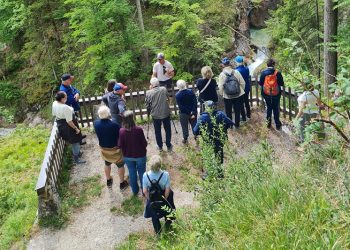
Fröse: We travel in small groups, usually with a staff-to-guest ratio of 1:3—one caregiver for every three guests. Anyone who needs more support can switch to a 1:1 ratio for an additional fee. There are also always people who need assistance at night—for example, to use the restroom; that happens. Officially, our day ends at 10 p.m., but if someone still needs something, we’re happy to help, of course.
The trips usually last between ten and fourteen days. Not because it takes us that long, but because the guests need time to arrive. One day for arrival, one day for departure, and then another day to settle in. And then there are still plenty of days left to really experience the place.
We have 93-year-olds with us who are taking a day off to sleep. Curtains closed, no activities, no outings. And I find myself thinking: I hope they aren’t disappointed because they’re missing out on something. The answer usually comes curtly and firmly: Nope. I’m sleeping now, and tomorrow I’ll be back in shape. That’s exactly what surprises me time and again—their serenity. We younger folks go on vacation wanting to experience everything and miss nothing. The older folks want that too, but for them it means something different. In other words: We cater to what each person needs.
This year we’re going to Usedom, the Black Forest, and Borkum. I’ve been to all three places before. But every trip is different anyway, because the group is different. Because the weather is different, because people have different days.

SBC: What are the advantages of a group trip over a solo trip?
Fröse: There’s a place for both. But in my view, working as a team offers key benefits for everyone involved. Firstly, safety: If something happens to someone, a colleague is there. If I’m having a bad day myself — and that does happen — there’s someone there to step in. That’s not weakness, it’s realism. We also split up according to our interests: I don’t cope too well with boating, but I do enjoy going to concerts or museums. Some of our colleagues aren’t too keen on that, so we make sure to share the tasks fairly.
Second: The human connection among the guests. What I witness every time is truly touching: the guests talk to one another. They share things they might not tell their families. Stories of their lives, losses, but also jokes and memories. And sometimes they encourage each other to do things they would never have told me. What a peer says just comes across differently sometimes.
Third, the more people who join the trip, the cheaper it gets. That’s no small matter these days.
SBC: Can family members come along?
Fröse: Absolutely —and that’s one of the most wonderful scenarios. I see many daughters and sons who would love to take their mother or father along, but are afraid of spending their entire vacation providing care. That’s a valid concern. Family caregivers are often already at their limit at home. A vacation is supposed to be a time of rest—for both of them.
On a guided group tour, that’s taken care of. Supervision is organized, and your daughter or son can take some time to themselves—go to a concert or sit alone by the sea for a couple of hours. And if someone wants to lend a hand—help out on the bus, cheer someone on—that’s welcome, but it’s not required.
What touches me every time is this: the older person is usually proud—their daughter or son is on vacation with me. That’s not something to be taken for granted, and these people know it.
SBC: If I want to book a guided tour, what should I look for when comparing offers?
Fröse: Pay attention to experience in traveling with people who require care; there are no established standards for these types of jobs yet. Many people in the social services field think this would be a dream job: traveling the world one-on-one with someone, seeing beautiful places, spending time by the sea. And yes, that’s part of it. But what’s often forgotten is that you need foreign language skills, solid first-aid training, basic knowledge of tourism, and above all, experience dealing with emergency situations—far from home, without your usual support network.
Even those with a background in caregiving don’t automatically have what it takes. Caregiving and assisted travel are two different fields. It requires specific training—and ideally a certain love of travel as well—because anyone who hasn’t traveled much will quickly feel uneasy in unfamiliar surroundings.
Reality can be harsh. On two occasions, I’ve had to take tour participants to a foreign hospital. A private hospital means you have to pay first and then receive treatment. That’s something you need to know and be able to handle. And it’s not covered in any nursing training program.
SBC: You say that a zest for life is a key pillar of aging. What do you mean by that?
Fröse: I believe that care and support aren’t the only things we should be talking about when it comes to aging. On average, people today spend over two decades in retirement. That’s not a short period—it’s an entire stage of life that needs to be lived and filled with meaning. For those who have loved to travel their whole lives, something is missing when that simply stops, because the tourism industry hasn’t really focused on this demographic yet. Only slowly are these new forms of tourism emerging that cater precisely to these needs.
I’m really saying this with the hotel and tourism industries in mind: there’s a huge group of people out there who have money, have time, and want to travel. And you often get two people for the price of one—the traveler and their companion. But for that to happen, hotels have to want these people to come. They need to be built to be accessible and design the breakfast buffet so that even someone with a walker can reach it. That sounds obvious, but it isn’t.
SBC: What is still missing—in terms of infrastructure, tourism, and society?
Fröse: A great deal. And sometimes it’s the simplest things that are missing. An accessible restroom in a museum. A bench to rest on in a supermarket. A menu in a readable font size. It sounds trivial, but someone who takes diuretics or is incontinent won’t go shopping if they don’t know whether a restroom is accessible along the way. They’ll send someone else or not buy anything at all. That’s exclusion from normal life.
SBC: What are your hopes for the future?
Fröse: That travel with care needs and disabilities becomes the norm. That people shouldn’t have to search to see if such options exist—but rather that assisted travel for those with care needs is just as commonplace as any other form of travel.
One of the companies I provide travel care services for has been in business for ten years. The first four or five years were all about building the business from the ground up. Sometimes only one person would come along; now it’s a surefire success in the region. This shows: It works. But it takes patience, and it takes visibility.
Thank you for the interview!
Sonja Fröse accompanies people with care needs and disabilities on group trips. For more information, visit froese@sonjafroese.de and sonjafroese.de
Author: Anja Herberth
Chefredakteurin