
Friday, July 3, 2026
  • en English
  • de Deutsch
SmartBuildingsCompass
Header SBC English
  • Home
  • Housing
  • Everyday aids & Technology
  • Dementia & Health
  • Care & Relief
  • Download: Housing Tips
  • Topic search
    • Dementia
    • Special Feature: Age-friendly Construction & Renovation
    • Tools & Solutions
    • Home & Living
    • Crisis-resilient caregiving household
    • Stay healthy
No Result
View All Result
  • Home
  • Housing
  • Everyday aids & Technology
  • Dementia & Health
  • Care & Relief
  • Download: Housing Tips
  • Topic search
    • Dementia
    • Special Feature: Age-friendly Construction & Renovation
    • Tools & Solutions
    • Home & Living
    • Crisis-resilient caregiving household
    • Stay healthy
No Result
View All Result
SmartBuildingsCompass
No Result
View All Result
Home Home & Living

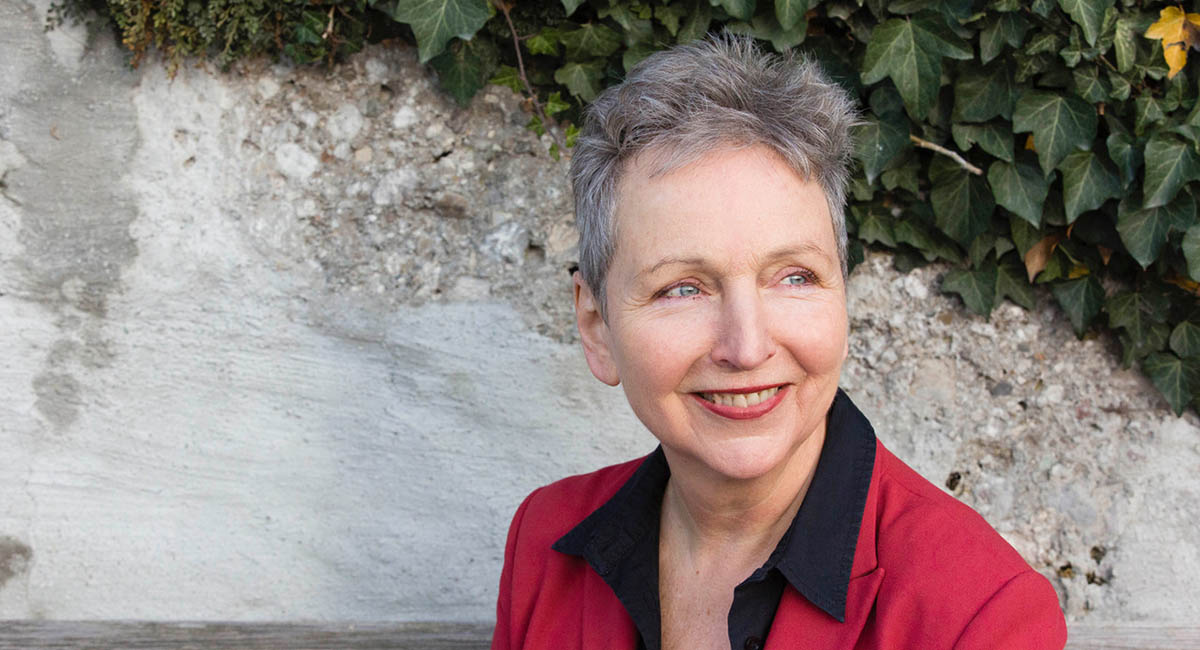
Does your home still serve you—or are you serving it? Ursula Spannberger on the right moment to rethink living

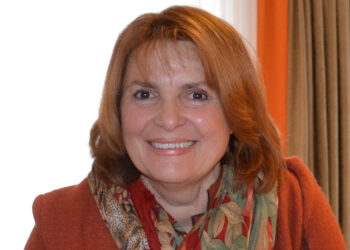
Our interviewee: Architect Ursula Spannberger (Credit: RAUM.WERT)

Interviewee: Architect Ursula Spannberger (Credit: RAUM.WERT)

This article is also available in: Deutsch

Sometimes our relationship with our own home changes gradually: the large garden becomes a burden. The second floor remains uncleaned because daily life has long since set different limits. What once meant security, freedom, and familiarity suddenly begins to create pressure and pangs of guilt.

But when is the right time to take an honest look at one’s living situation? How can you tell if your familiar home is still a source of support—or if it has long since been taking more energy than it provides? And how do you figure out which living arrangement best suits your needs, habits, and ideas about growing older?

Ursula Spannberger is an architect who developed the RAUM.WERT method about 15 years ago: a tool that helps people identify and articulate their own needs regarding living space. She assists individuals with housing decisions as well as communities in participatory processes related to vacant properties, new forms of housing, school construction, and community projects.

Header SBC English

At the same time, she herself has experienced many of the very questions she has been asking professionally for years: This summer, she will move into the Silberstreif communal housing project in Salzburg—a step she had long ruled out for herself.

In this interview, Ursula Spannberger explains why spaces do much more than simply provide us with shelter, how a cluster apartment differs from other forms of communal living—and why the best time to start thinking about housing in old age is usually sooner than you might think.

SBC: Ms. Spannberger, you like to ask people: Does your house serve you—or are you already serving it? What exactly do you mean by that?

Spannberger: It’s a very simple question, but it strikes a chord. At some point in midlife—or even earlier—the balance begins to shift. You could be working in the garden; you really should finally clean out the second floor again. But you don’t do it because you lack the energy or the joy. And instead of asking whether your home might have become too big, you end up feeling guilty.

That’s the moment when your home is no longer working for you—but you’re working for it. And that’s exactly the signal to pause and ask yourself seriously: What do I really need from my living environment right now? What has changed?

SBC: You’ve developed a method for this—the RAUM.WERT method. What’s behind it?

Spannberger: The principle is simple: Space has an impact. Spaces influence our well-being, our energy, and our relationships. Most people know this intuitively—but the only criterion they have at their disposal is: beautiful or ugly. And you can’t build on that assessment, because while it’s true, it doesn’t provide a basis for action.

This method asks different questions. It asks about nine specific aspects of space—for example: How do you move around? Where do you experience closeness, and where do you experience distance? Do you have a space where you can truly retreat? Incidentally, this applies to many women in family situations, since they don’t have a space of their own that’s entirely for themselves.

These questions provide guidance, and anyone can answer them in everyday language, even without a background in architecture.

And that’s exactly what was important to me: there’s often a huge gap of misunderstanding between architects and users. My colleagues sometimes worry that users will want to get involved in the planning process—but they aren’t architecture experts; they’re experts on their own daily lives. And that’s something completely different—and something very valuable. And they can create a briefing for themselves on how something should be designed so that the building serves their needs.

SBC: When should you start asking yourself these questions?

Spannberger: Much earlier than most people do. I recommend doing this by the time you’re in your early or mid-60s at the latest—when you still have the strength and flexibility to truly shape change. Not when the need becomes urgent, but before it becomes urgent.

We always start with an assessment: How does this space serve me right now? What works, and what doesn’t? This honest assessment then gives us a clear picture of what’s needed. And only then do we begin the search for the right solution.

A small first step that everyone can take on their own: What kind of person am I? Am I someone who is comfortable being alone—or do I need companionship? Where has this already shown up in my life? And how might that change in the coming years? Many people come to surprising insights about themselves in the process.

SBC: You yourself are currently in the process of moving—into the Silberstreif communal housing project in Salzburg—and are experiencing this transition to a completely new living situation firsthand.

Spannberger: Yes, I provided architectural guidance to the group for years and was truly impressed by what they’d built. But I always said: That’s not for me. I’m more of a lone wolf. After intense periods of work, I need to be alone to recharge—a space where I can retreat, my own silence.

Something else I’ve noticed over time: You become a bit more eccentric as you get older. You need your alone time even more—and in doing so, you fail to realize that it’s slowly turning into loneliness. These are subtle changes. I’m 70 years old now and still fully engaged in my career. But when I start working less, I’ll also have far fewer social contacts.

A friend once said offhand, “When we live in Silberstreif someday…”—and that just clicked something inside me. Suddenly it dawned on me: Maybe that would be cool after all.

Now that the move is getting closer and closer, I’m going through all the stages that I’d previously only known in theory or by observing others. And I realize how hard our society makes it for us to see this step for what it is: a good decision for our own future.

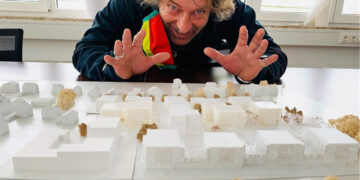
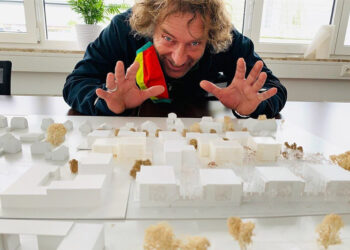
Gemeinschaftswohnen bedeutet auch, gemeinsam an Lösungen zu arbeiten. Credit: RAUM.WERT
SBC: What exactly defines Silberstreif—in terms of space?

Spannberger: What really won me over as an architect is the variety of the common spaces. On the ground floor, there’s a semi-public area with its own entrance and large windows—visible to the entire neighborhood and accessible from the outside as well. It’s a space that has an impact on the neighborhood. It can be rented out, but we also host events there ourselves and have already put together a program for the first three months.

On the fourth floor, there’s a living room just for us—with a dining area, a game table, a lounge, a small balcony, and a large rooftop terrace where we can garden. There’s also a workshop on the ground floor, a studio for painting and sewing in the basement, and a small fitness room. I think this variety of different common areas, each with its own set of rules, is very cleverly planned.

And something that’s very important to me personally: I’ll be living in a small apartment that’s 45 square meters. By removing a wall, the classic two-room apartment became a one-room apartment. This is my very own personal space; I can close my door and be in my own world. But I can go out and meet people at any time. This difference—between forced and voluntary community—is the crux of it for me.

SBC: What exactly do you mean by “compulsory” and “voluntary” community?

Spannberger: This is an aspect of space that’s often underestimated—proximity and distance. In a cluster-style apartment building, where the residential units are arranged around common areas, you always have to pass through the common area when going in and out. That sounds harmless, but it has real consequences: If I’m not feeling well and don’t want to see anyone, I still have to say “hello.” If I want to go for a walk alone, I have to explain why—or at least I feel like I have to explain it. For some people, that’s not a problem. For others, it’s a reason why a cluster apartment ultimately isn’t a good fit.

Here at Silberstreif, each person has their own fully equipped living unit. It’s like a large apartment building with ordinary, anonymous hallways and a stairwell. I can leave my apartment, walk down the stairwell, and out the front door—and hop on my bike or go for a walk in the woods without having to run into anyone. Maybe I’ll run into someone in the stairwell, maybe not. But I don’t have to go through our common areas because they have their own entrance.

This is no small matter. It’s precisely this difference between a chosen community and an unavoidable one. I always recommend that you honestly figure this out for yourself before deciding on a living arrangement. Anyone who has never lived in a shared apartment should think carefully about whether their expectations match reality.

This is also linked to another aspect of space—flexibility and personalization. It’s about how quickly and easily spaces can be adapted for different uses. When designing the common area on the ground floor, we deliberately opted for defined zones: There’s a stage, a daytime bar in the center, and an area that’s more suited for a study café or crafts. Distinct atmospheres, clear purposes, and a large central space that remains empty for now.

That might not sound very flexible—but that’s exactly the point. What creates a dreary atmosphere in many common areas are folding tables that stand against the wall when folded up. Armchairs stacked in the corner, waiting. Sure, you can quickly rearrange them—but the space will never feel cozy because it doesn’t convey a specific purpose. A room that’s merely practical isn’t necessarily inviting. It needs an atmosphere and a clear sense of purpose so that people will truly want to enter and stay.

SBC: So, ultimately, this means there are different models of communal living. Can you tell us about some other options?

Spannberger: There are far more models than most people realize. Take the WohnBuddy model, for example: You rent out a room in your own apartment to a younger person, who in return takes on certain tasks—such as grocery shopping, small chores, or simply being there.

Sharing a house with a young family is another option—which raises the question: What renovations will I need to make, how do I choose the right family, what are my needs, and how can I balance them with the needs of others?

And then there’s something else I consider particularly forward-looking: projects that reimagine village life as a whole. Many small communities have vacant spaces—the former tavern, rooms the church no longer needs, unused ground-floor areas. My program for communities, which I call “Zukunftsraum Gemeinschaft” (Community Space for the Future), addresses exactly that. I facilitate participatory processes in which people themselves decide what these spaces should become: whether it’s a village store, a coworking space, workshops, childcare, apartments, or a combination of these.

SBC: Do you have a real-world example for us?

Spannberger: We were commissioned by the City of Salzburg to develop a concept for a large dining hall in a retirement home that was no longer in use. The area is surrounded by schools, youth centers, and clubs that need space. Through the participatory process, we collaboratively determined how this space could be used in a multifunctional way—including by people from outside the facility.

The best part is that this allows the people who live there to reconnect with the outside world, and children come into the building. It brings life to the place, which helps combat loneliness—not only within the facility, but also by fostering a genuine sense of community.

SBC: What is your most important message for people who are just starting to think about where they will live in their later years?

Spannberger: Start before it becomes urgent. And begin with the diagnosis, not the solution. The question isn’t: Which model is good? The question is: What do I need? What do I want to “take with me”? Which spaces give me energy, and which ones drain it? Where do I experience closeness, and where do I need distance?

And then: Trust that nursing homes and assisted living aren’t your only options. There are housing options that didn’t even exist ten years ago. The image of aging that we as a society still allow to dominate is far too narrow. Reality is much richer—you just have to be willing to find it and live it.

Thank you for the interview!

Ursula Spannberger is an architect and the developer of the RAUM.WERT method. She assists individuals with housing decisions and communities with participatory processes related to future spaces and community. For more information, visit raumwert.cc

SmartBuildingsCompass has already spoken with co-founder Michael Flemmich about the “Silberstreif” communal living project in Salzburg: Co-living: What lessons have you learned from your project, Michael Flemmich?

Anja Herberth
Author: Anja Herberth

Chefredakteurin

Tags: Housing Options for SeniorsShared living
Previous Post

When the apartment becomes a heat trap: What can older people do now, Roland Wallner?

Related Posts

Michael Flemming worked on this project for 12 long years (Credit: Verein Silberstreif)
Constructing & Renovating

Communal Living: What lessons have you learned from your project, Michael Flemmich?

11. June 2026
Our interview partner: Sonja Schiff - gerontologist, coach, seminar leader - and DJ. Credit: Rochus Gratzfeld
Home & Living

How can we rock our lives in old age, Sonja Schiff?

22. May 2026
For many people, communal living forms sound like a lovely idea at first. But there is often a long way to go between a good idea and a viable project. (Credit: bring-together.de)
Constructing & Renovating

Living together, the right way: The power of effective matching

11. April 2026
Eleanor Ambos in "A Life in Color" - Credit: SixPackFilm
Home & Living

“A Life in Color”: Cheers to the crazy life

4. March 2026
The pension study clearly shows that Austrians are very worried when they think about their pension - 40 percent rate their own risk of poverty in old age as high. Credit: Alexander Caminada/Ageing without limits
Home & Living

Study on retirement provision 2026: The fear of the future

14. January 2026
Bruges, West Flanders: With its Dementievriendelijk Brugge project, this Belgian city in the northwest of the country is demonstrating what active inclusion and quality of life in urban areas can look like. Photo: Shutterstock
Dementia

Bruges shows how it’s done: A city becomes dementia-friendly

3. July 2025

Leave a Reply Cancel reply

Your email address will not be published. Required fields are marked *

  • Deutsch
  • English

.

loader

Newsletter

What tools and concepts are available for senior living, care and support - and where can they be found? Our newsletter provides answers!

I accept the terms and conditions

Recent News

Our interviewee: Architect Ursula Spannberger (Credit: RAUM.WERT)

Does your home still serve you—or are you serving it? Ursula Spannberger on the right moment to rethink living

3. July 2026
Large windows and direct sunlight can cause apartments to heat up significantly in the summer. For older adults, prolonged heat can pose a health risk. (Credit: Shutterstock)

When the apartment becomes a heat trap: What can older people do now, Roland Wallner?

12. June 2026
Professional travel companions like Sonja Fröse provide support so that vacations are possible despite disabilities and care needs. (Credit: SG Reisen)

Vacations for People with Care Needs or Disabilities: How Does It Work, Sonja Fröse?

12. June 2026
Credit: Vienna Museum/Fischka Collective

Changing Places: When a standard accessible restroom isn’t enough

12. June 2026
Put it on yourself without struggling with the buttons: just overlap the fasteners — and you're done. Credit: Yorokani

Getting Dressed in Seconds: How Magnetic Clothing Helps Older Adults Stay Active

11. June 2026
SmartBuildingsCompass

Made with care. For you.

Our research and interviews on safe and independent living in old age are written by our team with a great deal of energy and passion. We hope you enjoy reading them!

Do you need more information? If so, you are welcome to contact us at redaktion@sbc.co.at.

All rights reserved (2025).

  • Deutsch
  • English

Follow us

Instagram
  • Home
  • Subscribe to our newsletter
  • Glossary
  • About us
  • Contact
  • Marketing: Information for businesses
  • Download your 10 tips for independent, safe living in older age
  • Presentations & workshops for local authorities & nonprofits
  • Contact & Legal Notice
  • FAQs
  • Disclosure Statement
  • Nettiquette
  • Data protection
  • General Terms and Conditions (GTC)

© 2025 by owl lab e.U. Wir navigieren Wandel.

We use cookies on our website. Some of them are essential, while others help us improve this website and your experience.
Cookie SettingsAccept All
Manage consent

Privacy Overview

This website uses cookies to improve your experience while you navigate through the website. Out of these, the cookies that are categorized as necessary are stored on your browser as they are essential for the working of basic functionalities of the website. We also use third-party cookies that help us analyze and understand how you use this website. These cookies will be stored in your browser only with your consent. You also have the option to opt-out of these cookies. But opting out of some of these cookies may affect your browsing experience.
SAVE & ACCEPT
No Result
View All Result
  • Home
  • Home & Living
  • Everyday Aids & Technology
  • Care & Relief
  • Dementia & Health
  • Download: 10 tips
  • Topics
    • Special Feature: Age-friendly Construction & Renovation
    • Dementia
    • Tools & Solutions
    • Crisis-resilient caregiving household
    • Stay healthy
  • Deutsch
  • English

© 2025 by owl lab e.U. Wir navigieren Wandel.

Safe & independent living in old age

27 pages of tips for independent, safe living in old age—download now!

Download our PDF with tipps now!
loader

Email addresse*
I accept the privacy policy and agree that SmartBuildingsCompass.com may contact me beyond this request to send me its regular newsletter. I can unsubscribe at any time.

Sicher & selbstbestimmt Wohnen im Alter!

27 Seiten Tipps für sicheres, selbstbestimmtes Wohnen im Alter - jetzt downloaden!

Jetzt gleich downloaden!
loader

Email addresse*
I accept the privacy policy and agree that SmartBuildingsCompass.com may contact me beyond this request to send me its regular newsletter. I can unsubscribe at any time.