
Saturday, March 7, 2026
  • en English
  • de Deutsch
SmartBuildingsCompass
Header SBC English
  • Home
  • Home & Living
  • Tech / Tools
  • Healthcare & Dementia
  • Care & Relatives
  • Download: 10 tips
  • Why we care
No Result
View All Result
  • Home
  • Home & Living
  • Tech / Tools
  • Healthcare & Dementia
  • Care & Relatives
  • Download: 10 tips
  • Why we care
No Result
View All Result
SmartBuildingsCompass
No Result
View All Result
Home Care & Relatives

International Women’s Day: Who bears the burden of care – and for how long?

Let yourself be a little nuts - and don't feel guilty about it! Credit: Shutterstock

Let yourself be a little nuts - and don't feel guilty about it! Credit: Shutterstock

Dieser Beitrag ist auch verfügbar auf: Deutsch

International Women’s Day is one of those days when women are discussed, analyzed and applauded. There are panels, statements and fine sentences about equality, poverty in old age and unpaid care work. And then it’s business as usual: In everyday life, in budgets, in structures.

However, the situation is no longer just a matter of justice, but a tough question of social stability. In the EU, the average pension of women over 65 is around a quarter lower than that of men – and Austria is one of the countries with the largest gaps. This is no coincidence, but the result of part-time work, interruptions and lower incomes – also because many women still work in professional fields such as health & social services, education, retail & sales and office work, which are socially indispensable but are not valued enough economically. Nevertheless, it should be noted here that women are now more likely to be in employment and more economically independent. And that has an impact – but more on that later.

This bundling in special sectors is not a special Austrian issue, but a permanent pattern in OECD countries, also emphasizes the OECD. Occupational and industry segregation remains a key driver of inequalities, and many women continue to work in so-called “pink-collar” sectors. And when women come home after work, the second part of the day is often waiting: Care and support work in the family. This too is still predominantly carried out by women.

Header SBC English

The fact that women are more pessimistic about the future is therefore not a “mood”, but a symptom. A recent analysis by Allianz Research speaks of a clear “gender sentiment gap”: On average, women are noticeably more pessimistic than men – also because they experience more structural dependencies. They are more often dependent on third parties and social benefits. And it is precisely these systems, which are supposed to cushion the blow, that are currently coming under pressure themselves.

And this is where it gets uncomfortable: The care system we rely on is beginning to collapse – and after all, 85% of people in need of care are supported at home in Austria and Germany. The Caregiver Support Ratio – simplified: how many potential relatives are available for a very old person – will fall massively in the coming decades. The reasons are both banal and brutal: After the baby boomers, there are less populous generations coming up. And women’s lifelines are changing – slowly, but they are. And as already mentioned: Women are working more, are more economically independent and are going their own way. Companies also need this workforce, as the baby boomer generation is now retiring.

>> It is precisely at this point that social progress meets a reality organized according to old assumptions. <<

It is precisely at this point that social progress meets a reality organized according to old assumptions. The development of women is right and necessary. But it collides with a system that is tacitly built on the assumption that “someone” is already providing care – and that “someone” is usually a woman. When roles change, the infrastructure has to change with them. Otherwise, we end up in a paradoxical situation: We celebrate equality – and continue to organize care through traditional expectations.

So when we talk about care and poverty in old age on International Women’s Day, please don’t just do it as a moral exercise. It is about teh bitter reality: We cannot secure the care of an ageing society with appeals for private sacrifice – especially not when the number of available relatives is falling. Those who ignore this are shifting the burden further onto those who are already carrying more of it.

Perhaps we should take more inspiration from the wonderful Eleanor Ambos, the protagonist in the film “A Life in Color.” A movie that poses the question of how we want to age – rating: Worth seeing. Us women should all act a little more like Eleanor: Don’t let yourself be squeezed into roles, don’t feel guilty about taking your life seriously. “To be nuts and not to feel guilty about it.” In a society that is still quicker to judge women, quicker to categorize them and quicker to push them into responsibility, this is not a provocation. It is self-protection.

International Women’s Day would be a good time to acknowledge this truth: Applause changes nothing. What counts are structures – in care, in working models and in relief. As long as we don’t tackle this consistently, March 8 will remain a ritual. And the price for this will be paid in everyday life – by women, by families and ultimately by all of us.


Anja Herberth
Author: Anja Herberth

Chefredakteurin

Previous Post

Healthcare system under pressure: What needs to be clarified now

Related Posts

Protest day on March 23. Pharmacies are fighting for better economic conditions - 20% of pharmacies have already given up.  Credit: Shutterstock
Care & Relatives

Pharmacies in Germany: Why they will remain closed on March 23

3. March 2026
"In my world" is published by Thienemann Verlag
Care & Relatives

“In my world”: A children’s book on coping with grief

17. February 2026
The Care Development Commission will meet on Friday to decide how to proceed with 24-hour care in Austria. Credit: Shutterstock
Care & Relatives

24-hour care: When the money doesn’t follow the need

17. February 2026
Interview: Leading complexity researcher Prof. Peter Klimek (Photo credit: CSH Eugenie Sophie)
Care & Relatives

Early warning system for heat waves: How an Austrian research project detects hotspots – and makes protective measures more targeted

29. January 2026
Community nurses are regional (health) caregivers who provide support so that people can remain healthy and independent at home for as long as possible. With the end of EU funding and despite a positive evaluation, the project is being reduced, restructured or discontinued in some federal states.  Credit: Shutterstock
Care & Relatives

Community Nursing: What happens when support and prevention become a source of savings?

20. November 2025
All tablets swallowed whole reached the stomach without any signs of dangerous swallowing. Crushed forms, on the other hand, led to significantly more residue in the throat, which can impair the absorption of the active ingredients and promote complications.  Credit: Shutterstock
Care & Relatives

Taking tablets with swallowing difficulties: Take whole instead of crushed

17. November 2025

Leave a Reply Cancel reply

Your email address will not be published. Required fields are marked *

  • Deutsch
  • English

.

loader

Newsletter

What tools and concepts are available for senior living, care and support - and where can they be found? Our newsletter provides answers!

I accept the terms and conditions

Recent News

Let yourself be a little nuts - and don't feel guilty about it! Credit: Shutterstock

International Women’s Day: Who bears the burden of care – and for how long?

7. March 2026
Our interview partner: Health Economist & Dean of the Faculty of Social Sciences, Economics and Business Administration at the JKU Linz, Prof. Dr. Prof. Gerald J. Pruckner (Credit: Andreas Röbl)

Healthcare system under pressure: What needs to be clarified now

6. March 2026
Eleanor Ambos in "A Life in Color" - Credit: SixPackFilm

“A Life in Color”: Cheers to the crazy life

4. March 2026
Protest day on March 23. Pharmacies are fighting for better economic conditions - 20% of pharmacies have already given up.  Credit: Shutterstock

Pharmacies in Germany: Why they will remain closed on March 23

3. March 2026
Our interview partner Nicolas Tobaben is Head of Disaster Management at the German Johanniter Regional Association North (Credit: Johanniter)

Crisis requires community: “Only when a few people consciously consider others can it truly be sustainable.”

23. February 2026
SmartBuildingsCompass

Made with care. For you.

Our research and interviews on safe and independent living in old age are written by our team with a great deal of energy and passion. We hope you enjoy reading them!

Do you need more information? If so, you are welcome to contact us at redaktion@sbc.co.at.

All rights reserved (2025).

  • Deutsch
  • English

Follow us

Instagram
  • Home
  • Subscribe to our newsletter
  • Glossary
  • About us
  • Contact
  • Marketing: Information for businesses
  • Download your 10 tips for independent, safe living in older age
  • Presentations & workshops for local authorities & nonprofits
  • Contact & Legal Notice
  • FAQs
  • Disclosure Statement
  • Nettiquette
  • Data protection
  • General Terms and Conditions (GTC)

© 2025 by owl lab e.U. Wir navigieren Wandel.

We use cookies on our website. Some of them are essential, while others help us improve this website and your experience.
Cookie SettingsAccept All
Manage consent

Privacy Overview

This website uses cookies to improve your experience while you navigate through the website. Out of these, the cookies that are categorized as necessary are stored on your browser as they are essential for the working of basic functionalities of the website. We also use third-party cookies that help us analyze and understand how you use this website. These cookies will be stored in your browser only with your consent. You also have the option to opt-out of these cookies. But opting out of some of these cookies may affect your browsing experience.
SAVE & ACCEPT
No Result
View All Result
  • Home
  • Home & Living
  • Tech / Tools
  • Topic search
    • Topic: Orientation
    • Topic: Dementia
    • Topic: Building & Renovating
    • Topic: Healthcare
  • Local authorities & Nonprofits
  • Download: 10 Tips
  • Deutsch
  • English

© 2025 by owl lab e.U. Wir navigieren Wandel.

Safe & independent living in old age

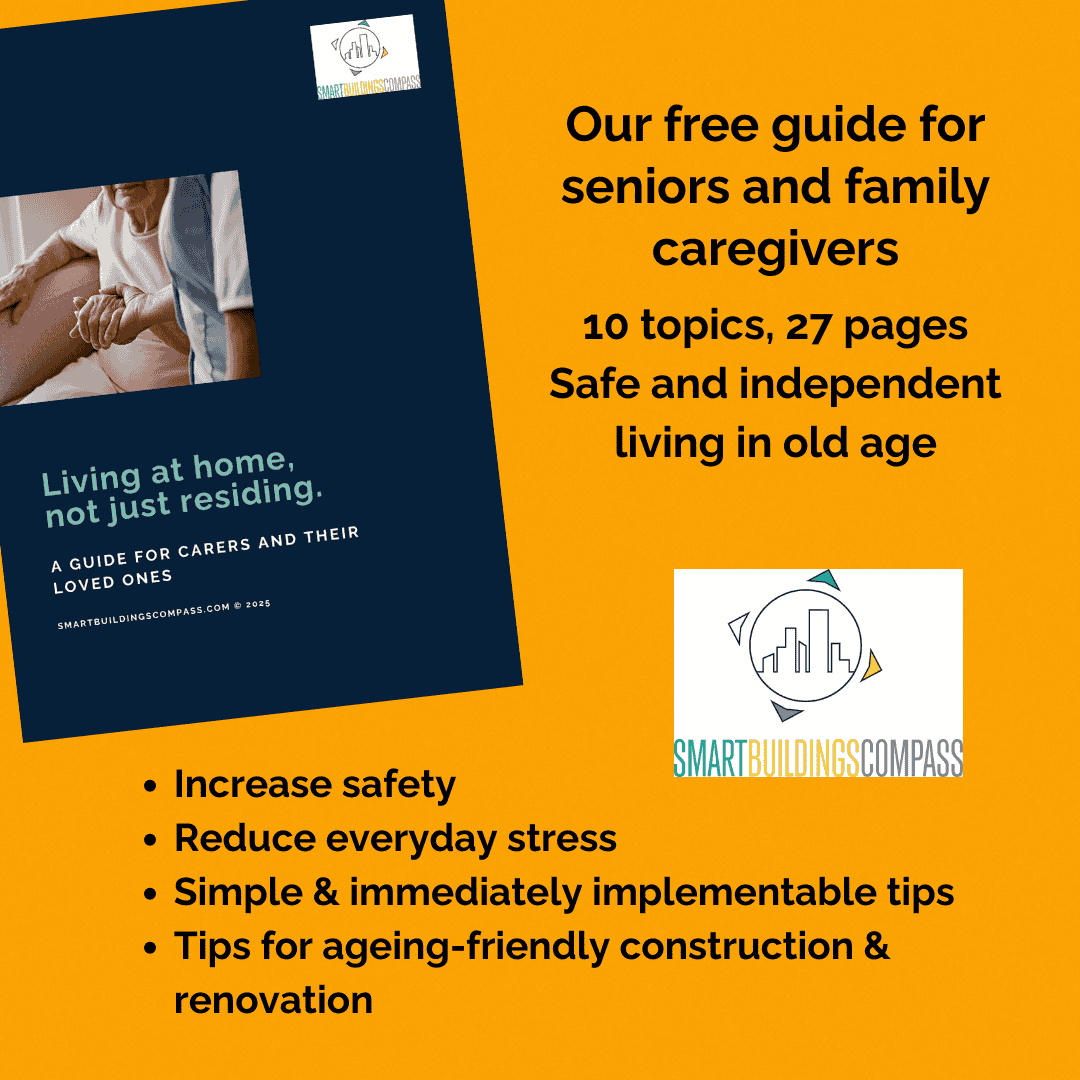
27 pages of tips for independent, safe living in old age—download now!

Download our PDF with tipps now!
loader

Email addresse*
I accept the privacy policy and agree that SmartBuildingsCompass.com may contact me beyond this request to send me its regular newsletter. I can unsubscribe at any time.

Sicher & selbstbestimmt Wohnen im Alter!

27 Seiten Tipps für sicheres, selbstbestimmtes Wohnen im Alter - jetzt downloaden!

Jetzt gleich downloaden!
loader

Email addresse*
I accept the privacy policy and agree that SmartBuildingsCompass.com may contact me beyond this request to send me its regular newsletter. I can unsubscribe at any time.