This article is also available in:
 Deutsch
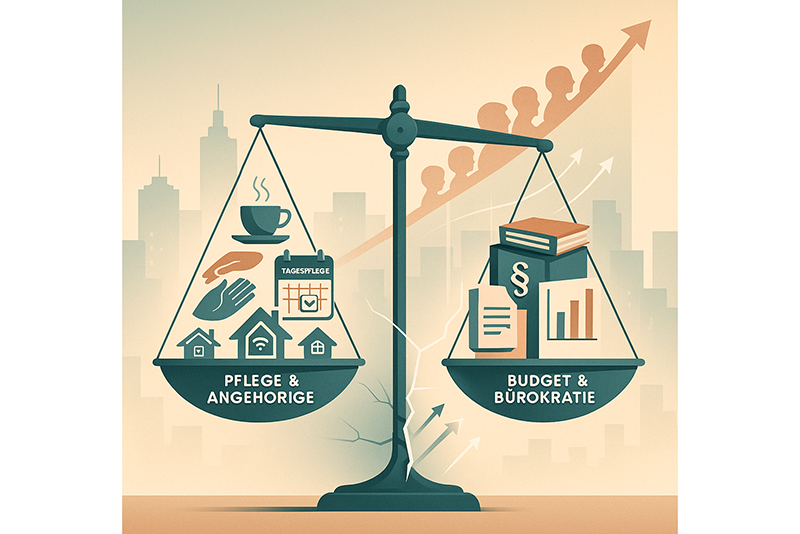
Care is often defined as a social benefit, but this is a very one-sided representation. After all, care is economic, location, financial and social policy in so many ways:
- Good support for family members increases labor force participation – especially among women, who carry out most of the care work at home. Good relief and support reduces sickness rates, part-time rates and fluctuation. Good care support also reduces the gender pay gap: As a result, women have more income available throughout their lives and we reduce the risk of poverty in old age.
- Prevention, professional short-term care and good (partial) outpatient support services such as day care avoid expensive acute stays. This helps people to remain living in their own four walls for as long as possible: Safely and independently. This does not immediately require 24/7 care – but one that adapts to the needs of an ageing population.
This need for everyday help, coordination and relief for relatives is increasing with the current rise in the number of pensioners. For Germany, the analysis institute Prognos assumes that 40% more people will be dependent on care staff by 2045. In Austria the WIFO Institute forecasts forecasts a 57% increase in the number of people receiving care benefits by 2050. The costs for all care services in AUT will increase from EUR 2.71 billion in 2021 to around EUR 4.22 billion in 2030 (+56%) and around EUR 10.7 billion (+294%) by 2050.
You might also be interested in



As care at home is the cheapest form of care compared to admission to care organizations, system costs are reduced overall if people are cared for at home for as long as possible.

- Care also creates skilled, local jobs and fuels innovation – from digital health to barrier-free, intelligent housing. Local innovation is particularly important in the health and care sector because it involves sensitive data that we do not want to have processed in foreign clouds.
- And last but not least, care has an impact on the smallest units of our society: families. If they are not adequately supported with care, the already melting trust in public institutions erodes. Good support for families has a stabilizing effect on parties in the political center: As people, citizens would quite happily have solutions to their most pressing problems and challenges for all the tax money they hand over. And if they receive these, they may not drift to the political fringes in elections.
It should actually be relatively easy to convince politicians and their finance and controlling departments of innovative projects in the care sector, right? Not at all.
Lack of strategy, orgies of cuts and distribution battles
In practice, a strategy-less policy of cuts and undignified distribution battles dominate.
- Projects are not seen as embedded in the contexts described above, but as pure cost factors in their own little silo kingdom. Anything that provides long-term relief in another budget is wiped away: you are not responsible for this, someone else should please take care of this challenge. Decisions are made in one’s own echo chamber without looking at the big picture and without influencing the causes.
- Companies fear for their economic future despite their range of solutions. If there is no market for their products and bureaucracy and regulations take away their breathing space, these companies either leave the European market and dedicate themselves to markets that roll out the red carpet. Or they die a quiet death.
- Another old classic: professional associations defend their vested interests, and barriers to entry remain in place. The most recent example: pharmacies and in-office pharmacies in medical practices are not established based on actual need, but rather on their distance from the nearest one. Every centimeter counts. In practice, doctors end up building their clinics out in the middle of nowhere just so they can include an in-office pharmacy. The often-cited convenience of being able to walk right next door is particularly meaningful for older people.
My interviews regularly reveal the consequences of short-sighted policies: family caregivers burn out due to the strain and become patients even at a young age. Counseling and support services are not sufficiently known and are therefore not used. The financial burdens in the families even for basic care are constantly increasing. Inpatient facilities are also overburdened because the housing situation, which is not age-appropriate, and gaps in outpatient care and assisted living provoke acute emergencies. Even long-standing regional contact points for illnesses such as dementia are falling victim to the red pencil.
Older people urgently need low-threshold support services to help them navigate the complexity of bureaucracy and digitalization. They often fail to find support options or fill out applications that can only be submitted online. And also because structures such as post offices, bank branches and grocery stores are eroding, especially in rural areas, older people increasingly need support in the form of adult representatives – and these structures are already working at their limits. This is because it is often simply no longer possible to switch to digital banking and self-service services, for example. P.S.: Incidentally, countries such as Rwanda are managing to support the population in using e-government structures – and no, that’s not a joke – this is not a joke, but a bitter reality.
Short-sightedness creates long-term problems
Without a clear strategy, sufficient staff and well-organized services, families, local authorities and the healthcare system will come under pressure. Families who provide care at home should actually receive all the support they need to manage this for as long as possible. Because everything else is much, much more expensive. In reality, family caregivers are often left on their own – with endless forms, waiting lists and the implicit message to please take care of themselves.
And once again I ask myself when the tipping point will be reached: when will concepts be put together according to real necessity and meaningfulness – and not according to old concepts, (vested) rights, access barriers and rigid professional rights?

Author: Anja Herberth
Chefredakteurin