This article is also available in:
Deutsch
This “village” — this sense of community — becomes increasingly important as we age. Community living provides what many traditional living arrangements lack: closeness, support, and a sense of belonging—without sacrificing privacy. It’s not just about shared spaces, but also about a conscious sense of community in everyday life.
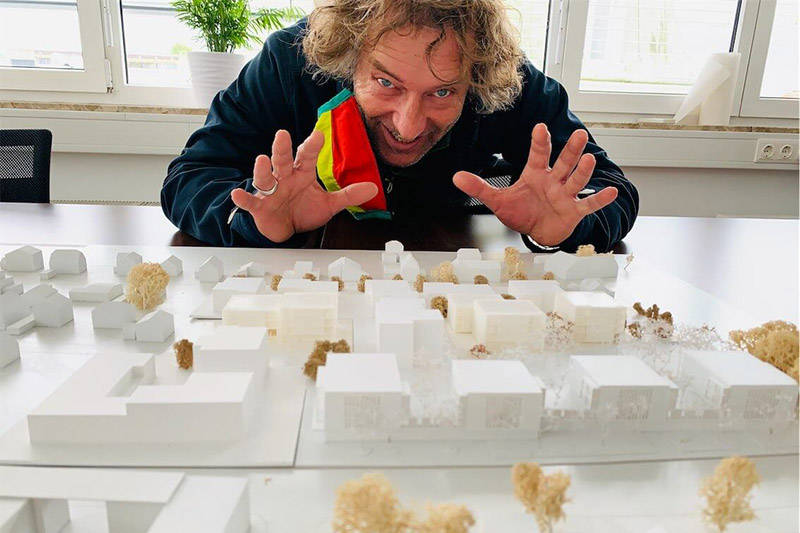
However, anyone who wants to grow old together needs more than just a good idea. They need stamina, (political) allies — and a good dose of perseverance. A conversation with Michael Flemmich, founder of the Silberstreif association in Salzburg, about his housing project, which is now entering its next phase: The handover of the keys in July 2026. In this interview, he shares his experiences from the past 12 years with us.
Together instead of alone
Communal living is more than just sharing living space. It combines privacy with a genuine sense of community, mutual support, and a daily life that feels less anonymous. Whether it’s a multigenerational home, cluster housing, a senior living community, or a housing project: what matters most is that people choose to live together while still maintaining their own space.
How did the Silberstreif project come about? It’s the story of his grandmother that has stayed with Michael Flemmich ever since. She lived in an old building without an elevator, somewhere in Salzburg. Mentally sharp but physically limited—and increasingly alone. Going out? Only if someone came and carried her down the stairs. Coming in? Only if someone helped. “As you get older, your circle of friends shrinks, and loneliness sets in quickly. If you live alone in old age, things can quickly become very precarious,” says Flemmich.
This experience led to the founding of the Silberstreif association in Salzburg in 2015. A handful of people in their 50s who thought to themselves: This is not how we want to grow old. Living together, sharing our lives, and—if necessary—being there for one another. Not in a nursing home, not alone—but right in the middle of things, in a community that has agreed on this beforehand. Flemmich: “If you live in a house with like-minded people between the ages of 50 and 95, it will be easier for someone to bring you food, check on you, and ensure you don’t become lonely.” Twelve years after the idea was conceived, the date for the key handover has now been set: July 16.
The idea is simple—but the journey wasn’t
Originally, the founders had planned to buy a plot of land and build the property themselves. That plan quickly fell through: land prices in Salzburg are hardly any different from those in Vienna. Banks no longer grant large loans to people over 50. “Once you reach a certain age, you’re no longer considered creditworthy,” Flemmich notes matter-of-factly.
So they looked for other ways. And that meant knocking on doors, explaining, and persuading people. “We visited every political party and every developer,” recalls Flemmich. Because the concept of communal living for people over 50—self-organized, based on solidarity, and barrier-free—was new to many at the time. To some, it was simply suspicious.
“Communal living isn’t viewed as a legitimate project everywhere,” says Flemmich. While in Vienna, for example, communal living is part of the housing concept in many places, things work differently in other states. Flemmich: “Anything outside the established players and projects isn’t accepted.”
The breakthrough came thanks to people who supported the project—political networkers who understood the concept. “Without these people, we wouldn’t have achieved anything to this day,” says Flemmich. His takeaway: “Those who know the rules of the game have a decisive advantage.”
The Deal: Housing in Exchange for Social Work
In the Salzburg-Gneis neighborhood, an established residential area on the outskirts of the city, a new housing development comprising 250 apartments was built. Large construction projects are never uncontroversial in established residential neighborhoods—and that was certainly the case in Gneis. There were public participation processes, residents were involved, and there were intense discussions.
Silberstreif seized this opportunity: The organization became deeply involved in the participatory process, contributed ideas, and connected people. And that is exactly what proved to be the key to success. An unusual proposal worked: If Silberstreif agreed to volunteer to do networking work in the new neighborhood—bringing newcomers together with long-time residents, kickstarting community life—then politicians would push the project forward. A solution was found with Heimat Österreich, one of the major nonprofit housing developers. Managing Director Stephan Gröger agreed to bring Silberstreif on board. “That was the deal,” says Flemmich: subsidized housing in exchange for social work, personal initiative in exchange for the right to communal living.
And that raised another crucial question: Who is actually allowed to live here? Under the standard housing assistance program, the city allocates apartments based on a list of criteria. You have to be a resident of Salzburg, have worked in the city long enough, and not earn too much. In other words: The apartments are allocated, but who your neighbors will be is uncertain.
For a community like Silberstreif, this approach isn’t enough. After all, the core idea is: I want to grow old with people I get along with reasonably well, people who fit into the community. Flemmich: “We want to grow old together and support one another. And you can only do that if you agree on it from the very beginning.”
And it worked: Silberstreif was granted the right to select the residents themselves. The city then reviewed the list and verified whether these individuals were eligible. But the fundamental decision about who would move in with whom rested with the association.
Who’s coming—and who isn’t
When asked who is interested in this model, Flemmich is amazed. “We could have filled three houses. Easily.” The demand was—and still is—enormous. It was mainly singles who signed up. Maintaining a gender balance was particularly difficult: far more women than men signed up. “Women are a bit more socially savvy,” says Flemmich with a smile. “Or maybe they think more about how they want to grow old.” Paradoxically, the four couple apartments in the project were harder to fill than all the others. The model attracts people who are alone—or who foresee being alone and want to secure their future. Not financially, but socially.
The project’s mix of age groups is not just a nice bonus, but a strategic necessity. “We don’t all want to be 85 at the same time,” says Flemmich. A group consisting solely of people of similar ages ages as a community at the same pace—and eventually, the energy to keep the community going runs out. And who will take care of the common areas when everyone is 80?
The Hidden Costs
“There are a few things we only realized as construction progressed,” says Flemmich with the matter-of-factness of someone who has spent twelve years learning how systems really work. What many people don’t factor in when they dream of communal living: the costs that arise.
Although the association was able to implement its concept in collaboration with Heimat Österreich—the large communal living room, the fitness room, the space for artistic activities, and the small workshop—in the case of this publicly funded project, only the private living spaces are subsidized; the communal areas are not. These are financed at normal market rates, which are currently very high due to the multiple crises in the market. “We didn’t realize at the beginning that the costs would be so high,” Flemmich admits openly.
In particular, the “Silberstube” on the ground floor—which is intended to serve the entire neighborhood as an open meeting place for events such as repair cafés, children’s birthday parties, flea markets, etc.—places a burden on the budget of around 30,000 euros per year. This is an amount that the association hopes to recoup in part through rentals and events. But it is an amount that puts the project under constant pressure.
Then there are the demolition costs: If the association were to cease to exist at some point, the spaces created collectively would have to be demolished—so that “normal” apartments can be built again. The funds for this must be set aside from the very beginning. They are held in an account and, of course, are not available for furnishing.
How to lead a group of more than 30 people for twelve years—and beyond
To this end, the association has divided itself into five working groups: Construction and Interior Design, Finance and Legal Affairs, Public Relations, Events and New Members—and managing the Silberstube. Each group is responsible for its own area of work, and members discuss, plan, and implement projects together.
How are decisions made? Sociocracy is a model for the survival of groups like Silberstreif: Almost all building groups in Austria use this decision-making principle, which does not rely on everyone being enthusiastic, but rather on everyone being able to live with a compromise reached collectively.
Silberstreif practices this once a year with an expert over a weekend. Flemmich is convinced that without this practice, the group would not be able to survive. Because the conflicts that arise are minor—and that is precisely why they are so dangerous. Flemmich illustrates the conflicts with an example: “One resident wants a dog, another is afraid of them. A third says she won’t move in without her dog, and a fourth is allergic to them.”
This is just one example of the many conflicts that need to be resolved when groups move in together. Being too late to be open about expectations, unspoken assumptions, and old dynamics that move into the home: This is exactly what Silberstreif recognized early on and created a structural framework designed to catch conflicts—before they escalate.
What policymakers have failed to do so far—and what needs to change
What Flemmich wants isn’t really complicated: If policymakers say they want to promote communal living, then the euro must follow that goal. Specifically, this means that developers building large housing complexes should be required—or at least incentivized—to include space for housing cooperatives. Those willing to volunteer their time for community work should not have to pay market-rate rent for common spaces. And subsidized ground-floor spaces that currently stand empty because no one can afford the rent should be allocated at subsidized rates for social uses.
“There’s definitely room for improvement,” says Flemmich. He admits that Vienna is further along in this regard. That’s because Vienna has recognized that resident satisfaction is a political asset—that people who are allowed to have a say in shaping their community are happier with where they live, and that this strengthens the community. Flemmich: “This way of thinking hasn’t really caught on in Salzburg yet.”
And there is one wish that has not come true. Silberstreif wanted a small guest apartment—for grandchildren who come to visit, or a caregiver when the time comes. The Housing Promotion Act prohibits this, as it would constitute hoarding of housing stock. Flemmich understands the logic, but he still thinks it’s short-sighted—especially since there’s already a concrete case: A member of the association has a wife who needs care, and a nursing home has refused to admit her. A solution within the community would be obvious, but formally it’s not possible.
This highlights the fundamental tension at the heart of this project: it thinks beyond the system within which it operates. It aims to make things possible for which there are as yet no laws or regulations.
At the first stop
On July 16, the project will enter a new phase: After twelve years, a pandemic, a war, skyrocketing construction costs, changes to the funding system, and countless evenings spent in working groups—the keys will be handed over.
Michael Flemmich calls it the first milestone. But behind this modesty lies something that cannot be measured in square meters or funding guidelines: the quiet assurance that someone will be there in one’s old age. That someone will bring over a meal, that someone will answer the door when you knock.
That’s the essence of it—no grand concept, no political theory. Just the knowledge that our neighbor’s door isn’t far away.
More information about the Silberstreif association: https://silberstreif.live
Author: Anja Herberth
Chefredakteurin