Dieser Beitrag ist auch verfügbar auf:
Deutsch
The bathroom is one of the most dangerous rooms in the home – and also one of the most important. Hardly any other room plays such a decisive role in determining whether you can live independently at home—because personal hygiene is an essential prerequisite for doing so. By renovating in a timely and thoughtful manner, you can not only prevent accidents but also ensure long-term comfort and quality of life.
We spoke to two experts who work with this topic on a daily basis: Niklas Ettl, Sales Manager Project Business at Duscholux, and Erdogan Demirci, who has been working at H.S.K. Duschkabinenbau for over 25 years. Both are familiar with the topic from the healthcare and hotel sectors as well as from private bathroom renovations – and have a view at the topic that goes far beyond the usual guidebook.
Why the bathroom has been underestimated for so long
Moisture, slippery tiles, tight spaces and a lack of stopping points make this room statistically the most dangerous in the home. Nevertheless, the bathroom is a room that is often underestimated. Niklas Ettl puts it in a nutshell: “In practice, we often see very narrow bathrooms with lots of obstacles and tripping hazards.” What used to be built as an aesthetic feature – edges and steps – become a daily hazard in old age. Needs change as we get older, and getting in and out of the bath in particular becomes a real challenge as we get older.
For bathroom expert Niklas Ettl, a good bathroom renovation doesn’t start with the product – but with the people: “It’s important to clarify all the parameters at an early stage: What do customers have in mind? How do they want to use the bathroom? Is a person already in care – and if so, how does the handling work in everyday life? Where are there already hurdles that need to be overcome?”
Ettl recommends open discussions with customers, even if it’s difficult: “It’s an uncomfortable topic to bring up what no longer works as well as it did when you were younger. But you should talk about it before a renovation: What is the environment like? Are there caring relatives who can help? How will a disability or illness develop? What is the future vision for this space?” If you clarify this early, you will make more sustainable decisions and save yourself expensive subsequent improvements.
The trend: barrier-free floor-level shower. Here is an example from Duscholux with an almost free-floating walk-in shower enclosure. (Credit: Duscholux)
An anti-slip coating can be applied on request (Credit: HSK Duschkabinenbau KG)
This is what the anti-slip coating looks like (Credit: HSK Duschkabinenbau KG)
It is no longer necessary to remove the tiles for a partial bathroom renovation. If desired, this renovation can also be carried out in a minimally invasive way by fitting large-format back panels. (Credit: HSK Duschkabinenbau KG)
On trend: The bathtub needs to go
The trend is clearly moving towards floor-level showers: Fortunately, these barrier-free renovations are now starting from the age of around 55 – an observation shared by both experts. Erdogan Demirci: “The bathtub is often replaced by a spacious, barrier-free shower even at a younger age.”
Partial bathroom refurbishments can be carried out in a minimally invasive way if required, and now only take 3 to 4 days. This means that there is no need to remove the tiles and re-tile. This is made possible by large-format backsplashes and panels, which are available in many colors and decors. These are also very easy to maintain and clean due to the lack of grouting, as soap residue tends to build up there. They are available with different surfaces – including water-repellent ones. Demirci emphasizes another advantage: “This type of renovation saves a lot of noise and construction work in the bathroom.”
According to Demirci, the floor-level mineral cast shower tray is currently the most popular solution. It enables safe access without steps or thresholds, offers sufficient space for a shower stool or rollator and, if necessary, also provides space for carers or professional carers to accompany the patient. These level shower trays are easy to clean and, ideally, have a non-slip finish (anti-slip coating). They can also be made to measure, as the trays can be cut to size.
Door systems: Dependent on available space
Choosing the right door system depends on one thing above all: The space available. This is often the decisive factor when it comes to age-friendly conversions.
If there is enough space, walk-in shower enclosures are possible. These days, they can be installed in a bathroom with inconspicuous, glass-flush hinges and a frameless wall connection, almost as if they were floating. They are completely barrier-free and a good choice if the bathroom is large enough. A revolving door can only be opened outwards and requires a large bathroom. In return, it offers a particularly wide, convenient entrance. A swing door can be opened inwards and outwards, so it can also be opened from the outside in an emergency.
Sliding doors are space-saving because they do not require any swinging space. However, the entrance width is usually narrower and the guide rails (attention – hurdle!) are more intensive to clean. The folding door is well suited to small bathrooms and folds up like an accordion. As a result, it offers a wide access opening despite taking up minimal space. It is a good alternative when a rollator or wheelchair comes into play. Hinged folding doors, on the other hand, combine the best of folding doors and hinged doors: they can be folded completely to the side and open up the entire shower area. If family members have to help out, this is one of the strongest solutions for an age-appropriate bathroom – alongside the walk-in partition.
These hinged folding doors are also available in a large format: Originally used in the hotel and hospital sector, they are now also increasingly in demand for private, age-appropriate bathrooms. “We can build door sections up to 1.40 meters long – these are already very large dimensions in this segment,” explains Ettl. Horizontally divisible shower cubicles are also used in hospitals, describes Niklas Ettl: “I can wheel patients into the shower in a wheelchair, then only close the lower part of the cubicle – and have the space above completely free for the carer to shower and clean the person. This gives them both the dignity and space they need.”
A note on the locking system: If you are planning a flat shower tray or a level-access shower, you should pay attention to the so-called lift-and-lower mechanism. The door lifts slightly when opened, does not drag on the floor and closes particularly tightly when pulled shut.
For those who don’t want to give up their bathtub
Not everyone wants to give up taking a full bath. For many people, bathing has its own special significance: It’s a time for relaxation, a cherished ritual and is associated with a sense of well-being. And here, too, there are smart solutions that combine comfort and safety. Erdogan Demirci describes the challenge: “The problem with the conventional bathtub is the knee-high barrier.” Without a bath door, this leads to dangerous compromises: You turn when getting in on a slippery surface, hold on to something, lose your balance.
Hinged folding doors can be folded completely to the side and are one of the strongest solutions when using a rollator or wheelchair. (Credit: Duscholux)
An example of a shower tray, here from HSK Duschkabinenbau (Credit: Duschkabinenbau)
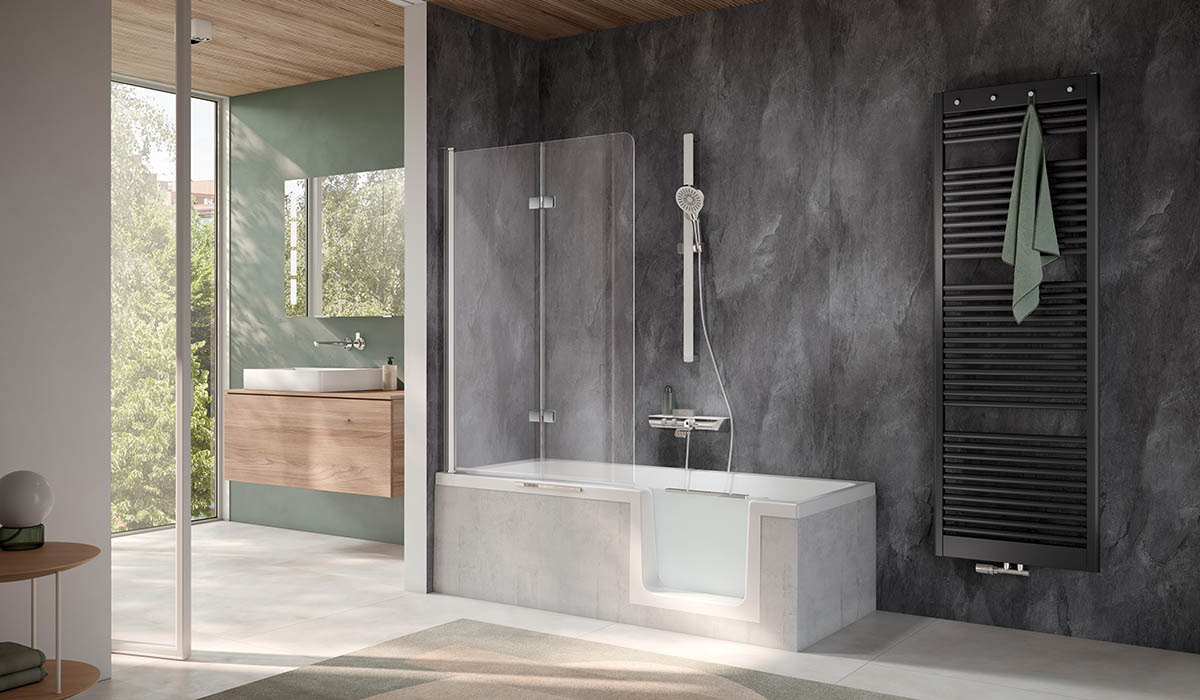
Step-in Pure from Duscholux (Credit: Duscholux)
Simple locking system of the Step-in Pure (Credit: Duscholux)
Closed tub door, here with "Dobla" from HSK Duschkabinenbau (Credit: HSK Duschkabinenbau KG)
The solution from H.S.K. is called “Dobla”. “It allows me to achieve a very low access height in combination with a magnetic door that is very easy to open,” explains Demirci. The bath has no latches or electrical functions. This makes it very easy to use, especially for older people: The door adheres magnetically to the inner wall of the bath and also has overflow protection – so nothing can happen when showering.
Duscholux offers a similar philosophy with the Step-in Pure. Niklas Ettl describes the concept: “We deliberately designed the door section so that it can be completely removed and hung in a parking position on the bathtub.” So if you shower more often than you bathe, simply unhook the door. The cleaning effort is reduced and use remains flexible. The system also has two drain systems: a classic drain that can be closed and a safety drain that only closes when the door element is correctly hung.
The solutions all have a small step (10-15 cm) at the entrance – but it is significantly smaller than in a classic bathtub. “We can also sink the solution a little into the floor. However, you have to take a close look at the situation on site and discuss with the customer what can still be implemented. Otherwise, we clearly advise in the direction of barrier-free showers,” says Ettl.
Materials that make life (and cleaning) easier
One aspect of age-friendly bathrooms that is often underestimated is the choice of the right surfaces and materials. After all, fewer grout lines mean less cleaning—and that matters as we age, when energy and strength are limited. For the glass itself, manufacturers offer special coatings that prevent limescale buildup. Ettl explains how the coatings work: “Under a microscope, you can see that the glass has a very uneven surface. That’s exactly where the limescale adheres. The coatings make this surface smoother, giving the limescale less surface area to cling to.”
Demirci adds: “The glass is sealed twice in our Twin-Seal process, which creates a kind of lotus effect. The water forms droplets and runs off instead of remaining on the glass and leaving limescale marks when it dries. This is for customers who want to protect the glass from limescale corrosion but don’t want to clean it every day or wipe it with a squeegee.”
Duscholux, on the other hand, relies on the CareTecPro coating: “We are the only manufacturer whose glass coating can be cleaned with a microfiber cleaning cloth,” says Ettl and explains why this is important: “Many people clean with microfiber cloths and destroy the coating and seals without knowing it. As long as you don’t clean our system with a wire sponge, the seal remains intact.”
Handholds: The underestimated topic
One of the most important and at the same time most underestimated aspects of bathroom renovation: grab rails. Those who don’t need them themselves rarely think about them. Those who do need them immediately know how important they are. Niklas Ettl speaks from his own personal experience: “You underestimate their effect if you don’t need these aids yourself. But once you see how difficult it is for people to stand up or walk safely through the bathroom on their own – then you have to take the issue of safety seriously.”
He recommends: “Good grab rails that can also support the weight if someone wants to pull themselves up out of the bath – that really provides a lot of safety.” He emphasizes the importance of using high-quality products from manufacturers such as Hewi or Keuco. There are also combined solutions, i.e. a grab rail and hand shower function in one.
A practical tip that both experts emphasize: Grab rails must be anchored in a reinforced wall. “If you need a grab rail, you shouldn’t just screw it into a plasterboard wall. The wall behind it must be reinforced. You have to think about this in advance when renovating,” emphasizes Demirci. This means that even if you don’t need a grab rail today, it is wise to reinforce the walls accordingly when renovating. The effort involved is minimal – the benefits later on are enormous.
Plan early – and when applying for grants, be sure to read the fine print
One of the most important messages conveyed by both experts: The earlier you think about age-appropriate refurbishment, the better. Not just when the need is acute – but ideally when the next bathroom renovation is planned anyway. After all, subsequent renovations and conversions always cost more than solutions that are considered from the outset.
Individual adaptation to needs is particularly important for an age-appropriate bathroom. “It is always important to communicate intensively as early as possible in the project: Which challenges need to be solved for today, which for the future?” says Ettl. And Demirci adds: “Especially if you are applying for subsidies, you should rely on the expertise of specialist tradespeople.” Because as soon as funding is to be applied for, good intentions are often not enough: Compliance with certain standards and technical specifications is often a prerequisite – in Austria, for example, ÖNORM B 1600, in Germany comparable regulations and funding criteria.
Good advice from qualified specialist companies therefore not only helps with practical implementation, but also with correctly taking relevant requirements into account from the outset. Adhering to the right parameters increases the chances of being able to take advantage of subsidies – and can significantly reduce the financial burden of an investment.
Thank you very much for the interviews!
Niklas Ettl is Sales Manager Project Business at Duscholux. More information at duscholux.com
Erdogan Demirci has been with H.S.K. for over 25 years. Duschkabinenbau for over 25 years. More information at hsk.de
Author: Anja Herberth
Chefredakteurin