Friday, May 22, 2026
  • en English
  • de Deutsch
SmartBuildingsCompass
Header SBC English
  • Home
  • Housing
  • Everyday aids & Technology
  • Dementia & Health
  • Care & Relief
  • Download: Housing Tips
  • Topic search
    • Dementia
    • Special Feature: Age-friendly Construction & Renovation
    • Tools & Solutions
    • Home & Living
    • Crisis-resilient caregiving household
    • Stay healthy
No Result
View All Result
  • Home
  • Housing
  • Everyday aids & Technology
  • Dementia & Health
  • Care & Relief
  • Download: Housing Tips
  • Topic search
    • Dementia
    • Special Feature: Age-friendly Construction & Renovation
    • Tools & Solutions
    • Home & Living
    • Crisis-resilient caregiving household
    • Stay healthy
No Result
View All Result
SmartBuildingsCompass
No Result
View All Result
Home Special Feature: Housing & Renovation

How do I create accessibility over door thresholds, Mr. Gaschler?

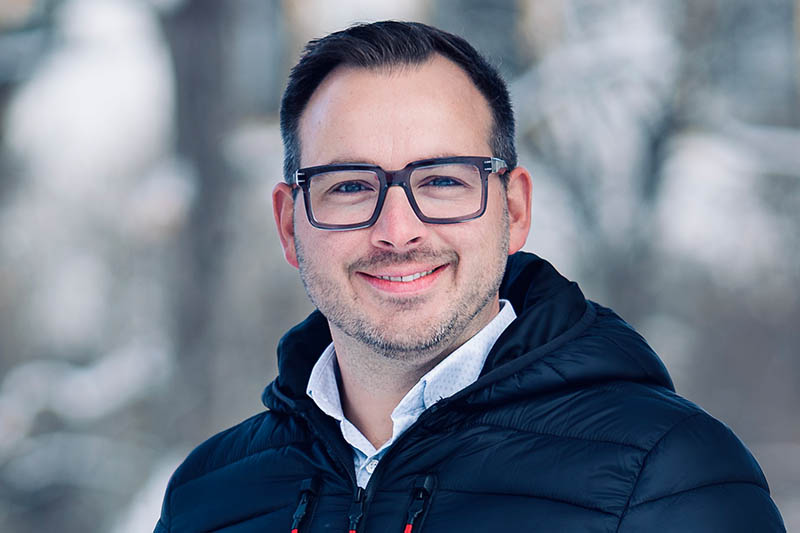
Our interview partner: Stefan Gaschler, Product Specialist at Alumat (Credit: Alumat)

Our interview partner: Stefan Gaschler, Product Specialist at Alumat (Credit: Alumat)

Dieser Beitrag ist auch verfügbar auf: Deutsch

Door thresholds are one of the most common and annoying barriers in everyday life – for people with wheelchairs or walkers, but also for older people and for very small children who are unsteady on their feet. This is because they restrict the range of movement of people with disabilities in a building and when entering and exiting, and pose a dangerous risk of falling. This is precisely where solutions that help to safely bridge door thresholds come in – and thus restore freedom of movement and safety.

Alumat has developed a solution that does not require any mechanics and can be integrated and used for almost any type of door: the magnetic zero threshold. In contrast to other solutions such as ramps, this also makes it possible to seal doors against driving rain and noise when closing them.

We spoke to Stefan Gaschler from Alumat to find out what this term means, why thresholds still exist and what other tips he has for age-appropriate refurbishment.

Header SBC English
SBC: Mr Gaschler, what does the norm for barrier-free building design say about door thresholds – and why does actual practice deviate so significantly from it?

Gaschler: The current DIN standard 18040 for Germany is clear: Lower door stops are not permitted in the door area. And thresholds may only be a maximum of two centimetres high if there is no other technical possibility. But even then, only if an expert expressly states that this is technically unavoidable. The aim is always a threshold-free transition.

What happens in practice: This exception has been turned into a standard. Two centimetres is still taken for granted in many places today – even though the standard does not stipulate this at all. This is a misconception that has persisted over the years.

This is currently changing. The standard is currently being completely revised and will only allow a maximum of one centimeter in the future. More importantly, the term “level transition” is coming to the fore – and roll-over capability is being included as a criterion for the first time. This means that angular stops, which cannot actually be rolled over, will finally become obsolete. A horizontal transition with a tolerance-related height offset of a maximum of 4 mm is permitted between two structural levels, whereby the use of transition rails and profiles is permitted.

In new builds, however, we believe there is no longer any reason to install two-centimeter thresholds. You know in advance how high the floor will be, which external covering will be used – everything can be planned properly. In older buildings, you often find threshold heights of two, three, sometimes even four centimeters. The zero threshold is not always achievable there – but it is almost always possible to roll over.

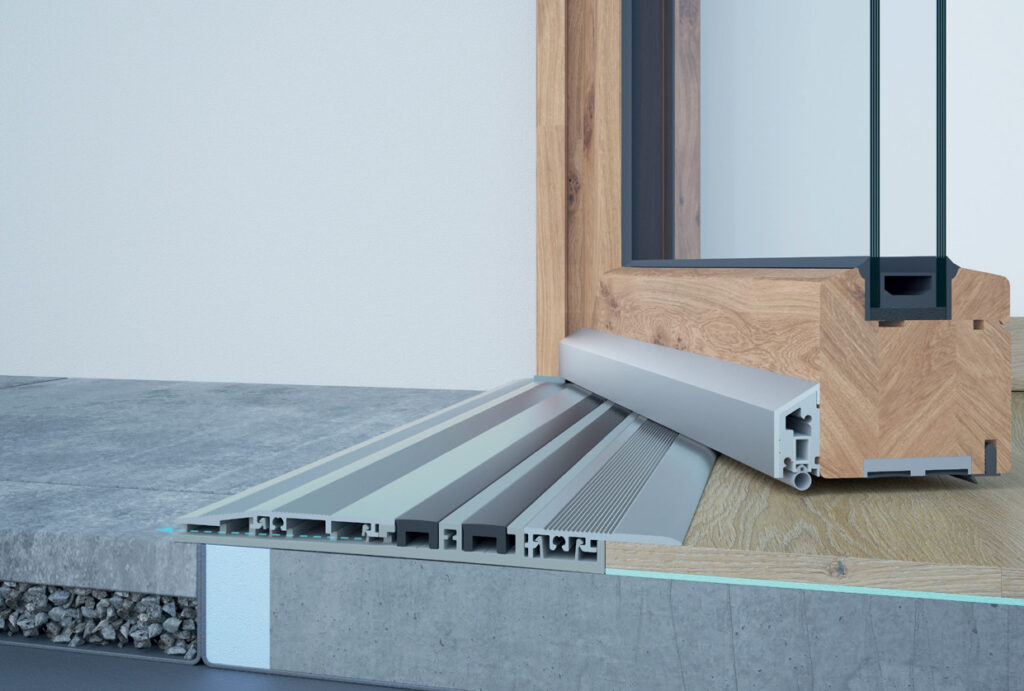
Here is a cross-section of a magnetic zero threshold: it can be rolled over, can be used for interior and exterior doors and is compatible with every PVC, timber, timber-aluminum or aluminum system on the market. Credit: Alumat
SBC: Alumat has developed a solution for this. Please explain to us what the term “magnetic zero threshold” means and what typical everyday hurdles and challenges this solution is suitable for.

Gaschler: The magnetic zero threshold is suitable wherever door thresholds make everyday life difficult or dangerous. Our products can be used in both new and existing buildings: For front doors, balcony and patio doors, side entrance doors and also for interior doors.

This is often forgotten: Interior doors should also be barrier-free. Particularly in older buildings – we sometimes have threshold heights of two, three or even four centimetres – these transitions can be a real hurdle for older people or people with disabilities. We have solutions for this too: With transition profiles that are designed like a small ramp, existing interior doors can also be converted so that they can be crossed independently with a wheelchair or rollator.

What surprises many people is that we also work in listed buildings. There, the historic doors must be retained – but the threshold in the lower area can be replaced. This requires careful craftsmanship, but is possible. This is also a viable option for private buildings where accessibility suddenly becomes necessary due to an accident or illness: the door remains, only the threshold is removed and replaced with an Alumat zero threshold.

Another important point: our products are compatible across all systems with every PVC-U, timber, timber-aluminum or aluminum system on the market. There is virtually no door or window system that cannot be combined with our threshold products.

SBC: How does this solution work?

Gaschler: Magnetic strips are located in the threshold profiles. The counterpart – a flat magnetic part – is attached to the door leaf. As soon as the door is closed, both magnets attract each other and seal the door completely. The magnets are only there to seal the doors. This is important for external doors against driving rain, wind and draughts, but also against sound and smoke, depending on the variant. This is also important for internal thresholds.

The decisive factor: There are no mechanics. No springs, no moving parts that need to be adjusted or maintained. The technology works like a magnet on a pinboard – so it’s very simple, reliable and maintenance-free. We give a 20-year guarantee on the magnetic pulling force, and the technology has been in use for over 30 years – installed in a wide variety of properties throughout Europe.

And cleaning is very easy: the magnetic strips can be removed from the channel with a magnetic object, then you can go over them with a vacuum cleaner, wipe them with a damp cloth if necessary, and reinsert the magnetic strips. Done.

SBC: If I, as an end consumer, am interested in installing this zero threshold solution: What should I pay attention to when ordering and installing it?

Gaschler: The most important thing first: installation is carried out by a specialist company. The installation itself corresponds to that of a normal window or French window – the same standards apply as for any other building element. What requires additional care in the zero threshold area is the precision of the measurements: the interior floor structure and exterior flooring must be precisely coordinated to ensure that the level transition is really successful.

The solution is available for any door area, i.e. for front doors, balcony and patio doors, side entrance doors and interior doors. In new buildings, this is easy to plan – you know which floor covering is coming, how high the screed is and can plan ahead accordingly. In existing buildings, it is more challenging, but solvable – then it is less about the zero threshold and more about the best possible roll-over capability, i.e. a gentle ramp shape that allows wheelchairs and rollators to pass safely.

Our thresholds are available internationally from window and door manufacturers and dealers. Any carpenter or joiner can work with them – there are no special requirements that would exclude a normal specialist company.

SBC: Do you have any other expert tips on age-appropriate refurbishment?

Gaschler: Be sure to check the funding options before you start renovating. In Germany, the KfW Bank provides funding for barrier-free conversions in existing buildings. There are also grants from the care insurance fund – if you have a care degree, you can receive a proportion of the funding for conversion measures such as barrier-free transitions. This applies to exterior doors as well as interior doors and transitions into rooms. It is worth clarifying this in advance – it saves considerable costs.

Another tip: think beyond the threshold when renovating. Door widths, movement areas, bathrooms – these are all interrelated issues. Anyone who is renovating should take the opportunity to tackle several points at once.

And finally, for anyone who needs planning support, I strongly recommend contacting specialist consultants for barrier-free building. There are people who not only have the specialist knowledge, but also know from their own experience what really matters. This combination is priceless.

Thank you for the interview!

Stefan Gaschler is a product specialist at Alumat, a German manufacturer of threshold solutions for barrier-free door transitions. More information at alumat.de

Editor’s note: The information on funding agencies relates to Germany. In Austria, there are also subsidies, favorable loans and investment grants for barrier-free conversions and renovations in the federal states. Please enquire at the relevant state offices.

Furthermore, DIN standard 18040 only applies in Germany. In Austria, ÖNORM B 1600 and B 1601 apply as corresponding regulations.


Anja Herberth
Author: Anja Herberth

Chefredakteurin

Tags: Accessibility
Previous Post

How do you approach a renovation project the right way – and what are the mistakes you make right from the start?

Next Post

How can we rock our lives in old age, Sonja Schiff?

Related Posts

Our interviewee: Alexander te Best, Managing Director of the stairlift supplier Lifta in Austria (Credit: Alexander Solc Photography)
Special Feature: Housing & Renovation

When is a stairlift the right decision, Mr. te Best?

22. May 2026
What do I need to consider when choosing a bath lift? In an interview: Nico Rosenstädt, Managing Director of Idumo Austria (Credit: Idumo Austria)
Special Feature: Housing & Renovation

How do I choose the right bath lift, Mr. Rosenstädt?

22. May 2026
Our interview partner: architect, expert and wheelchair user Kornelia Grundmann - Credit: Martin Raffeiner
Special Feature: Housing & Renovation

How do you approach a renovation project the right way – and what are the mistakes you make right from the start?

9. May 2026
Temperature control means that the water temperature is regulated and limited so that it remains constant and cannot exceed a safe level. Thanks to CoolTouch technology, the surfaces do not heat up either. Credit: GROHE
Special Feature: Housing & Renovation

Age-friendly bathroom fittings: Temperature limitation & ease of use

9. May 2026
A well-chosen toilet can improve hygiene and independence in old age. Credit: LAUFEN
Special Feature: Housing & Renovation

Supportive toilets: About shower toilets and age-friendly seats

9. May 2026
A fall can cost you your independence and fundamentally change your life at home: Around a quarter of falls are so serious that medical treatment is necessary. Credit: Shutterstock
Special Feature: Housing & Renovation

Risk of falling: Why prevention and adaptation of the living space should start early

25. April 2026
Next Post
Our interview partner: Sonja Schiff - gerontologist, coach, seminar leader - and DJ. Credit: Rochus Gratzfeld

How can we rock our lives in old age, Sonja Schiff?

Leave a Reply Cancel reply

Your email address will not be published. Required fields are marked *

  • Deutsch
  • English

.

loader

Newsletter

What tools and concepts are available for senior living, care and support - and where can they be found? Our newsletter provides answers!

I accept the terms and conditions

Recent News

Our interviewee: Alexander te Best, Managing Director of the stairlift supplier Lifta in Austria (Credit: Alexander Solc Photography)

When is a stairlift the right decision, Mr. te Best?

22. May 2026
What do I need to consider when choosing a bath lift? In an interview: Nico Rosenstädt, Managing Director of Idumo Austria (Credit: Idumo Austria)

How do I choose the right bath lift, Mr. Rosenstädt?

22. May 2026
Our interview partner: Sonja Schiff - gerontologist, coach, seminar leader - and DJ. Credit: Rochus Gratzfeld

How can we rock our lives in old age, Sonja Schiff?

22. May 2026
Our interview partner: Stefan Gaschler, Product Specialist at Alumat (Credit: Alumat)

How do I create accessibility over door thresholds, Mr. Gaschler?

22. May 2026
Our interview partner: architect, expert and wheelchair user Kornelia Grundmann - Credit: Martin Raffeiner

How do you approach a renovation project the right way – and what are the mistakes you make right from the start?

9. May 2026
SmartBuildingsCompass

Made with care. For you.

Our research and interviews on safe and independent living in old age are written by our team with a great deal of energy and passion. We hope you enjoy reading them!

Do you need more information? If so, you are welcome to contact us at redaktion@sbc.co.at.

All rights reserved (2025).

  • Deutsch
  • English

Follow us

Instagram
  • Home
  • Subscribe to our newsletter
  • Glossary
  • About us
  • Contact
  • Marketing: Information for businesses
  • Download your 10 tips for independent, safe living in older age
  • Presentations & workshops for local authorities & nonprofits
  • Contact & Legal Notice
  • FAQs
  • Disclosure Statement
  • Nettiquette
  • Data protection
  • General Terms and Conditions (GTC)

© 2025 by owl lab e.U. Wir navigieren Wandel.

We use cookies on our website. Some of them are essential, while others help us improve this website and your experience.
Cookie SettingsAccept All
Manage consent

Privacy Overview

This website uses cookies to improve your experience while you navigate through the website. Out of these, the cookies that are categorized as necessary are stored on your browser as they are essential for the working of basic functionalities of the website. We also use third-party cookies that help us analyze and understand how you use this website. These cookies will be stored in your browser only with your consent. You also have the option to opt-out of these cookies. But opting out of some of these cookies may affect your browsing experience.
SAVE & ACCEPT
No Result
View All Result
  • Home
  • Housing
  • Everyday Aids & Technology
  • Care & Relief
  • Dementia & Health
  • Download: Housing Tips
  • Topic search
    • Dementia
    • Special Feature: Age-friendly Construction & Renovation
    • Tools & Solutions
    • Home & Living
    • Crisis-resilient caregiving household
    • Stay healthy
  • Deutsch
  • English

© 2025 by owl lab e.U. Wir navigieren Wandel.

Safe & independent living in old age

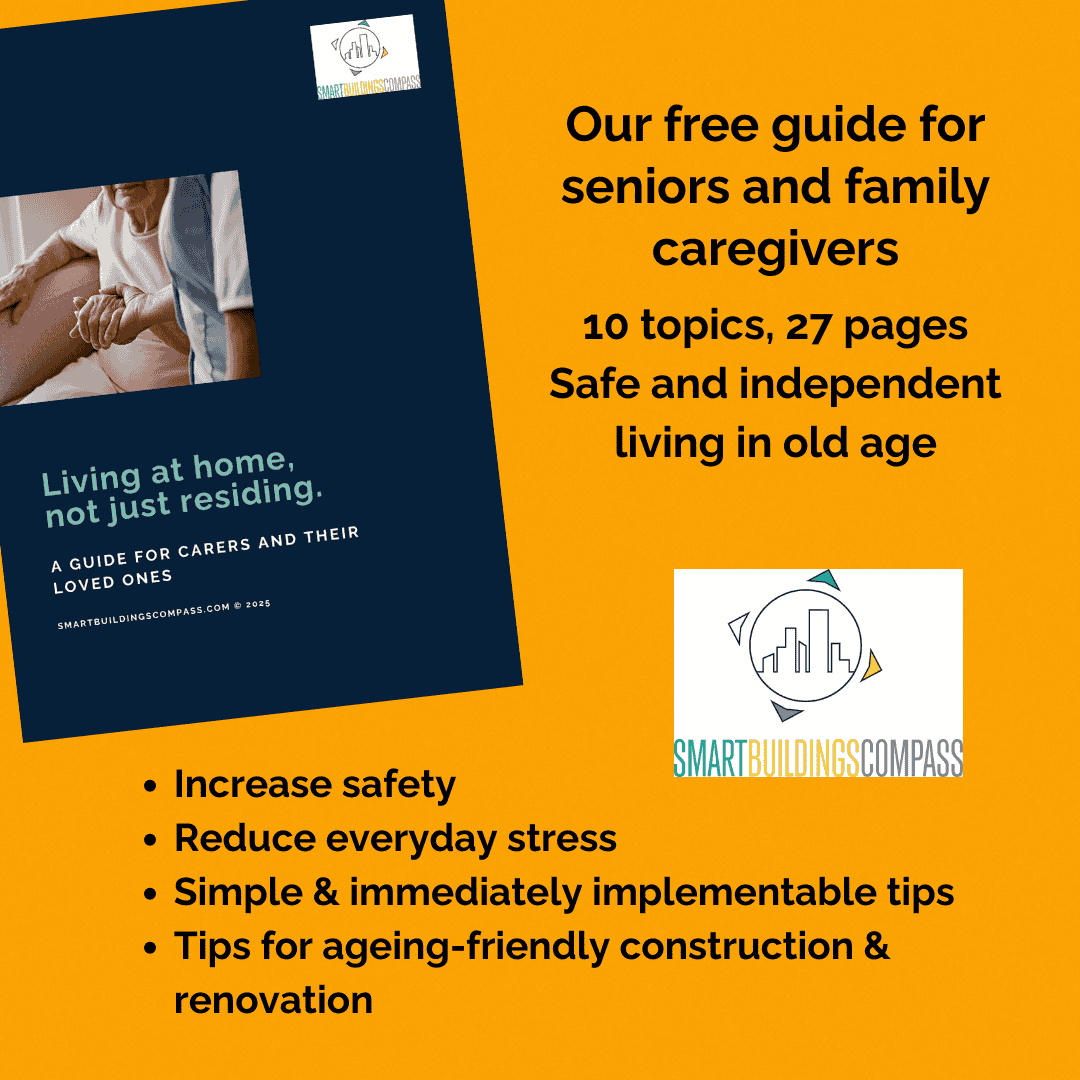
27 pages of tips for independent, safe living in old age—download now!

Download our PDF with tipps now!
loader

Email addresse*
I accept the privacy policy and agree that SmartBuildingsCompass.com may contact me beyond this request to send me its regular newsletter. I can unsubscribe at any time.

Sicher & selbstbestimmt Wohnen im Alter!

27 Seiten Tipps für sicheres, selbstbestimmtes Wohnen im Alter - jetzt downloaden!

Jetzt gleich downloaden!
loader

Email addresse*
I accept the privacy policy and agree that SmartBuildingsCompass.com may contact me beyond this request to send me its regular newsletter. I can unsubscribe at any time.