SBC: Negative images of old age have real consequences. What specific effects do you observe?
Schiff: Your own image of age has an enormous impact on your own ageing – this is scientifically well documented. Those who believe that old age only means decline unsurprisingly develop a fear of their own ageing. This fear in turn slows you down. You don’t look, you don’t prepare, you withdraw.
I experience this very concretely when it comes to work: older people who can no longer find a job because they are said to be too expensive, too inflexible, no longer able to work in a team. These are all consequences of negative age images. A client recently told me that she had sent out an offer – at her normal hourly rate, which she had been asking for her entire working life. After that: silence. When asked, she said it was too expensive. She was retired. They thought she was doing it on the cheap, on a semi-voluntary basis. This is not an exception, it’s a pattern.
What I also get very often: People after retirement who suddenly have the feeling that they are no longer seen. Women know this as invisibility – this disappearance from the public eye.
Dealing with self-determination is also exciting. An Austrian study conducted by Silver Living with the SORA Institute in 2022 revealed an astonishing field of tension: 600 women and men aged between 50 and 75 were asked about their housing plans and ideas for old age. When asked what was most important to them, 75 percent answered with a single word: independence. Living a self-determined life, not being a burden to anyone – that was by far the most important aspect. However, when asked whether they had ever specifically thought about making changes to their home, most said no.
This is not a contradiction that can simply be dismissed. We want to live a self-determined life – but we don’t want to look and change anything. Along the lines of: It’s not that far yet. I’m still doing well. Behind this is the same fear of getting older that is also evident in other issues: Looking away, putting it off, hoping that it will somehow work out. It becomes clear at the age of 80 that this won’t work out, when suddenly everything is too difficult, too narrow, too inaccessible.
SBC: Your blog is called “Rocking getting older”: What does that mean to you personally? And what advice do you give in your coaching sessions so that your clients can also develop this attitude?
Schiff: Basically, I want to encourage people, and that starts with raising awareness. What has changed? People used to live an average of seven years after retirement. Today it’s 22 to 25 years. That’s a third of our lives – a third that is no longer determined by work. This is a completely new phase of life that has never existed before.
I like to tell people: this is the only phase in life in which you receive money month after month without having to make any actual payments. It sounds mundane, but it means that energy is freed up. For the question of who I actually am – beyond my professional role?
In my seminars, I also show photos from my own family history: a picture of my grandmother at the age of 52. Most of the participants estimate her to be 75 or 80 in the photo. This is no exception – in gerontology this is called the rejuvenation of old age. Today, we are retiring healthier and more agile than any generation before us. When we are healthy, we generally feel 10-15 years younger than we actually are. We have not experienced war, hunger or different working conditions. Most people are not even aware of this.
What I also do in the seminars is name the stumbling blocks. When you retire, you lose up to two thirds of your social contacts. Your colleagues are gone. If you already had a thin social network in your professional life, it thins out even further. And after ten or fifteen years, you find yourself alone in old age. I ask my participants to map out their social network – and then cross out everything that will disappear when they retire. That’s a moment that sits with many of them.
Keeping up with technology is also part of this. If you opt out of all apps at 60, you’ll be completely out at 75 – and lose a large part of your self-determination. You don’t have to love technology. If you still want to make your own doctor’s appointments at 80 – without having to go through your children, grandchildren or neighbors – there’s no way around staying on the ball with technology.
SBC: You are familiar with both the socially constructed and the real challenges of ageing. What issues do your clients come to you with – what concerns them most?
Schiff: What is fundamentally interesting: It’s mainly men who come to the seminars, women tend to come to the individual coaching sessions. And women often don’t contact us because of themselves – but with the sentence: “Help, my husband is retiring.” They are simply afraid of the changes and what it means for their own lives.
Then there is the large group of adult children who see that their mother will soon no longer be able to cope on her own. But the mother can’t or doesn’t want to see this yet. Enduring this helplessness, looking for a conversation without running the mother over with the subject – that’s what ends up with me.
Childless women come with a completely different issue: their friends are looking after their grandchildren and the women are missing that. The feeling of lack arises again, the feeling that I am not a real woman and I have missed out on so much in life. Others come after a health collapse – a fall, a heart attack – and suddenly say: now I really want to live. And then there are people who realize: I no longer have any goals in retirement. That sounds banal, but it’s not.
SBC: Loneliness is a highly relevant topic. What advice do you have for people who find themselves in this situation?
Schiff: The really lonely people don’t come to me. These people often have no energy left to get help – and that is perhaps one of the reasons why they are so lonely. When it comes to loneliness, I therefore work more preventively in the pre-retirement seminars, i.e. before it arises. I show how loneliness arises: with the transition to retirement, with the loss of the world of work, with the slow thinning out of the social network. When I have the participants map out their social network – and then cross out everything that is falling away – some of them really feel what is breaking at that moment.
Then I work with them on the question: which of these relationships could be more than just a working relationship? If you find out that a colleague is also going to the theater, you can say to her: Let’s take this with us into the new phase of our lives. That’s not a guarantee – but it is an opportunity. Because if the topic of work disappears, you need other topics to connect with each other.
My advice is always: don’t just move within your own age cohort. Go into young worlds. See where the younger people are – and go there. Contact with people from other generations is one of the most important ways to combat loneliness.
Even if you just sit at home, don’t move around, don’t develop anymore – then nobody enjoys spending time with you anymore. Iris Apfel said it well: you have to be interested to be interesting. That’s harsh, but it’s true.
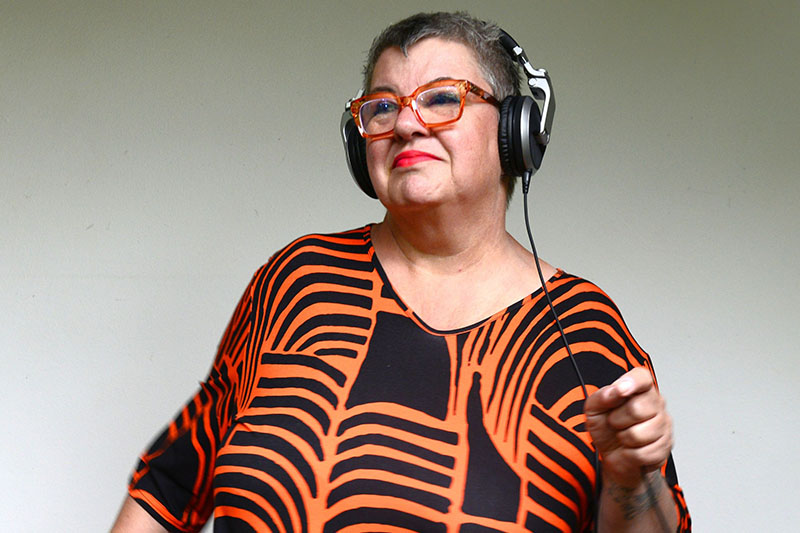
SBC: You can also be booked as a DJ: How did that come about, and which evenings have you already played?
Schiff: There is a scientific and a personal side to this. The scientific side: Musical memory is one of the most powerful forms of memory of all. When I put on songs that people listened to in their youth – even songs that they may not have particularly liked at the time – they sing along. They dance, they move. It makes them happy because it takes them back to a time when life was different. And at the same time, people are on the move and in social contact.
On the personal side, I took myself by the nose: I’ve been telling people in retirement preparation seminars for 20 years that they should take the opportunity to reinvent themselves. At some point, I asked myself: where am I actually reinventing myself? I started a list of everything that interested me. After a year, I realized that almost everything on this list was related to geriatric care again. So it was familiar territory. I went through the list again and crossed out everything that drew me back to familiar territory. What remained was at the top: DJane – Songs of your life.
A Swedish television report gave me the impetus for this. DJ Gloria from Stockholm, 80 years old, plays for over-60 parties with up to 2,000 people. When I saw that, I thought: if she can do it at 80, I can do it too. I then bought a second-hand DJ controller – from a 13-year-old boy via Willhaben. The father asked me if I was buying it for my grandchild. No, was my answer, for me. The look on his face was divine.
I now often combine lectures and DJ sets as a package. This is well received.
SBC: On your website, you share book tips on ageing. Is there a book that you would particularly like to recommend – and why this one in particular?
Schiff: Very much so, and there are several books: Accidental Icon by Iris Apfel. She died at the age of 102.5 – and only really became famous in old age. Nobody has to be as shrill as she was, but this woman never dropped out of life. She dared, she made herself visible, she was never ashamed.
And this one sentence from the book: You have to be interested to be interesting. That actually says everything about loneliness. If I’m no longer interested in the world, if I only talk about how awful getting older is – then no one will enjoy being with me. I think that’s one of her most important messages.
I would like to mention a second book: In full bloom – Portraits of older women from 56, upwards to 92. These pictures are simply encouraging. Here are women who are alive, really alive.
And if I may add my own book: My husband and I have published a illustrated book together with two other female photographers. The women in it were born between 1939 and the mid-1970s. They are nudes, some of them very covert – but all self-determined. Each woman showed herself the way she wanted to.
Each woman wrote a text to accompany her photo. Three keywords were given – being a woman, physicality, getting older. We did not touch the texts except for spelling and comma errors.
The result is very touching. You can see how far women have to go to make peace with themselves. The belly was too big, the breasts too small – this constant struggle with beauty ideals that accompanies many women throughout their lives. And now, in old age, many have found this peace. They are proud of the body that has carried them for so long.
That’s something I’m really proud of.
Thank you for the interview!
Sonja Schiff is a trained psychiatric nurse and built up an outpatient care service in Salzburg over many years. Today, the gerontologist is retired and active as a seminar leader with a focus on preparing for retirement and age-appropriate living. Together with architect Ursula Spannberger, she offers workshops on the topic of “Preparing your home for later” . As DJ VintageVenus she plays for best-ager events. More information at: sonjaschiff.com



 Deutsch