SBC: I hear that a stairlift is not purchased at the first sign, but much later. Why do you think that is?
te Best: The stairlift is the only product I’ve ever sold for which there are inquiries – but hardly anyone really wants it. You can tell by the different ways our consultants and fitters are received: The consultants are tolerated, the fitters are fed roast pork.
Because a stairlift means admitting that something no longer works the way it used to. This is not an easy realization – and it takes time. And the most common sentence our fitters hear at the handover is: “I should have done this much earlier.”
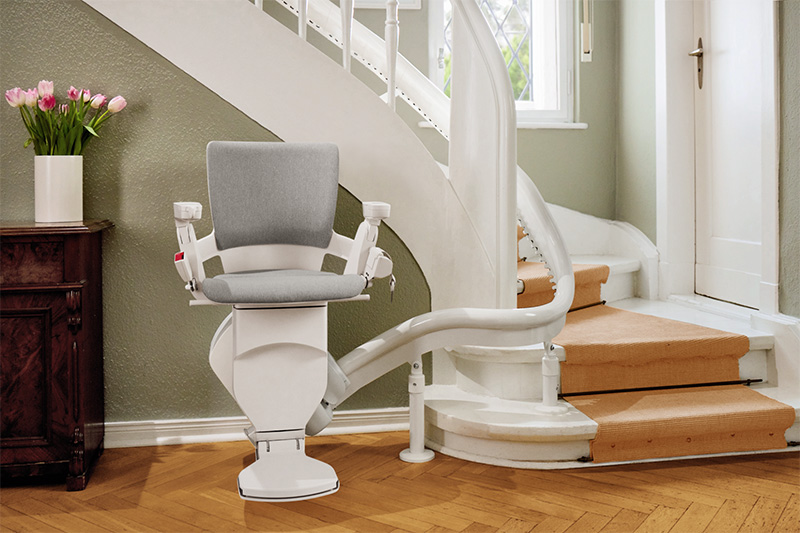
Because the stairs are one of the biggest tripping hazards in everyday life – and the lift is the quickest and easiest answer. Not as an admission, but as a decision for a safe, self-determined life at home.
SBC: So when is the right time?
te Best: From a purely rational point of view: As soon as you realize for the first time that you’d rather not go up the stairs. Not when you can no longer – but when you no longer want to. If you wait until you can’t, you suddenly have to act very quickly.
Another thing I keep noticing is that the gradual process often goes unnoticed. You no longer walk up and down the stairs five times a day, but take it all in on the first walk. You don’t even realize how much you’ve already adapted to the changed situation.
SBC: Are there any restrictions? When is installation not possible?
te Best: As a rule of thumb, if you can carry a laundry basket up the stairs, then we can also install a stairlift. The industry is now very experienced in installing a lift even on the narrowest of stairs. From a purely technical point of view, there is always a solution.
Building authority restrictions – such as escape widths – are an issue from time to time, and in some federal states building authority submissions are also required. However, a reputable company will clarify this directly on site and also take care of the corresponding processing.
SBC: What should you look out for when deciding on a stairlift?
te Best: Basically, you won’t get a bad stairlift on the market – regardless of the company. What really matters is that you understand the lift, can operate it safely and can get on and off comfortably. That is the most important thing.
Rely on your own gut feeling. Does it feel safe? Do you understand the operation intuitively? Then it fits.
SBC: Are there any subsidies for a stairlift?
te Best: Yes – but this topic deserves honest words. In Germany, the situation is much clearer: anyone with a care level receives a lump sum of just over EUR 4,000 under the Care Strengthening Act, which is standardized nationwide and relatively unbureaucratic. If a spouse has a care level, then EUR 8,000 is available.
In Austria, things are much more complicated. Subsidies vary from state to state and from district office to district office. At Lifta, we handle the entire subsidy management for our customers – with two employees who deal exclusively with this. Because it is really time-consuming.
A practical tip: Always submit the subsidy application before the lift is installed. If you fail to do so, you will in most cases be completely excluded from the subsidy. And anyone waiting for a grant approval must allow a few weeks. Only then does production begin, which takes another month or so. So if you urgently need a lift, you are well advised to take care of it early on.
SBC: As a professional, do you have any general tips for age-friendly renovation?
te Best: The room that really counts in old age is the bathroom. If you have the opportunity, you should make it barrier-free at an early stage. Barrier-free renovation is not that quick and costs a lot. Anyone who builds a new home does this automatically anyway. Anyone living in an existing building should at least have it on their radar.
Otherwise – and I say this deliberately because I don’t want to give advice that is easier to say than to implement – my honest recommendation is: Use the technology that is already there. Delivery and ordering services, voice assistants, digital everyday aids. I’ve spoken to people over 90 who use Siri to do everything that makes their lives easier. That’s not a weakness – it’s smart.
In my perception, construction is becoming less and less relevant as an answer to old age. The plots are getting smaller, the prices higher, the conversion of existing buildings is hardly affordable. But the technology that makes life easier is improving – and it is becoming more and more accessible. I am convinced that AI will play a central role in this over the next few years. Not as a replacement for human contact, but as a silent companion that thinks for us. Because in the end, it always comes down to the same question: How long will your home really function in everyday life?
Thank you very much for the interview!
Alexander te Best is Managing Director of Lifta in Austria, one of the leading suppliers of stair and passenger lifts in German-speaking countries. More information at lifta.at


 Deutsch