• de Deutsch
  • en English
Smart Buildings Compass
  • Home
  • Living
  • Building & Renovation
  • Everyday aids
  • Care
  • Dementia
  • Health
  • Finance & Planning
No Result
View All Result
  • Home
  • Living
  • Building & Renovation
  • Everyday aids
  • Care
  • Dementia
  • Health
  • Finance & Planning
No Result
View All Result
Smart Buildings Compass
No Result
View All Result
Home Finance & Planning

Planning Ahead for Care: What Should I Look for in Long-Term Care Insurance, Helmut Höbart?

Our interviewee: Independent insurance broker Helmut Höbart (Credit: Theresia Kaufmann)

Our interviewee: Independent insurance broker Helmut Höbart (Credit: Theresia Kaufmann)

This article is also available in: Deutsch

Public support works like basic cover rather than fully comprehensive insurance, and people often don’t realize this until it’s too late. Anyone who has to arrange for 24-hour care, wound care, or home modifications can quickly end up paying several thousand euros out of pocket. And it’s not uncommon for people to dip into savings that were actually intended for the next generation. Public coverage is like partial coverage—not comprehensive coverage—and people often don’t realize this until it’s too late.

In a SmartBuildingsCompass.com survey, many readers indicated that they expect a gap in funding their own care in old age. We will therefore address this very topic in a series of interviews.

You might also be interested in

Our interviewee: Stefani Gromes, an attorney from Darmstadt who specializes in the intersection of family and social law. Credit: Gromes Law Firm

Costs for care homes: How can families prepare in advance, Ms Gromes?

27. August 2026
Let yourself be a little nuts - and don't feel guilty about it! Credit: Shutterstock

International Women’s Day: Who bears the burden of care – and for how long?

7. March 2026
Our interview partner: Health Economist & Dean of the Faculty of Social Sciences, Economics and Business Administration at the JKU Linz, Prof. Dr. Prof. Gerald J. Pruckner (Credit: Andreas Röbl)

Healthcare system under pressure: What needs to be clarified now

6. March 2026
Protest day on March 23. Pharmacies are fighting for better economic conditions - 20% of pharmacies have already given up.  Credit: Shutterstock

Pharmacies in Germany: Why they will remain closed on March 23

3. March 2026

Those who start planning for long-term care early, around age 40, can still build up a financial cushion for their later years. However, the market is relatively small, the options vary widely, and the terms and conditions are difficult for laypeople to understand.

Header SBC English

Independent insurance broker Helmut Höbart specializes in personal insurance. He reviewed long-term care insurance options in Austria for us and explains the criteria he uses to evaluate private long-term care plans for his clients.

Please note: The information in this interview applies to Austria. Different legal frameworks apply in Germany, which we will address in a separate article.

What to Expect in This Interview:

  • At what care level private coverage makes a significant financial difference,
  • when monthly payments and lump-sum payments address different needs,
  • why starting at age 40 is significantly cheaper and easier than starting at 50,
  • how to compare plans without being guided solely by the premium.
SBC: Many people believe that the long-term care allowance provides them with adequate financial security, but are now realizing, as they care for their own parents and grandparents, just how high the actual costs are. Based on your practical experience, when is additional financial support needed?

Höbart: In my view, the key factor is the point at which care becomes truly expensive. And that’s the case starting around care level 5, when people are generally already severely limited or bedridden. At the lower levels, people do need some assistance—for example, with personal hygiene—but this can often be adequately covered by in-home care. This type of care is relatively well-subsidized and, in terms of cost, is usually still affordable.

Once someone needs round-the-clock care, the long-term care allowance is no longer nearly enough. And that’s exactly when I recommend taking out private insurance. Those with a larger budget can, of course, get coverage starting at Level 3, but I especially recommend good coverage starting at Care Level 5.

SBC: How many providers are there in Austria, and how did you go about comparing them?

Höbart: The market is smaller than you might think. In Austria, only five insurers currently offer their own long-term care insurance. I first looked at the premiums and then compared the benefits across the different care levels—specifically for a healthy 40-year-old, because that’s a realistic starting age.

It quickly becomes clear that every provider calculates costs differently: Some are very comprehensive, but correspondingly expensive. Others only provide coverage starting at a higher tier, but offer more in return. I ruled out one provider because, despite my inquiries, I didn’t receive any detailed information. If I can’t understand what I’ll actually receive in an emergency, that’s not a basis for a recommendation in my view.

SBC: How exactly do the offers differ?

Höbart: The most important difference lies in whether an insurer pays only a monthly benefit or also makes a lump-sum payment. For example, one provider pays a one-time lump sum of 15,000 euros starting at care level 3—or 30,000 euros with a higher premium—and an additional monthly annuity starting at level 5. Another provider does not pay a lump sum, but instead pays a higher monthly benefit starting at care level 5 for a comparable premium.

Which option is better depends on your individual situation. If you have sufficient savings, what you need most is a reliable monthly payment. Those without a large financial cushion benefit greatly from a lump-sum payment, because the largest expenses occur right at the start of the need for long-term care, as well as when round-the-clock care becomes necessary.

SBC: Why is a lump-sum payment so valuable in these situations?

Höbart: Because there’s almost always an initial investment required. You need a nursing bed, and the bathroom may need to be remodeled. Doors may need to be widened or steps removed so that the person can be cared for at home or even manage some tasks independently.

It’s similar to accident insurance: If I receive a large sum from my insurance company after an accident, I can afford the renovations and other necessary measures without going into debt. With 15,000 euros, you can at least get started on the most important projects, and that can make the difference between being able to continue living at home or not.

SBC: Why did you choose the age of 40 for your comparison?

Höbart: Because the age at which you start plays a huge role, for two reasons. First, the premium increases significantly with age: A 50-year-old insured person pays noticeably more for the same coverage than someone who is 40. And someone who starts at age 20 pays considerably less.

Second, you have to answer health-related questions when taking out a policy. By the age of 50, many people already have pre-existing conditions and may no longer be insurable at all. If we’re honest, many 40-year-olds are already taking medication regularly, and that’s where the dilemma begins. The highest possible enrollment age among the providers I compared is 65, but to qualify, you really need to be in excellent health.

SBC: What is the minimum monthly cost you can expect?

Höbart: For a healthy 40-year-old, a budget of around 50 euros per month is already enough to secure very solid coverage starting at care level 5. Depending on the provider and the plan chosen, this may even include an additional lump-sum payment. For a 50-year-old, the cost for comparable coverage is already significantly higher.

It’s important not only to look at the premium, but also to always consider how much coverage you actually get for your money.

SBC: What should you look for in the terms and conditions, for example?

Höbart: First, look at the health-related questions in the application, since they vary from insurer to insurer. For someone with a pre-existing medical condition, one provider may be a better fit than another. Next, let’s look at supplemental benefits: For example, one provider may continue to pay benefits even if the insured person is hospitalized and the state nursing care allowance is suspended during that time. That’s a nice perk, but it’s often not the deciding factor.

What matters is that the coverage kicks in exactly during the phase when high costs arise—such as for home modifications—and that it fits your individual life situation.

SBC: Is it possible to do an initial comparison on your own, perhaps with the help of AI?

Höbart: That’s definitely a good place to start. You can use AI to get an overview of the strengths of each offer and have it analyze them based on your own criteria. But the real work begins when you look at the differences in the terms and conditions, and that requires experience. Even as an expert, it takes me a whole day to do a thorough comparison—it’s not something you can do in five minutes.

Insurance like this determines whether you’ll be well taken care of in your old age. We live in a time when the government is gradually scaling back its support due to a lack of funds. That’s why you should thoroughly review your own retirement plan before committing.

SBC: As a layperson, how can you tell if you’re getting good advice?

Höbart: The most important criterion is whether the advisor really knows what they’re talking about. My tip: Prepare three specific questions, such as at what care level the benefit kicks in, whether there’s a lump-sum payment, and what health-related questions will be asked. Anyone who can’t answer these questions doesn’t know what they’re talking about.

You should also pay attention to their independence. Anyone who only offers products from a single insurer is in the business of sales, not consulting.

SBC: For whom is this issue particularly urgent right now?

Höbart: For the generation between 40 and 50. That’s exactly the age when you see firsthand, through your own parents or grandparents, just how expensive long-term care is. At the same time, it’s the age when you can still make adequate provisions for yourself at reasonable premiums. Those who start now are not only protecting themselves, but also what they’ve built up and may want to pass on to their family.

Thank you very much for the interview!

Helmut Höbart is an independent insurance broker specializing in personal insurance. He primarily advises clients on disability, health, and long-term care insurance. Before transitioning to insurance consulting, he worked full-time as a rescue and emergency paramedic for the Red Cross and therefore has firsthand experience with the healthcare system. Learn more about him at deine-sichere-zukunft.at


Checklist: How to Go About Researching Long-Term Care Planning

  1. Determine your needs: When will you need the benefits? Do you have sufficient savings for home modifications and assistive devices?
  2. Choose the type of benefit: Just a monthly pension, or also a lump-sum payment—for example, when you first become eligible for long-term care or when you reach a particularly high care level?
  3. Start early: The earlier you start, the lower the premium, and the health questions are easier to answer.
  4. Compare benefits, not just premiums: What do you get for your money at care levels 3, 5, and 6?
  5. Review the health questions: They vary by provider, and this is where it’s determined—especially in the case of pre-existing conditions—whether you’re still insurable.
  6. Get independent advice: Ask specific questions and make sure to compare several providers.
At what care level does private long-term care insurance become particularly worthwhile?

Long-term care becomes particularly expensive starting at Care Level 5, when comprehensive, round-the-clock care is necessary and the government’s long-term care allowance is no longer nearly enough. Adequate coverage should therefore kick in by this level at the latest—or even earlier, with a higher monthly budget.

What is the advantage of a one-time payment?

When the need for care first arises—for example, when a person becomes bedridden—there are usually significant costs involved, such as for a nursing bed or barrier-free renovations to the bathroom and living area. A one-time payment provides the financial flexibility needed to cover these expenses.

At what age should you take out long-term care insurance?

As early as possible, ideally around age 40 or earlier. As you get older, premiums increase significantly, and pre-existing conditions can make it difficult or impossible to obtain coverage. The maximum enrollment age is usually 65.

How much does private long-term care insurance cost in Austria?

For a healthy 40-year-old, a solid level of coverage starting at long-term care level 5 is already available for about 50 euros a month. Older policyholders pay significantly more for the same coverage. What matters is the ratio of premium to coverage, not the premium alone.

How can I tell if I'm getting good insurance advice?

Good advisors compare multiple providers and can answer specific questions about when coverage begins, lump-sum payments, and health-related questions. Be aware of the difference between brokers and agents: Insurance agents offer only the products of a single insurer and do not provide independent advice. An independent broker compares the options available on the market and can help you find the right insurance for you.

Anja Herberth
Author: Anja Herberth

Tags: Care & the system
Previous Post

Why should we take poor sleep seriously, Prof. Seidel?

Related Posts

Our interviewee: Stefani Gromes, an attorney from Darmstadt who specializes in the intersection of family and social law. Credit: Gromes Law Firm
Finance & Planning

Costs for care homes: How can families prepare in advance, Ms Gromes?

27. August 2026
Let yourself be a little nuts - and don't feel guilty about it! Credit: Shutterstock
Care & relief

International Women’s Day: Who bears the burden of care – and for how long?

7. March 2026
Our interview partner: Health Economist & Dean of the Faculty of Social Sciences, Economics and Business Administration at the JKU Linz, Prof. Dr. Prof. Gerald J. Pruckner (Credit: Andreas Röbl)
Health & Prevention

Healthcare system under pressure: What needs to be clarified now

6. March 2026
Protest day on March 23. Pharmacies are fighting for better economic conditions - 20% of pharmacies have already given up.  Credit: Shutterstock
Care & relief

Pharmacies in Germany: Why they will remain closed on March 23

3. March 2026
Our interview partner Nicolas Tobaben is Head of Disaster Management at the German Johanniter Regional Association North (Credit: Johanniter)
Care & relief

Crisis requires community: “Only when a few people consciously consider others can it truly be sustainable.”

23. February 2026
Christian Gamsler is deputy disaster control officer of the Carinthian provincial government
Crisis-resilient caregiving household

How Carinthia is building regional resilience with “lighthouses”

23. February 2026

Leave a Reply Cancel reply

Your email address will not be published. Required fields are marked *

  • Deutsch
  • English

.

loader

Newsletter

What tools and concepts are available for senior living, care and support - and where can they be found? Our newsletter provides answers!

I accept the terms and conditions

Smart Buildings Compass

Made with care. For you.

Our research and interviews on safe and independent living in old age are written by our team with a great deal of energy and passion. We hope you enjoy reading them!

Do you need more information? If so, you are welcome to contact us at redaktion@sbc.co.at.

All rights reserved (2026).

  • Deutsch
  • English

Follow us

Instagram
  • Home
  • Subscribe to our newsletter
  • Glossary
  • About us
  • Contact
  • Marketing: Information for businesses
  • Download your 10 tips for independent, safe living in older age
  • Presentations & workshops for local authorities & nonprofits
  • Contact & Legal Notice
  • Disclosure Statement
  • Nettiquette
  • Data protection
  • General Terms and Conditions (GTC)

© 2026 by owl lab e.U. Wir navigieren Wandel.

We use cookies on our website. Some of them are essential, while others help us improve this website and your experience.
Cookie SettingsAccept All
Manage consent

Privacy Overview

This website uses cookies to improve your experience while you navigate through the website. Out of these, the cookies that are categorized as necessary are stored on your browser as they are essential for the working of basic functionalities of the website. We also use third-party cookies that help us analyze and understand how you use this website. These cookies will be stored in your browser only with your consent. You also have the option to opt-out of these cookies. But opting out of some of these cookies may affect your browsing experience.
SAVE & ACCEPT
No Result
View All Result
  • Home
  • Home & Living
  • Everyday Aids & Technology
  • Care & Relief
  • Dementia & Health
  • Download: 10 tips
  • Find a solution
    • Special Feature: Age-friendly Construction & Renovation
    • Dementia
    • Crisis-resilient caregiving household
  • Deutsch
  • English

© 2026 by owl lab e.U. Wir navigieren Wandel.

Safe & independent living in old age

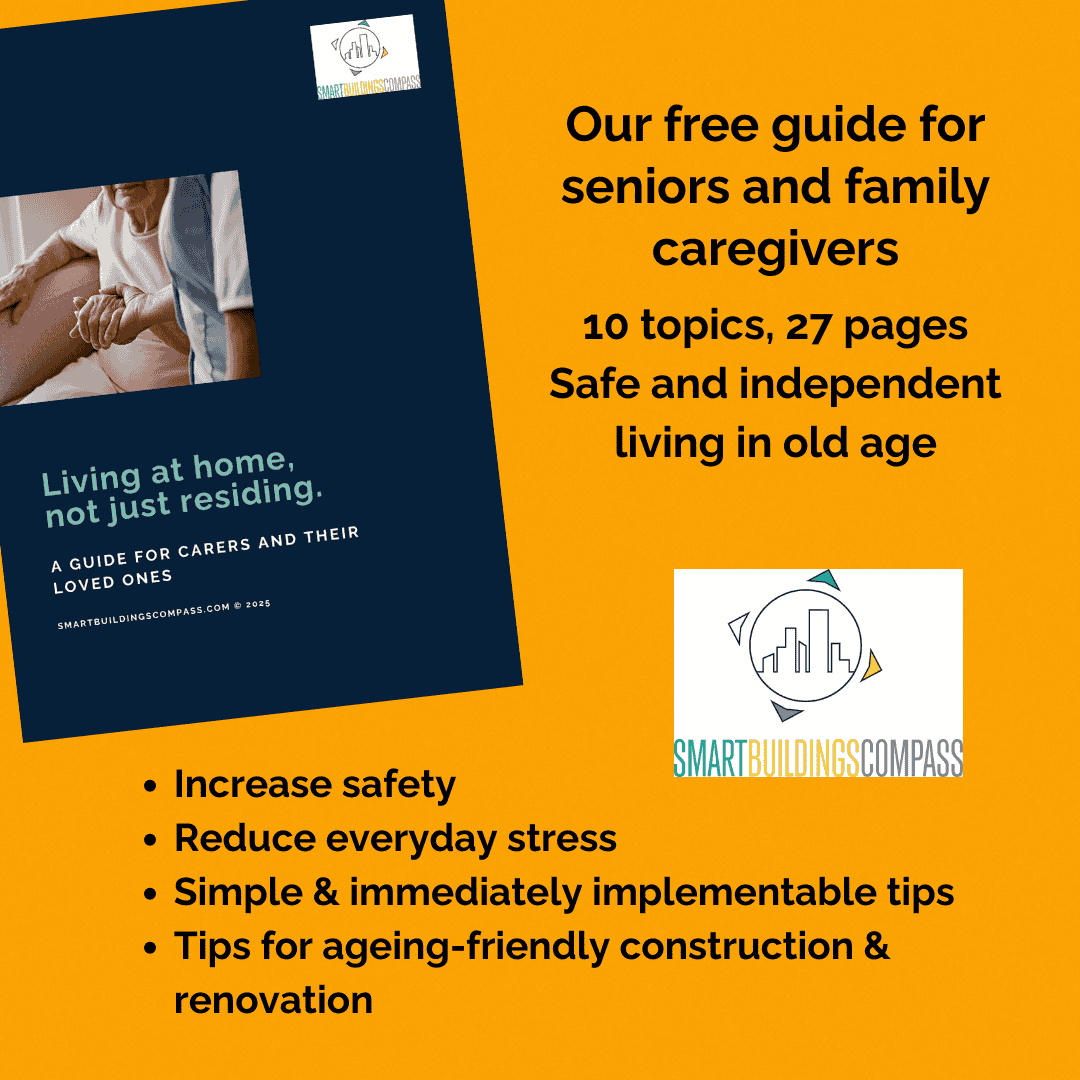
27 pages of tips for independent, safe living in old age—download now!

Download our PDF with tipps now!
loader

Email addresse*
I accept the privacy policy and agree that SmartBuildingsCompass.com may contact me beyond this request to send me its regular newsletter. I can unsubscribe at any time.