
Saturday, January 24, 2026
  • en English
  • de Deutsch
SmartBuildingsCompass
Header SBC English
  • Home
  • Home & Living
  • Tech / Tools
  • Healthcare & Dementia
  • Care & Relatives
  • Download: 10 tips
  • Why we care
No Result
View All Result
  • Home
  • Home & Living
  • Tech / Tools
  • Healthcare & Dementia
  • Care & Relatives
  • Download: 10 tips
  • Why we care
No Result
View All Result
SmartBuildingsCompass
No Result
View All Result
Home Dementia

Digital dementia: Are we heading for a wave of dementia?

Digital dementia

Science warns against an uncritical approach to digital media and emphasizes the importance of mental training and conscious media use to maintain mental performance—especially in young people. Credit: Shutterstock

Can you imagine a life without smartphones and computers? Digitalization is already permeating all areas of life – from communication and the world of work to healthcare. Both at work and in our private lives. But what price are we paying for technological progress? Science warns that the constant, purely stimulating use of digital technologies is impairing our cognitive abilities and will lead to a wave of dementia in the future.

In his book “Digitales Unbehagen: Risiken, Nebenwirkungen und Gefahren der Digitalisierung” (Digital discomfort: risks, side effects and dangers of digitalization), the well-known neuroscientist and psychiatrist Manfred Spitzer gets to the bottom of the health-threatening side of the digital transformation. He has been medical director at Ulm University Hospital since 1998 and is the overall director of the Transfer Center for Neuroscience and Learning, which opened there in 2004.

Why are we addressing this issue?

Because Spitzer, together with international scientists, assumes that the excessive use of digital media will lead to a dramatic increase in dementia patients. The increasing dependence on digital systems could lead to users losing essential cognitive and practical skills. The brain relies on regular mental challenges to maintain its performance. The automation of many cognitive processes – be it through navigation systems, voice assistants or algorithms that take over decision-making – removes an important stimulus for the brain.

Header SBC English

For years, the scientist was attacked for this statement. Today we know: He was right. Digital dementia is now an officially recognized clinical picture. Studies show that dementia does indeed occur when the brain is no longer used properly.
How mindless entertainment changes our thinking

Are we losing our minds, our ability to think, due to digitalization? According to the German Alzheimer’s Society, around 1.8 million people in Germany were living with dementia at the end of 2023. In Austria, it is estimated that between 130,000 and 150,000 people are affected by this disease. Dementia, in Latin, is the decline of the mind, the erosion of personality, memory and the ability to speak. We forget how to walk, how to eat. We owe the control of our body to our mind. And when this slowly disappears, we virtually lose our hard disk – to stick with a digital term.

The WHO assumes that today’s figures will double by 2050. According to Canadian psychologists: The number will increase four- to six-fold. This is because the WHO is based on experience with people who spent their youth in the 50s and 60s of the 20th century. And there was no digital media back then. Back then, people read books and spent the day playing in the great outdoors. According to Spitzer, these activities “wired something up” and our brains learned as a result. In the passive use of smartphones and tablets, studies have shown that nothing is wired.

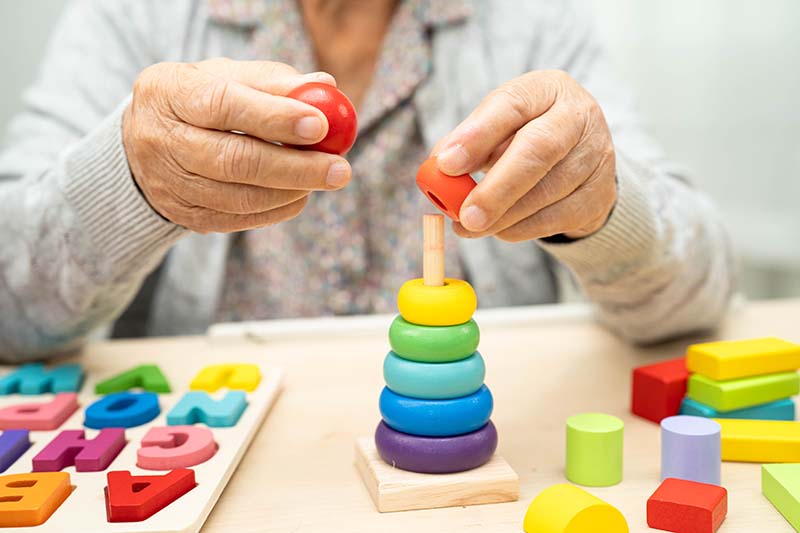
Special games train the motor skills of dementia patients. Credit: Shutterstock

A central aspect of Spitzer’s analysis is therefore the long-term effects of digital dementia. The neuroscientist describes how the constant use of digital technologies impairs our cognitive abilities. And not by working with digital tools, but by immersing ourselves in social media. Being bombarded with videos from Facebook and Tiktok. According to Spitzer, our brain changes with its use. And if it’s just being fed, it’s not capable of much else.

Children and young people: Ensuring a good starting point

As with so many other topics, the same applies here: The dose makes the poison. He argues that excessive media consumption – especially in young people – prevents the brain from developing basic thinking skills such as memory, critical thinking and problem solving independently. For children and young people in particular, he therefore advocates training the brain without smartphones, tablets, etc. Spitzer draws parallels between digital dementia and the effects of physical inactivity on the muscular system: those who hardly move break down muscles – and those who do not actively challenge their brain lose mental abilities.

This is particularly dangerous for children and young people whose brains are still developing. He refers to studies that show that excessive consumption of digital media correlates with reduced activity in the areas of the brain responsible for memory and learning. He warns against attention disorders: The constant distraction caused by digital stimuli leads to the brain undergoing less in-depth learning processes. This not only impairs short-term memory, but can also weaken long-term cognitive performance.

In the long term, this could not only impair academic performance, but also increase the risk of dementia later in life. A better trained brain protects against mental decline. Because our nerve cells break down when we get old. A well-trained brain descends from a higher mountain, and the descent takes longer. A lack of training means descending from a lower mountain.

Politicians have now become aware of this problem: In Sweden, digital textbooks have been abolished again and “real” textbooks have been reintroduced. In France, smartphones are only permitted from the age of 13 and social media only from the age of 17. In the USA, some states have taken measures to restrict the age of use of social media for minors.

A polarizing analysis with potential for discussion

Spitzer’s book is an important wake-up call for everyone involved in digitalization – whether in a private, professional or social context. However, critics accuse him of taking a one-sidedly negative view without sufficiently acknowledging the opportunities of digitalization. A more differentiated view would be desirable, especially for sectors such as smart buildings, where technological innovations offer many advantages.

“Digital Discomfort” is a provocative but readable book that encourages reflection on the responsible use of digital technologies. The debate about digital dementia is particularly relevant as it could have far-reaching consequences for our society and future generations. Anyone interested in the effects of digitalization on cognitive abilities will find valuable food for thought here – and should critically reflect on Spitzer’s theses in order to draw the right conclusions for a balanced digital future.

Sources:

  • Book: “Digital discomfort – risks, side effects and dangers of digitalization” by Manfred Spitzer
  • Podcast by thepioneer.de, Gabor Steingart in conversation with Manfred Spitzer: “We need to limit the influence of TikTok, Insta and co. on young people”
Anja Herberth
Author: Anja Herberth

Chefredakteurin

Previous Post

Barrier-free living: Solutions for independent living

Next Post

Loneliness: The underestimated health risk

Related Posts

Women's hearts beat differently—and need more attention. (Credit: AHA/American Heart Association)
Healthcare & Dementia

Go Red for Women 2026: Why women’s heart health needs more visibility

17. January 2026
The book "The unexpected journey" is a special kind of travel guide: For people who accompany a loved one with dementia. Book cover: Kailash
Dementia

Emma Heming Willis: “The unexpected journey”

12. January 2026
The Picasso "Tête de Femme" (1941) - a gouache on paper, with an estimated value of around 1 million euros - will be raffled off. Credit: Picasso Estate, Paris, 2025
Dementia

1 Picasso for 100 euros: A French idea that finances hope

12. January 2026
Sophie Rosentreter (right) with her mother Katrin and grandmother Ilse: "Grandma Ilse's" dementia is overwhelming the family. Today, Sophie Rosentreter is developing solutions for caring for and dealing with dementia. Credit: Katrin Schöning/Sophie Rosentreter
Healthcare & Dementia

Care & dementia expert Sophie Rosentreter: “The heart does not become demented”

18. November 2025
All tablets swallowed whole reached the stomach without any signs of dangerous swallowing. Crushed forms, on the other hand, led to significantly more residue in the throat, which can impair the absorption of the active ingredients and promote complications.  Credit: Shutterstock
Care & Relatives

Taking tablets with swallowing difficulties: Take whole instead of crushed

17. November 2025
The topic of dementia is more complex than is portrayed in the media. In conversation with Raphael Schönborn, we analyze levels that are often completely missing: The people affected themselves, and that we could turn dementia into an impairment that can be shaped and also influenced. If only we wanted to. Credit: PROMENZ/Dragan_dok
Dementia

Rethinking dementia: breaking down barriers and strengthening self-help

11. November 2025
Next Post
Ein älterer, einsamer Mann sitzt in einem Sessel

Loneliness: The underestimated health risk

Leave a Reply Cancel reply

Your email address will not be published. Required fields are marked *

  • Deutsch
  • English

.

loader

Newsletter

What tools and concepts are available for senior living, care and support - and where can they be found? Our newsletter provides answers!

I accept the terms and conditions

Recent News

Women's hearts beat differently—and need more attention. (Credit: AHA/American Heart Association)

Go Red for Women 2026: Why women’s heart health needs more visibility

17. January 2026
The pension study clearly shows that Austrians are very worried when they think about their pension - 40 percent rate their own risk of poverty in old age as high. Credit: Alexander Caminada/Ageing without limits

Study on retirement provision 2026: The fear of the future

14. January 2026
The book "The unexpected journey" is a special kind of travel guide: For people who accompany a loved one with dementia. Book cover: Kailash

Emma Heming Willis: “The unexpected journey”

12. January 2026
The Picasso "Tête de Femme" (1941) - a gouache on paper, with an estimated value of around 1 million euros - will be raffled off. Credit: Picasso Estate, Paris, 2025

1 Picasso for 100 euros: A French idea that finances hope

12. January 2026
Community nurses are regional (health) caregivers who provide support so that people can remain healthy and independent at home for as long as possible. With the end of EU funding and despite a positive evaluation, the project is being reduced, restructured or discontinued in some federal states.  Credit: Shutterstock

Community Nursing: What happens when support and prevention become a source of savings?

20. November 2025
SmartBuildingsCompass

Made with care. For you.

Our research and interviews on safe and independent living in old age are written by our team with a great deal of energy and passion. We hope you enjoy reading them!

Do you need more information? If so, you are welcome to contact us at redaktion@sbc.co.at.

All rights reserved (2025).

  • Deutsch
  • English

Follow us

Instagram
  • Home
  • Subscribe to our newsletter
  • Glossary
  • About us
  • Contact
  • Marketing: Information for businesses
  • Download your 10 tips for independent, safe living in older age
  • Presentations & workshops for local authorities & nonprofits
  • Contact & Legal Notice
  • FAQs
  • Disclosure Statement
  • Nettiquette
  • Data protection
  • General Terms and Conditions (GTC)

© 2025 by owl lab e.U. Wir navigieren Wandel.

We use cookies on our website. Some of them are essential, while others help us improve this website and your experience.
Cookie SettingsAccept All
Manage consent

Privacy Overview

This website uses cookies to improve your experience while you navigate through the website. Out of these, the cookies that are categorized as necessary are stored on your browser as they are essential for the working of basic functionalities of the website. We also use third-party cookies that help us analyze and understand how you use this website. These cookies will be stored in your browser only with your consent. You also have the option to opt-out of these cookies. But opting out of some of these cookies may affect your browsing experience.
SAVE & ACCEPT
No Result
View All Result
  • Home
  • Home & Living
  • Tech / Tools
  • Topic search
    • Topic: Orientation
    • Topic: Dementia
    • Topic: Building & Renovating
    • Topic: Healthcare
  • Local authorities & Nonprofits
  • Download: 10 Tips

© 2025 by owl lab e.U. Wir navigieren Wandel.

Safe & independent living in old age

27 pages of tips for independent, safe living in old age—download now!

Download our PDF with tipps now!
loader

Email addresse*
I accept the privacy policy and agree that SmartBuildingsCompass.com may contact me beyond this request to send me its regular newsletter. I can unsubscribe at any time.

Sicher & selbstbestimmt Wohnen im Alter!

27 Seiten Tipps für sicheres, selbstbestimmtes Wohnen im Alter - jetzt downloaden!

Jetzt gleich downloaden!
loader

Email addresse*
I accept the privacy policy and agree that SmartBuildingsCompass.com may contact me beyond this request to send me its regular newsletter. I can unsubscribe at any time.